Medical Review Management Services: Best Options
Compare the best medical review management services for healthcare practices. Learn how to collect, respond to, and showcase patient reviews.
TL;DR: Healthcare practices need review management tools that collect real patient feedback, help staff respond quickly, and keep unhappy patients out of public forums. The best medical review management services combine automated SMS/email requests, AI-assisted replies, and a feedback gate that routes complaints privately — so your online reputation reflects your actual care quality.
What Medical Review Management Services Actually Do
Medical review management services handle the full cycle of patient feedback: collecting reviews after visits, organizing them across platforms like Google and Healthgrades, drafting responses, and surfacing problems before they become public complaints. For a busy clinic, front desk staff can't manually track a dozen review sites while checking patients in — a dedicated service or software closes that gap. The payoff isn't just reputation; it's a steady stream of new patients who search "dentist near me" or "urgent care [city]" and read reviews before booking.
According to a 2024 survey by Software Advice, 71% of patients use online reviews as a first step when choosing a new doctor. That means your Google profile and Healthgrades listing are doing patient acquisition work whether you manage them or not.
How Healthcare Review Management Differs from Standard Reputation Software
Healthcare review management carries constraints that most general-purpose tools ignore. HIPAA prohibits acknowledging someone is your patient in a public response — even thanking a reviewer by name for "coming in last Tuesday" can be a violation. Most small-business review tools aren't built around that constraint. A solution designed for healthcare either prompts you to use compliant response templates or flags potential disclosures before you publish.
Responding to a patient review incorrectly can cost more than ignoring it.
Beyond compliance, healthcare practices face a platform mix that differs from restaurants or retailers. Google matters everywhere, but you also need to watch Healthgrades, Zocdoc, WebMD, Vitals, and RateMDs — platforms most general tools don't connect. A service that only handles Google and Facebook leaves gaps where prospective patients are actively searching.
If you're evaluating options across the broader category, the best reputation management software for medical clinics guide breaks down the top platforms with healthcare-specific feature comparisons.
Do this faster
HiFiveStar drafts a reply to any review in seconds — so your profile always looks cared for.
What to Look for in Patient Review Software
The right patient review software does a few specific things well. It sends review requests automatically after a visit — via SMS or email — without requiring staff to remember. It lets you respond to patient reviews from one inbox rather than logging into six different platforms. And it flags negative feedback fast, so you can reach out before a frustrated patient types a one-star review.
Here's what to check before signing up for anything:
- HIPAA-aware response tools. Does the software warn you before you accidentally disclose protected health information in a reply?
- Healthcare platform coverage. Does it pull reviews from Healthgrades, Zocdoc, and Vitals, not just Google and Facebook?
- Automated but personal outreach. Can you customize the timing and message so requests don't feel like a mass blast sent 30 seconds after checkout?
- Private feedback routing. The compliant approach — and this matters — is to invite all patients to share feedback, then give unhappy patients a direct, fast private channel to resolve the issue before they feel their only option is a public post. This isn't hiding bad reviews; every patient retains the right to post publicly on any platform. It's giving dissatisfied patients a faster path to resolution.
- AI-assisted responses. Drafting HIPAA-safe, on-brand replies to every review takes time. AI drafting helps — but you need a human reviewing before anything posts.
For dental practices specifically, the best review management software for dental practices covers options tailored to that niche.
How to Get More Patient Reviews Without Violating Platform Rules
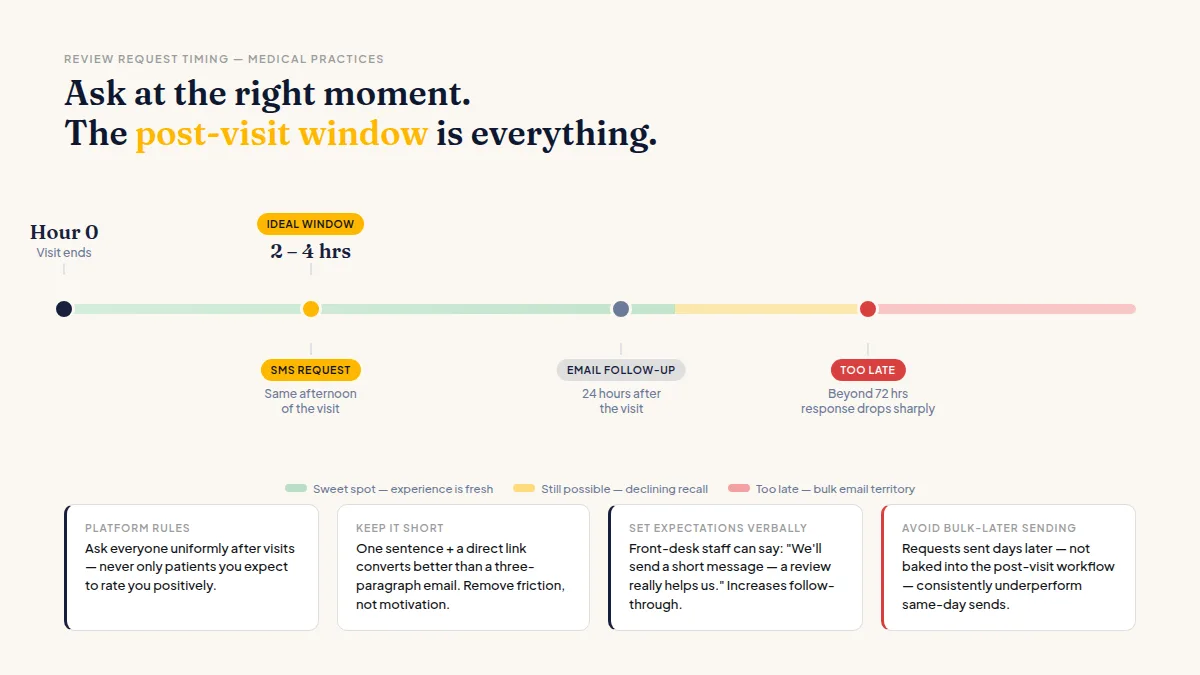
The single most effective method for generating more patient reviews is timing. Asking within a few hours of a positive visit — when the experience is fresh — consistently outperforms bulk emails sent days later. Most practices find that an SMS sent the same afternoon of a visit gets a meaningfully higher response than an email sent the following week.
A few ground rules:
Ask everyone, not just patients you think are happy. Google's guidelines prohibit selectively soliciting reviews only from customers you expect will rate you positively. Send requests uniformly after visits. Unhappy patients who get a fast, private resolution often don't post publicly at all — not because you blocked them, but because the problem got fixed.
Keep the ask short. A one-sentence SMS with a direct link converts better than a three-paragraph email explaining why reviews matter. Patients don't need to be convinced to help you; they need friction removed.
Train front-desk staff to mention it verbally. A quick "we'll send you a short message after your visit — if you have a moment, a review really helps us" sets the expectation and increases follow-through. This costs nothing.
Online reputation management for doctors is often treated as a marketing function, but it's really an operations function. The systems that work are the ones baked into the post-visit workflow, not bolted on as a monthly task someone remembers to do.
HiFiveStar handles the SMS and email request side, routes feedback privately when patients aren't satisfied, and drafts responses for you to review — all without fabricating reviews or gaming the process. If you're a medical clinic evaluating options, HiFiveStar for medical clinics outlines exactly what the platform does for healthcare practices.
Responding to Patient Reviews: The Rules That Protect You
Every patient review deserves a response — positive or negative. Review engagement is widely considered a local-ranking signal, and it shows prospective patients that you take feedback seriously. But for healthcare providers, the how matters as much as the whether.
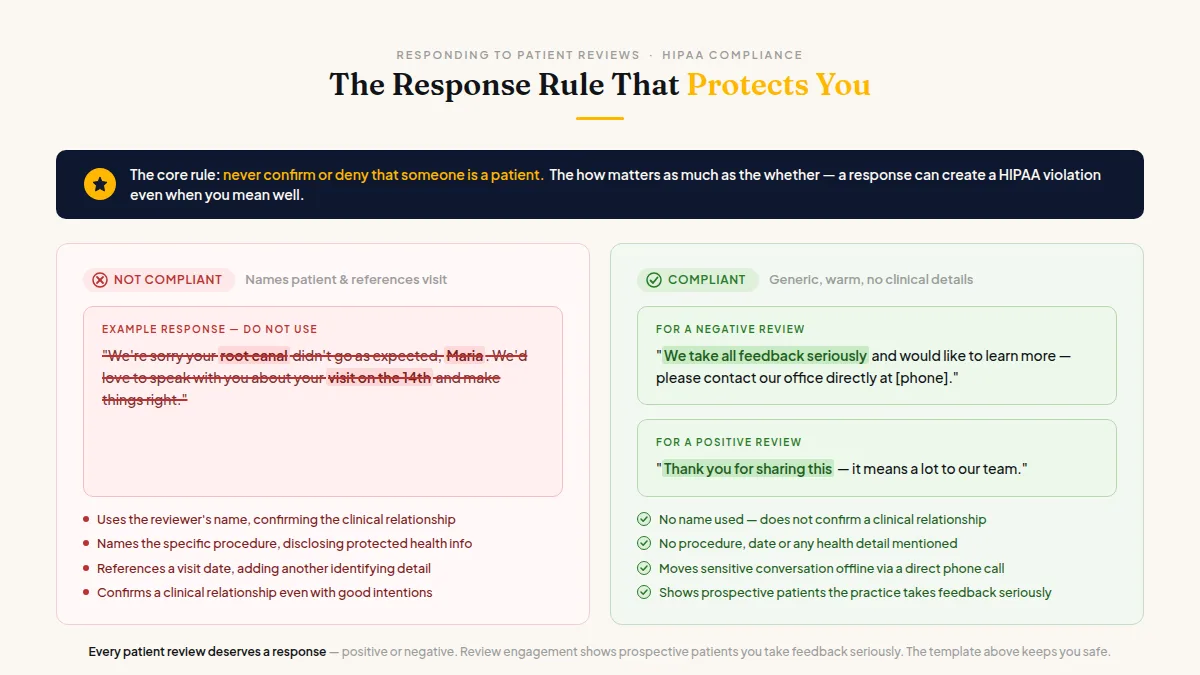
The core rule: never confirm or deny that someone is a patient. A safe response to a negative review acknowledges the concern without confirming the clinical relationship: "We take all feedback seriously and would like to learn more — please contact our office directly at [phone]." That's compliant. Saying "We're sorry your root canal didn't go as expected, Maria" is not.
For positive reviews, a brief, warm thank-you works fine. You don't need to reference the service or visit at all: "Thank you for sharing this — it means a lot to our team."
Building this response habit is where review management for clinics earns its keep. When you have 40 new reviews a month across six platforms, manual responses become a part-time job. AI-drafted responses that a staff member approves before posting cuts that time to minutes per week.
Frequently Asked Questions
Can I ask patients to leave reviews?
Yes — and you should. Google, Healthgrades, and most platforms explicitly allow businesses to invite customers to leave honest reviews. The constraint is that you must ask all patients uniformly, not only those you expect will rate you positively.
Is it a HIPAA violation to respond to a patient review?
It can be. The risk is acknowledging a clinical relationship in your response. The safe approach is to thank the reviewer without referencing their visit, treatment, or any identifying information, and to invite them to contact your office privately.
What review platforms matter most for medical practices?
Google is the most important for local search visibility. After that, Healthgrades, Zocdoc, WebMD, Vitals, and RateMDs are where patients actively search for providers — especially for primary care and specialists.
How quickly should I respond to a negative patient review?
In practice, responding within 24-48 hours signals attentiveness. Beyond a few days, the response feels reactive rather than genuine. Keep the reply brief, empathetic, and off-topic enough to stay HIPAA-safe.
Does responding to reviews actually affect my Google ranking?
Google encourages businesses to respond to reviews, and review engagement is widely considered a signal in local search rankings — though Google hasn't published a precise weighting. Consistent engagement is broadly recommended by local SEO practitioners.
What's the difference between review management software and a full-service reputation agency?
Software gives your team tools to manage reviews yourselves — automated requests, a unified inbox, AI response drafting. An agency manages it on your behalf. Software is cheaper and faster to start; agencies make sense for larger practices that want fully hands-off management.

Ready to Take Control of Your Online Reputation?
Join thousands of local businesses using HiFiveStar to get more reviews and grow faster.