Best Review Management Software for Dental Practices
Comparing the best review management software for dental practices? See how automated requests, AI replies, and review gating help dentists win more patients.
What Review Management Software Actually Does for a Dental Practice
Your Google Business profile is now doing the work your front desk used to do. When a prospective patient needs a dentist, they check your reviews before they ask a friend, call your office, or verify your insurance network. If your profile looks thin or hasn't had a new review in three months, they're clicking on the practice down the street — and you never get a chance to answer the phone.
Review management software handles the mechanics of fixing that: sending review requests to patients after appointments, helping you reply consistently, and giving unhappy patients a private channel to reach you before frustration turns into a public one-star post. The best review management software for dental practices does all of this without requiring you or your front desk staff to babysit a dozen platforms.
This article names the real contenders, describes what each does well, and gives you a clear recommendation based on what dental practices actually need.
The Main Competitors in Dental Practice Online Reputation Management
These are the platforms dental offices most commonly evaluate. None are bad — they make different trade-offs.
Birdeye is the most feature-rich option on the market. It covers review monitoring, SMS/email requests, surveys, webchat, and a full social inbox. For a multi-location dental group with a dedicated marketing coordinator, that breadth makes sense. For a single-location practice, you'll likely pay for capabilities you never touch. See our comparison of Birdeye alternatives for a detailed breakdown.
Podium built its name on text-message communication and is genuinely strong at two-way SMS. Dentists who want a combined review-request-and-webchat tool often start here. The trade-off is cost: Podium's plans are priced for businesses that will fully use the messaging suite, which many dental offices won't.
NiceJob focuses almost entirely on review generation through automated drip sequences. It integrates with practice management software and is straightforward to set up. It's a good fit if your only goal is volume of new Google reviews and you're comfortable handling replies yourself elsewhere.
Reputation.com targets enterprise and multi-location chains. Excellent analytics and location-level reporting. Overkill for most independent dental offices, and priced accordingly.
Grade.us / ReviewTrackers are monitoring-heavy platforms — good for aggregating reviews across sites into one dashboard, but lighter on the outreach and reply-drafting side.
The right tool isn't the one with the most features — it's the one your front desk will actually use after the first month.
Do this on autopilot
HiFiveStar gets local businesses more 5-star reviews and answers every one in your voice.
How to Get More Google Reviews for Dentists: The Timing Problem Every Practice Has
The biggest obstacle to collecting dental patient review requests isn't willingness — patients are often happy to leave a review. The obstacle is timing. Ask too soon (while the patient is still in the chair), and the request feels transactional. Ask too late (a week after the appointment), and the goodwill has faded.
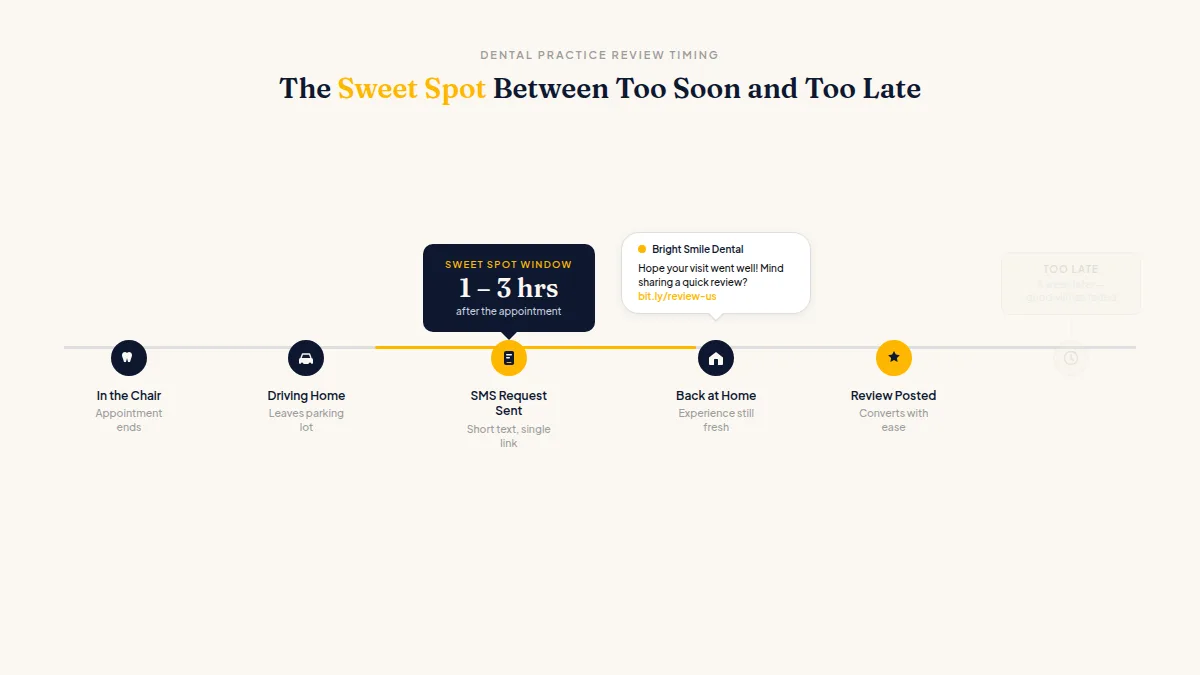
Most dental offices find the sweet spot is a request sent one to three hours after the appointment, while the patient is back at their desk or home and the positive experience is still fresh. A short SMS with a single link performs better here than a long email with multiple asks.
This is where review software for dentists earns its keep: automating that precisely-timed send so your front desk doesn't have to remember to do it manually after every appointment. Consistent timing — every patient, every time — builds review volume steadily rather than in sporadic bursts.
For a broader look at tools that handle this across healthcare, the 2024 guide to online reputation management for doctors and dental practices covers the tactical side in detail.
Responding to Dental Reviews: Why Your Reply Matters as Much as the Review Itself
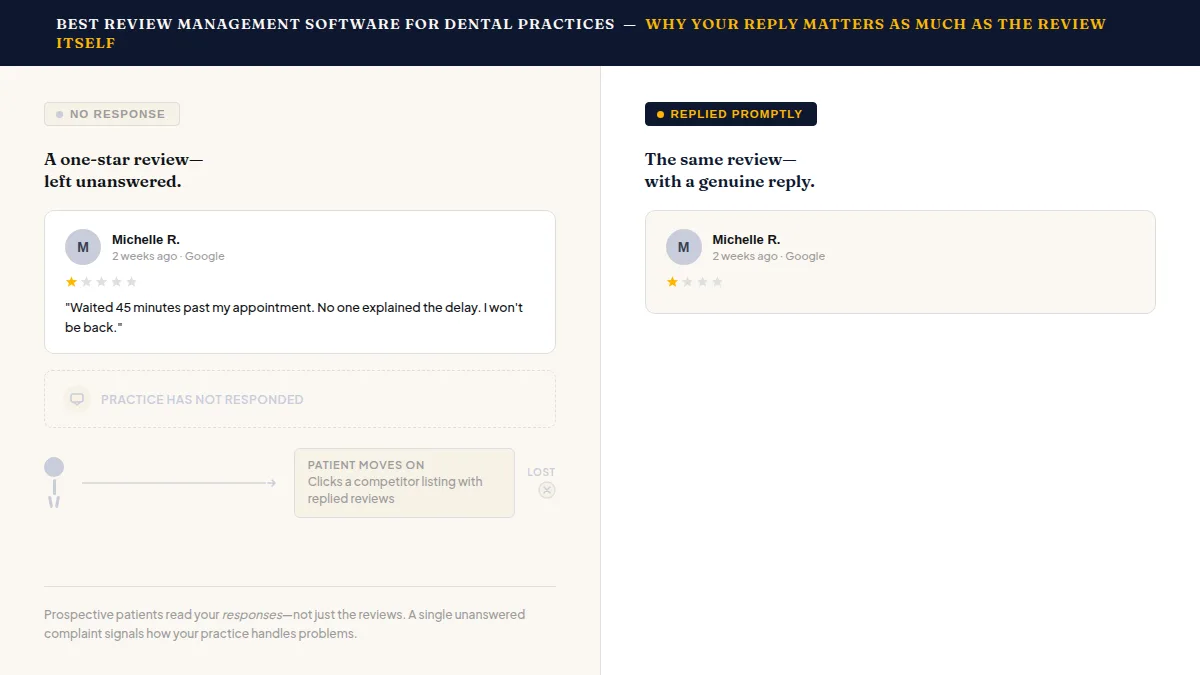
When a prospective patient reads your Google profile, they're not just reading the reviews — they're reading your responses. A thoughtful, professional reply to a three-star review tells them more about how your practice handles problems than ten five-star reviews that received no response at all.
Consistent replies are also a positive local-ranking signal. Google encourages businesses to respond to reviews, and activity in your profile — including reply frequency — is understood to factor into local search visibility, though Google has not published specific weighting details.
The practical problem: writing a genuine, non-generic reply for every review takes time most practices don't have. AI-drafted responses — trained on your voice and practice details — solve this without producing the copy-paste feel patients can spot immediately. The goal is a reply that sounds like your office manager wrote it, not a mail-merge template.
A compliant note on private feedback routing: Some platforms offer a "feedback gate" that routes unhappy patients to a private form before they reach a public review site. Done correctly, this gives dissatisfied patients a fast channel to resolve their concern directly with your practice. Done incorrectly, it means only happy patients ever reach the public review link — which violates Google's and Yelp's review policies. The compliant approach: every patient gets the same request; unhappy patients simply get an easier path to contact you first. No one is blocked from posting a public review.
Why HiFiveStar Fits Most Independent Dental Practices
HiFiveStar was built for exactly the kind of practice that doesn't have a marketing department: a single location or small group where the owner or office manager is also handling operations, scheduling, and patient experience.
Here's what it does that matters for dentist reputation management tools:
- Timed SMS and email review requests go out automatically after appointments, so every patient gets asked — not just the ones your staff remembered to follow up with.
- AI reply drafting in your voice means you can review and send responses to every review in minutes rather than hours, from one inbox connected to Google, Facebook, Yelp, TripAdvisor, and more.
- Private feedback routing gives unhappy patients a direct channel to your practice first — compliantly, with no one blocked from leaving a public review.
- An embeddable review widget lets you display your best reviews on your practice website without touching code.
- Zero fake reviews, ever — every request goes to a real patient you served.
HiFiveStar offers a free-forever plan: connect your Google Business Profile, send review requests, and see the reply inbox before committing to anything. Paid plans add volume, automation depth, and multi-location features. Visit HiFiveStar's dental practice plan for current pricing and signup details.
If you're comparing several tools, the best reputation management software for small businesses in 2025 roundup puts them side by side in a broader context.
Frequently Asked Questions
Does review management software work with dental practice management systems like Dentrix or Eaglesoft?
Many platforms offer direct integrations or CSV import so you can sync patient appointment data automatically. Check each vendor's integration page for your specific software — HiFiveStar supports list-based uploads and integrations so requests go out based on actual appointment records.
Is it against Google's rules to send review requests only to happy patients?
Yes. Google's review policies prohibit "review gating" — selectively directing only satisfied customers to leave a public review. The compliant approach is to ask all patients and give unhappy ones a private resolution path, while still allowing anyone to post publicly.
How many Google reviews does a dental practice need to rank well locally?
There's no published threshold from Google. In practice, review recency and consistency matter as much as total count — a steady flow of new reviews tends to outperform a large but stagnant total.
What's the best time to send a dental patient review request?
Many practices find that sending an SMS one to three hours after the appointment — while the patient is back in their routine but the visit is still fresh — gets better response rates than next-day or week-later requests.
Can I respond to reviews on Google, Yelp, and Facebook from one place?
Yes. Platforms like HiFiveStar aggregate reviews from multiple sources into a single inbox so you can draft and post replies without logging into each platform separately.
What's the difference between review management software and reputation management software?
Review management focuses on collecting, monitoring, and replying to reviews. Reputation management is broader and can include social listening, press monitoring, and brand sentiment tracking. For most dental practices, review management is what moves the needle — you can explore the full spectrum of reputation management tools if you want to understand where the categories overlap.


Ready to Take Control of Your Online Reputation?
Join thousands of local businesses using HiFiveStar to get more reviews and grow faster.