Good Review Examples for Doctors That Win New Patients
See good review examples for doctors that build trust and attract new patients, plus how to get more of them without asking awkwardly.
TL;DR: The reviews that attract new patients mention a specific problem solved, how the doctor made them feel, and a clear outcome — not just 'great doctor, highly recommend.' According to a 2024 Software Advice survey, 71% of patients use online reviews as their first step in finding a new doctor, so the words in your reviews matter more than most practitioners realise. Asking every patient right after the visit is the most reliable way to get reviews that read like the examples here.
What Makes a Good Doctor Review (and Why It Matters)
The first thing a prospective patient does before booking an appointment isn't call your office — it's read your reviews. That means your Google reviews are often the first real impression you make, before your website, before your staff, before anything else.
What separates a review that books appointments from one that gets scrolled past comes down to specificity. "Great doctor, highly recommend" tells a new patient almost nothing. A review that names a situation, describes how the visit felt, and mentions the outcome — that review does real work.
Specific details convert skeptical readers. Vague praise just fills space.
Good Review Examples for Doctors, By Specialty
These examples show what patient reviews look like when they move someone from "maybe" to "booked." They're models, not scripts — real patients write in their own words, which is exactly what you want.
General practice / family medicine:
"I've been putting off finding a new primary care doctor for two years. Dr. Reyes took the time to go through my full history on the first visit, explained what she was looking for and why, and called me personally with my lab results. I didn't feel rushed once. Booking was easy and the office got me in within a week."
Pediatrics:
"Dr. Kim has seen both my kids since they were newborns. He's calm, explains everything to the kids themselves (not just to me), and never makes me feel stupid for asking questions. The nurses actually follow up after sick visits to check in. That's rare."
Dentistry:
"I hadn't been to a dentist in four years because of anxiety. Dr. Patel's office was patient with me from the first call. They explained the costs upfront, the hygienist checked in during the cleaning, and there was zero judgment about the gap. I have a follow-up scheduled, which says everything."
If you manage a dental practice and want to see how review management works for dentists specifically, the principles are the same — specificity, emotion, and outcome.
Dermatology:
"I came in for something I'd been worried about for months. Dr. Okafor looked at it, explained exactly what it was, and had a treatment plan by the end of the appointment. No vague 'let's watch it.' Clear answers. That's all I wanted."
Orthopedics / physical therapy:
"After my knee surgery, I was nervous about recovery. The PT team gave me a realistic timeline, adjusted my plan when I had a setback, and celebrated progress with me. Six months later I'm back to hiking. I'd send anyone there."
Each of these good review examples for doctors works because it answers the question a new patient is actually asking: What will this feel like for me?
Do this faster
HiFiveStar gets local businesses more 5-star reviews and drafts a reply to any of them in seconds.
The Four Elements Every Strong Patient Review Contains
Four ingredients appear in every patient review that actually drives new appointments.
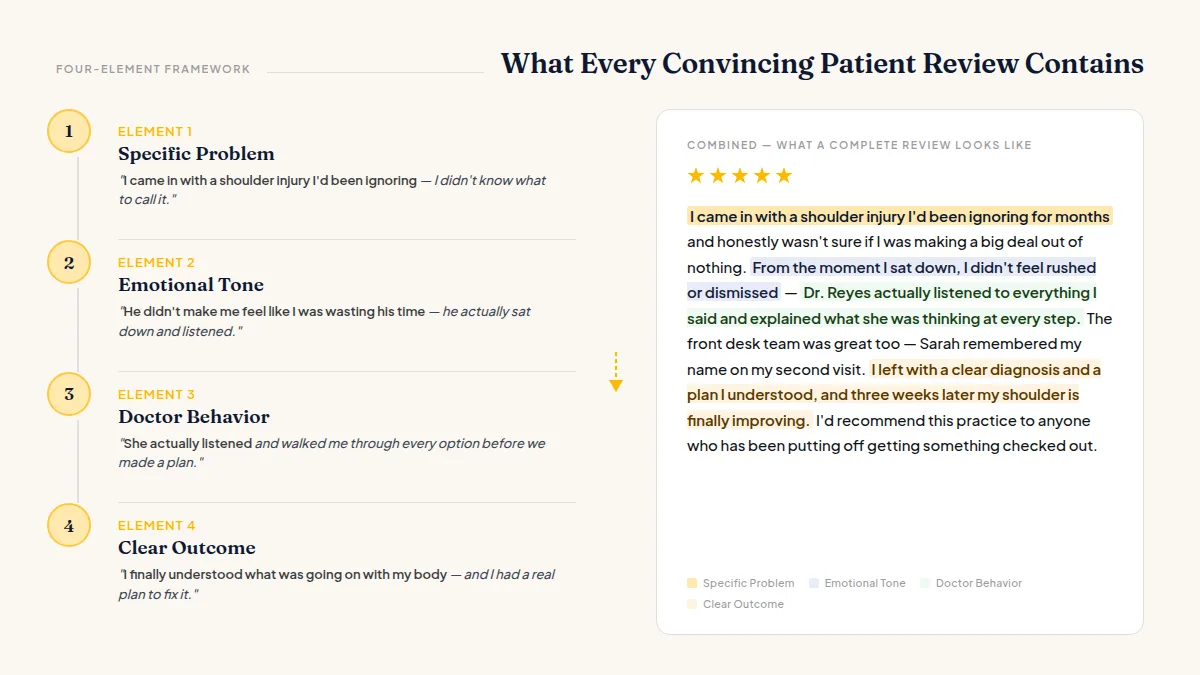
1. A specific situation or condition. Not necessarily a diagnosis — patients often don't name one — but enough context that a reader with a similar problem sees themselves. "I came in with a shoulder injury I'd been ignoring" beats "I had an issue."
2. How the patient felt during the visit. This is the most underrated element. "She actually listened" or "He didn't make me feel like I was wasting his time" speaks directly to the fear every new patient brings through the door.
3. A concrete outcome. Recovery, clarity, a diagnosis, a plan — something that happened as a result of the visit. Even "I finally understood what was going on with my body" counts.
4. A detail that signals authenticity. A staff member's name, the wait time, a specific follow-up call. These small details are what make a reader trust the review — and they're what makes reviews visible in local search results.
How to Get More Patient Reviews Without Awkwardness
Most patients who leave a review do so because someone asked. Timing and framing both matter.
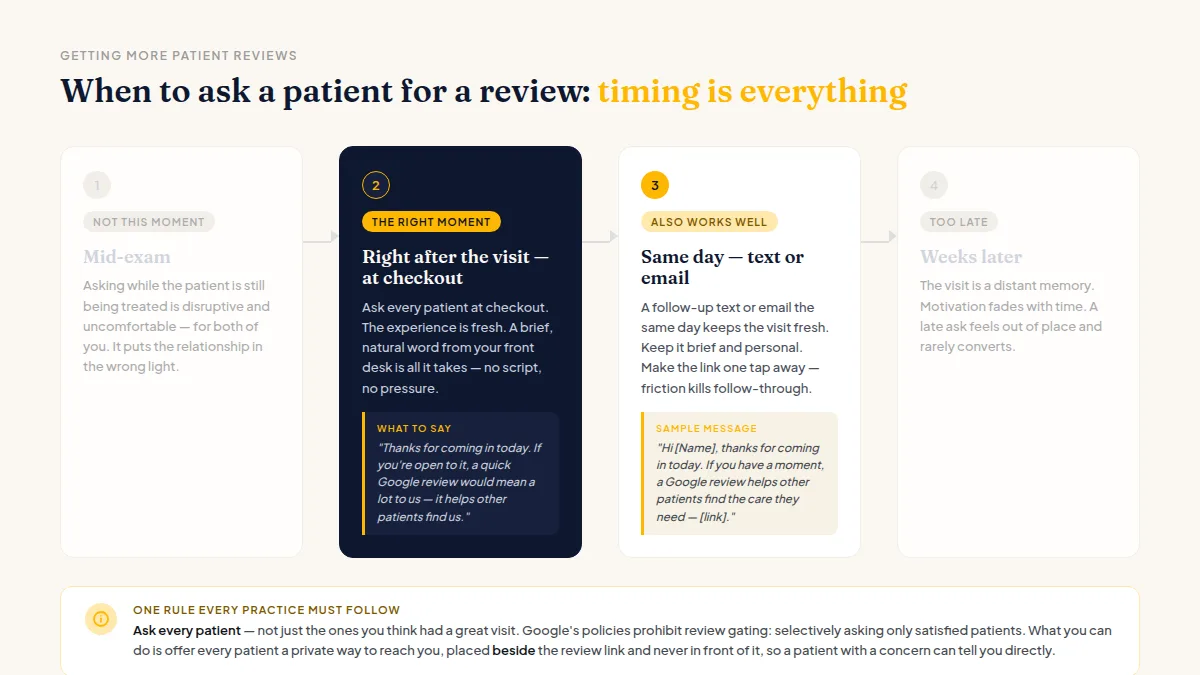
Ask every patient right after the visit, at checkout. A front-desk team member can say: "Thanks for coming in today. If you're open to it, a quick Google review would mean a lot to us — it helps other patients find us." That's it. No pressure, no lengthy script.
For practices following up by text or email, keep the message brief and personal: "Hi [Name], thanks for coming in today. If you have a moment, a Google review helps other patients find the care they need — [link]." Make the link visible and one tap away. Friction kills follow-through.
One compliance rule every practice must follow: ask every patient, not just the ones you think had a great visit. Google's review policies prohibit review gating — selectively asking only satisfied patients to post publicly while steering others away. Every patient is entitled to leave a public review. What you can do is offer every patient a private way to reach you, placed beside the review link and never in front of it, so a patient with a concern can tell you directly. That's permitted. Blocking or discouraging anyone from posting publicly is not.
Tools like HiFiveStar let practices send review requests by text or email after appointments, manage replies, and see all reviews across platforms in one inbox — which matters when you're managing multiple providers or locations.
The practices with the most reviews are almost never the ones with the happiest patients — they're the ones that ask consistently.
For more on how to respond to difficult reviews without making things worse, that post covers the most common mistakes practice managers make.
Frequently Asked Questions
What should a good patient review include?
The most useful patient reviews mention a specific situation, how the patient felt during the visit, a staff member or doctor by name, and some kind of outcome — even just clarity or peace of mind. Details are what make a review credible to someone reading it cold.
Are doctor review examples useful for training staff?
Yes. Sharing two or three strong examples with your front-desk team helps them understand what a compelling review looks like and makes their requests feel more natural. They can point to something concrete rather than asking patients to figure it out alone.
How do you ask patients for reviews without violating Google's policies?
Ask every patient, not just satisfied ones. You can offer a private feedback option for concerns, but you must never prevent anyone from leaving a public review. Keep the ask short, make the link easy to tap, and send it right after the visit.
How many Google reviews does a medical practice actually need?
There's no magic number, but practices with very few reviews often lose prospective patients to competitors with significantly more — not because the competitor is better, but because the volume signals established trust. Asking consistently over time matters more than any single push.
Do patients actually read doctor reviews, or just look at the star rating?
Both. Patients check star ratings first, then read the written text of the reviews that catch their attention — which is why the content of your reviews is worth caring about, and why responding to reviews sends a signal that you're engaged and attentive.
Can a medical practice respond to Google reviews?
Yes, and it's worth doing. A thoughtful response to a positive review shows prospective patients that the practice pays attention. When replying publicly, never include patient names, appointment details, or any health information — keep responses warm, general, and brief. This protects patient privacy and keeps you on the right side of HIPAA.



Ready to Take Control of Your Online Reputation?
Join thousands of local businesses using HiFiveStar to get more reviews and grow faster.