Bad Review Response Examples for Local Businesses
Real bad review response examples local business owners can adapt today — turn unhappy customers into loyal ones and show prospects you care.
TL;DR: Responding to a bad review within 24–48 hours with a calm, specific reply can turn a frustrated customer around and reassure everyone reading it. The best responses acknowledge the problem, apologize without over-explaining, and offer a clear next step offline. Avoid defensiveness, blanket apologies, or copy-paste replies — each response should feel personal to that reviewer.
Why Bad Review Responses Make Things Worse
Most business owners treat a bad review like a problem to contain. The response reads defensive, robotic, or like a form letter — and suddenly a one-star review that 10 people would have scrolled past becomes a thread that 500 people read because the reply made it worse. According to a 2022 Uberall study, 87% of consumers say a business's response to a negative review influences their purchasing decision. The response matters more than the review itself.
Here's what bad review response examples actually look like in the wild, and what to write instead.
Bad Review Response Examples That Backfire (and Why)
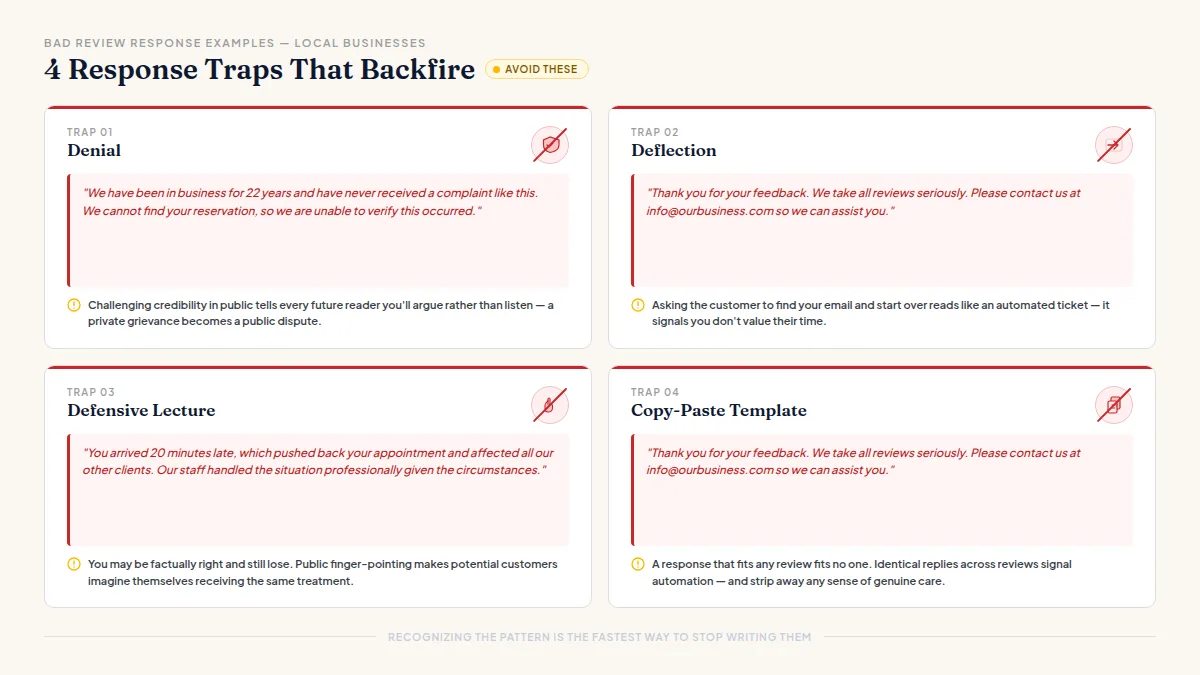
A bad response typically falls into one of four traps: denial, deflection, over-apology without action, or copy-paste templates that feel automated. Recognizing the pattern in a real example is the fastest way to stop writing them.
Example 1 — The Denial Response
"We have been in business for 22 years and have never received a complaint like this. We cannot find your reservation, so we are unable to verify this occurred."
What's wrong: Challenging the customer's credibility in public is almost always a losing move. Even if the details are fuzzy, this tells every future reader that you'll argue rather than listen. A private grievance becomes a public dispute — and you started it.
Example 2 — The Boilerplate Non-Answer
"Thank you for your feedback. We take all reviews seriously. Please contact us at info@ourbusiness.com so we can assist you."
What's wrong: This reads like an automated ticket acknowledgment. The customer already took time to write a review. Asking them to find your email and start over signals that you don't value their time — and every future reader picks up on that.
Example 3 — The Defensive Lecture
"You arrived 20 minutes late, which pushed back your appointment and affected all our other clients. Our staff handled the situation professionally given the circumstances."
What's wrong: You may be factually right and still lose. Public finger-pointing makes potential customers imagine themselves on the receiving end of the same treatment.
Example 4 — The Wall of Text Apology
"We are so deeply sorry and horrified that this happened and we want you to know that customer service is our absolute top priority and we are fully committed to making this right and hope you will give us another chance to show you who we really are as a business..."
What's wrong: Length signals panic. A response this long amplifies the review's weight. Readers infer something serious must have happened to warrant this much damage control.
A bad reply isn't neutral — it's a second negative review you wrote yourself.
Do this faster
HiFiveStar asks happy customers at exactly the right moment — so more of them actually leave a review.
What Good Responses Look Like Instead
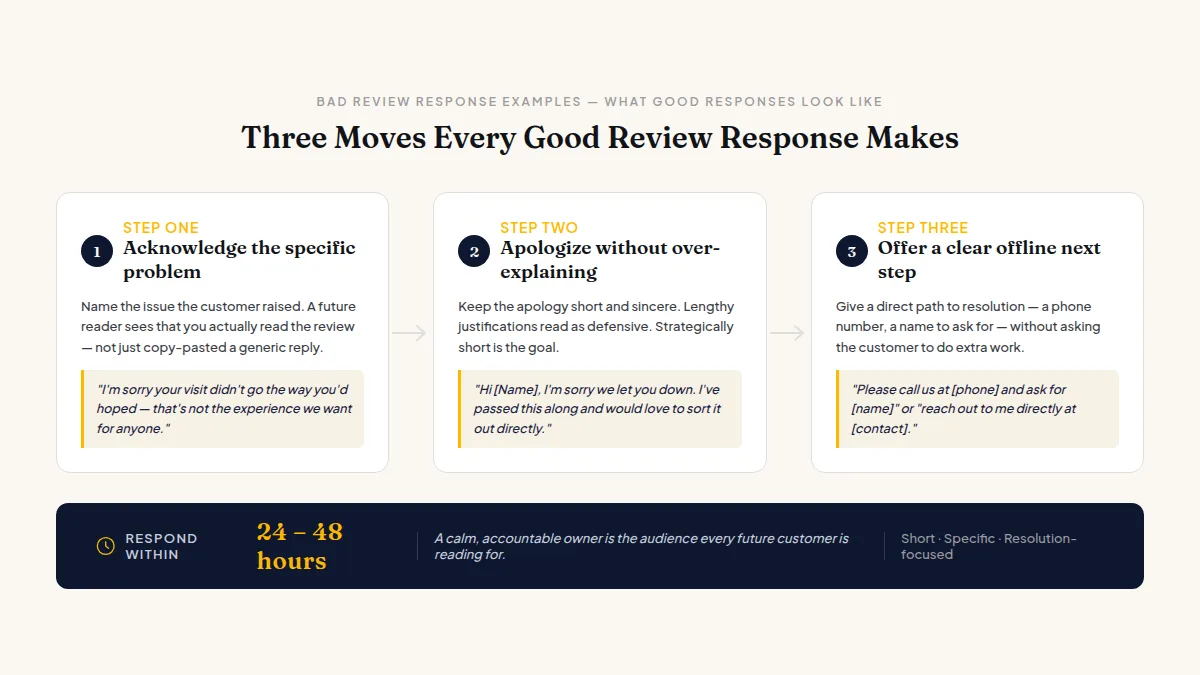
When you're studying bad review response examples, seeing the corrected version side by side is far more useful than theory alone. Good responses share three traits: they're short, they name the specific issue, and they move toward resolution without asking the customer to do extra work.
Rewrite of Example 1:
"Thanks for taking the time to leave this. I'm sorry your visit didn't go the way you'd hoped — that's not the experience we want for anyone. I'd like to understand what happened; please call us at [phone] and ask for [name]."
Rewrite of Example 2:
"Hi [Name], I'm sorry we let you down. I've passed this along to [manager name] and would love to sort it out directly — you can reach us at [phone] any time this week."
Rewrite of Example 3:
"Thanks for the feedback. I understand that felt frustrating, and I'm sorry the appointment didn't run smoothly. If you'd like to talk it through, please reach out to me directly at [contact]."
These aren't just polite — they're strategically short. A future customer scanning your Google reviews sees a calm, accountable owner. That's the audience you're actually writing for, not the person who left the review.
For a full library of ready-to-edit replies, negative review response templates for any business cover dozens of industries and complaint types.
How to Respond to Unhappy Customers Online Without Going Off-Script
The hardest part of responding to bad reviews isn't knowing what to write. It's writing it when you're angry or hurt. The review feels personal because your business is personal. This process keeps responses consistent even on difficult days.
Wait 30-60 minutes. Read the review once, close the tab, do something else. Responses written in the first five minutes after a stinging one-star rarely land well.
Identify the one specific complaint. Not the tone, not the star rating — the actual issue. Slow service? A billing problem? A staff interaction? Your response should name that thing, not a vague "experience."
Use a three-sentence structure:
- Acknowledge that they took time to write
- Address the specific issue with one line of accountability
- Offer a direct path to resolution — phone, email, or an invitation to return
Keep it under 75 words. Anything longer loses readers and inflates the drama.
One practical shortcut: if you manage reviews through software like HiFiveStar, AI-drafted replies give you a starting point written in the review's own language. You edit, cut what doesn't fit, and — at locations connected with your Google login — post the reply straight to Google from the dashboard. The draft gets you off the blank page on the days you don't have the mental energy to start from scratch.
The Star-Filter Misconception (and What the Rules Actually Allow)
Some businesses use a star filter on their review request page, where customers who rate the experience poorly get directed to a private feedback form before reaching a public platform. The compliance line here matters.
The compliant approach is to give unhappy customers a fast, private channel to raise their issue before they post publicly. That's legitimate — it often resolves problems that would have become one-star reviews. But you can never prevent any customer from posting a public review. Every customer must remain free to leave a review on Google, Yelp, or any other platform, regardless of how they rated the experience privately.
Review gating — selectively soliciting reviews only from customers you expect to be happy, or discouraging others from posting publicly — violates Google's guidelines and the FTC's endorsement rules. The star filter exists to offer a resolution path, not to suppress ratings.
Private feedback collected through that form can be answered directly by email when the customer left contact details. Resolving the issue privately often leads the customer to update or remove their public review on their own. That outcome is earned, not engineered.
Frequently Asked Questions
How quickly should I respond to a negative review?
Aim for within 24-48 hours. Faster responses signal attentiveness, but it's better to wait an hour and write a measured reply than to post a defensive one immediately.
Should I respond to every negative Google review?
Yes. Even a brief, professional reply shows future customers that someone is paying attention. An unanswered negative review can signal indifference more than the complaint itself does.
Can I ask a customer to remove a bad review after I resolve their issue?
You can let them know the issue has been resolved and that they're welcome to update their review if they'd like — but you can't offer any incentive, and you can't pressure them. The decision is entirely theirs.
What should I never say in a response to a negative review?
Never challenge whether the customer actually visited, never name other staff members or customers, and never threaten legal action publicly. All three tend to escalate and attract more attention to the original complaint.
Do Google review responses affect local search rankings?
Google encourages businesses to respond to reviews, and review engagement is widely considered a positive signal for local search — though Google hasn't published a specific formula. Consistent, thoughtful responses are good practice regardless of any ranking effect.
Where can I find negative review reply templates I can actually use?
A good starting point is a set of negative review response templates organized by business type and complaint category. Adapt them to the specific situation rather than copying word-for-word, so they read as genuine.



Ready to Take Control of Your Online Reputation?
Join thousands of local businesses using HiFiveStar to get more reviews and grow faster.