Negative Review Response Templates for Any Business
Use these negative review response templates to reply professionally to any bad review, protect your reputation, and turn unhappy customers into loyal ones.
TL;DR: Responding to negative reviews promptly and professionally can actually strengthen customer trust — 45% of consumers say they're more likely to visit a business that replies to bad reviews (Google/Ipsos). These ready-to-use templates cover common scenarios for restaurants, salons, clinics, and more, so you always know what to say. Customize them with your own voice and specific details to keep every response feeling genuine.
Why Your Response to a Negative Review Matters More Than the Review Itself
A negative review without a reply is the only version of events future customers ever read. When you respond — calmly, specifically, and fast — you shift that story. The reviewer may not change their mind, but the next hundred people scrolling through that thread will see a business that takes problems seriously. That's your real audience.
Knowing how to respond to negative reviews is a skill that compounds. One well-handled complaint, visible to every future reader, demonstrates your standards more convincingly than any ad.
The Structure Every Negative Review Response Needs
Every effective response follows the same skeleton regardless of industry. Get this right and you can adapt it to anything.
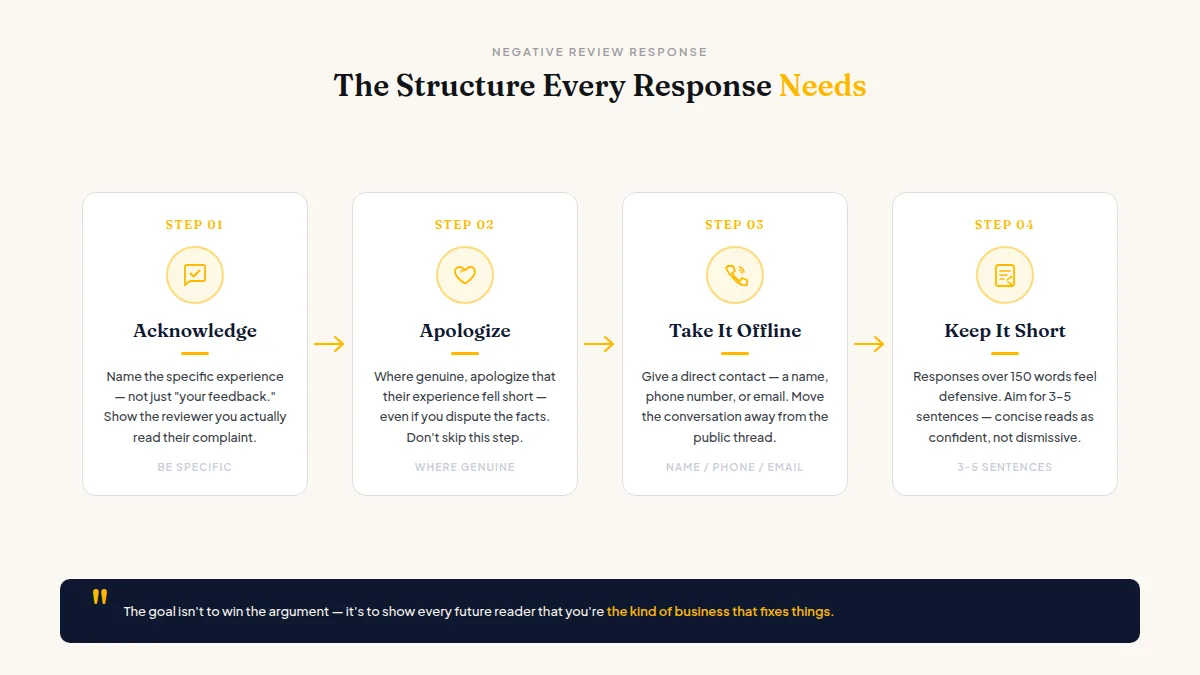
- Acknowledge — Name the specific experience, not just "your feedback."
- Apologize (where genuine) — Don't apologize for facts you dispute, but always apologize that their experience fell short.
- Take it offline — Give a direct contact: a name, phone number, or email.
- Keep it short — Responses over 150 words start to feel defensive. Aim for 3–5 sentences.
The goal isn't to win the argument — it's to show every future reader that you're the kind of business that fixes things.
Never paste the same canned line across every review. Platforms notice it, customers notice it, and it signals that your response is performance rather than genuine care. For a deeper guide on the full process of how to respond to negative reviews, the linked walkthrough covers the tactical steps in detail.
Do this on autopilot
HiFiveStar answers every review in your voice — so your profile always looks cared for.
Negative Review Response Templates by Business Type
These are starting points, not finished copy. Replace the bracketed text, match the tone to your voice, and cut anything that sounds generic when you read it aloud. The difference between a template that works and one that doesn't is almost always a single specific detail — a dish name, a service date, a staff member's name — that proves you actually read the complaint.
Restaurant or café
"Thank you for coming in, [First Name]. I'm sorry the [dish / service / wait time] didn't hit the mark — that's not the experience we want anyone to have. I'd love to make it right. Please reach out to me directly at [email/phone] so we can talk through what happened."
What makes this land: filling in the bracketed detail ("the 45-minute wait on a Tuesday night") transforms a generic apology into proof you read their review.
Salon or spa
"I appreciate you letting us know, [First Name]. What you're describing isn't the standard we hold ourselves to, and I'm sorry your visit didn't reflect that. Please call us at [phone] — I'd like to hear more and make this right."
Dental or medical clinic
"Thank you for sharing this, [First Name]. Patient experience is something we take very seriously, and I'm sorry your visit fell short of what you expected. Please contact our office directly at [phone/email] so we can speak privately and address your concerns."
Home services (plumber, electrician, HVAC, contractor)
"Thank you for the feedback, [First Name]. I'm sorry the job didn't meet your expectations — that's not how we want to leave any home. Please get in touch at [phone/email] and I'll personally make sure we sort this out."
Retail shop
"I'm sorry to hear about your experience, [First Name]. What you've described isn't what we expect our customers to walk away feeling. Please reach out to us at [email] — we'd like to fix this."
Auto shop
"Thanks for taking the time to share this, [First Name]. I'm sorry we let you down — trust is everything in this business and it sounds like we didn't earn yours on this visit. Please call us at [phone] so we can make it right."
For professional review response examples with more context around tone and phrasing, that resource is worth bookmarking.
What to Do When the Review Is Inaccurate or Unfair
Sometimes the complaint is exaggerated, mistaken, or — in rare cases — left by someone who was never your customer. Responding well still requires you to stay composed, even when the facts are wrong.
Don't lead with a correction. Even if you're right, opening with "Actually, our records show..." reads as combative to every bystander. Instead, acknowledge the concern, note that it doesn't match your usual service, and invite them to contact you privately so you can "understand what happened." That phrasing signals openness rather than defensiveness — and every third-party reader will notice the difference.
If you genuinely believe a review violates a platform's policies — spam, a competitor, or a completely fabricated experience — flag it through the platform's official removal process. Don't call it out publicly. That only amplifies it.
One compliance note: platforms like Google and Yelp prohibit "review gating," meaning you can't selectively ask only happy customers for public reviews while routing unhappy ones away. The compliant approach — which tools like HiFiveStar support — is to ask all customers for feedback and give dissatisfied ones a fast, private channel to resolve the issue first, without blocking anyone from posting publicly. Every customer retains the right to post, and your process has to reflect that.
Timing and Tone: The Two Variables That Sink Good Responses
A perfect template replied to three weeks late still looks bad. Responding within 24–48 hours signals that you're paying attention. After several days, even a thoughtful response can look like it was prompted only by public pressure rather than genuine concern.
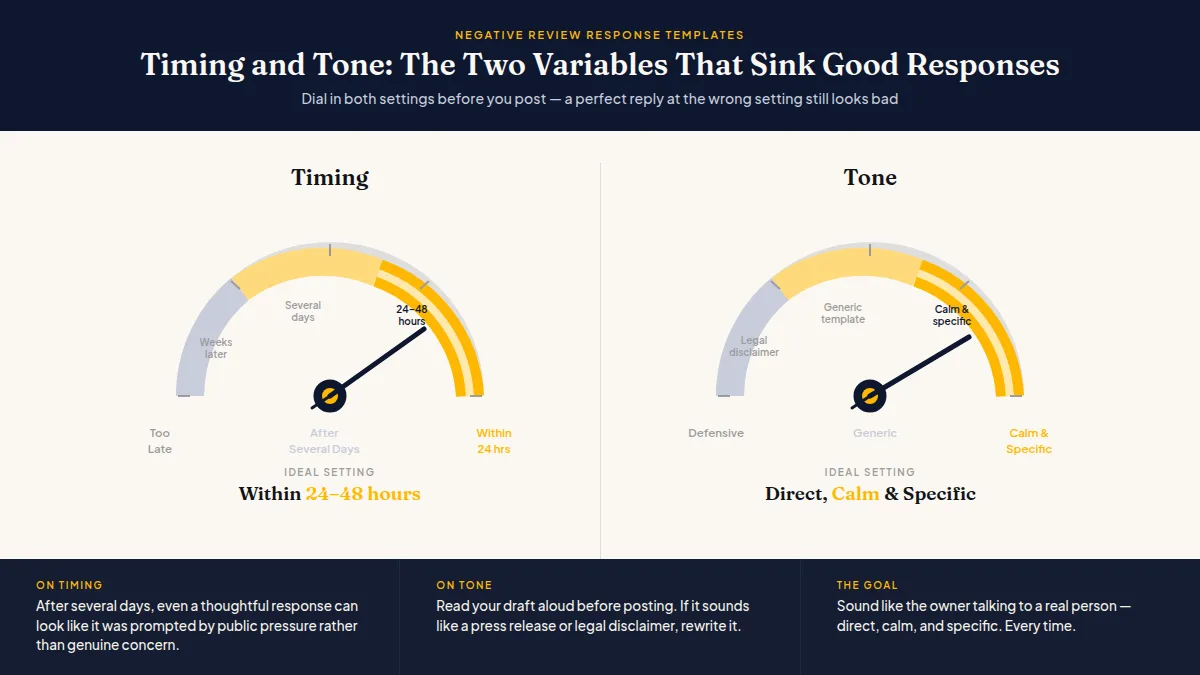
Tone is where most templates fail in practice. Read your draft aloud before you post. If it sounds like a press release or a legal disclaimer, rewrite it. The goal is to sound like the owner talking to a real person — direct, calm, and specific.
On the question of volume: businesses that respond consistently tend to attract more feedback overall. The most plausible reason is simple — customers see that reviews get read and acknowledged, so submitting one feels worthwhile. More total reviews means more opportunities to show the full picture of your service, not just the outliers.
If you want to reduce the share of negative reviews over time, the upstream answer is effective review request templates that prompt satisfied customers to speak up — so your public reputation reflects your actual performance.
Frequently Asked Questions
Should I respond to every negative review?
Yes, with rare exceptions. Even a brief, genuine response outperforms silence. The only cases where you might skip: a review that's clearly spam, or one where the platform is actively processing a removal request and a response would complicate that process.
What if the customer responds to my reply and escalates?
Take it private immediately. Reply once more — "I'd really like to resolve this directly, please contact me at [phone/email]" — and don't continue the public thread. Every additional public exchange increases the visibility of the conflict.
Can I ask a reviewer to update or remove their review after I've resolved the issue?
You can let them know the issue has been fixed and thank them for the feedback. You cannot incentivize or pressure someone to change their review — that violates Google's and Yelp's guidelines.
How long should a negative review response be?
Three to five sentences is the sweet spot. Enough to show you read the specific complaint; short enough to avoid coming across as defensive or panicked.
Does responding to negative reviews help with local search rankings?
Review engagement is widely considered a local-ranking signal, and Google explicitly encourages businesses to respond. Whether the response itself moves rankings is debated, but the reputational impact on potential customers deciding whether to call you is well-established.
What if I can't identify the customer because they used an anonymous name?
Respond as if their experience was real — because it probably was. Ask them to reach out privately so you can locate the visit and make it right. Don't speculate publicly about who they are or whether the review is legitimate.

Ready to Take Control of Your Online Reputation?
Join thousands of local businesses using HiFiveStar to get more reviews and grow faster.