How Responding to Reviews Gets You More Stars
Responding to reviews — good and bad — is one of the fastest ways to improve your star rating and win more customers. Here's how to do it right.
TL;DR: Replying to every review signals to future customers that you care, and it nudges fence-sitters to leave their own. Owners who respond quickly and personally — especially to negative reviews — consistently see higher ratings over time. A short, specific reply beats a copy-pasted template every time.
Why Responding to Reviews Actually Moves Your Star Rating
Most owners treat review responses as a courtesy — a polite "thank you" that checks a box. But how responding to reviews improves your rating runs deeper than that. Reply consistently, and two things happen: customers on the fence about leaving a review see that you actually read them, and customers who felt ignored stop staying silent.
Research suggests the effect is real. A 2022 Harvard Business Review study found that hotels that began responding to reviews saw their overall ratings increase and received more reviews over time. That study focused on hospitality, so the exact numbers may not translate one-for-one to your type of business — but the direction of the finding aligns with what review platforms and local SEO practitioners report across industries: engagement encourages volume, and volume tends to lift ratings.
The competitive angle is just as straightforward. Most of your local competitors are not responding. When someone compares two listings for a dentist, a plumber, or a restaurant, the business that replies thoughtfully to every review signals attentiveness — and that signal converts browsers into customers.
How to Respond to Negative Reviews Without Making Things Worse
A bad review stings, but every future customer who finds your listing will read how you handled it. Respond within 24–48 hours, stay calm, and keep it short. A brief, non-defensive reply often builds more trust than a fifth five-star review would.
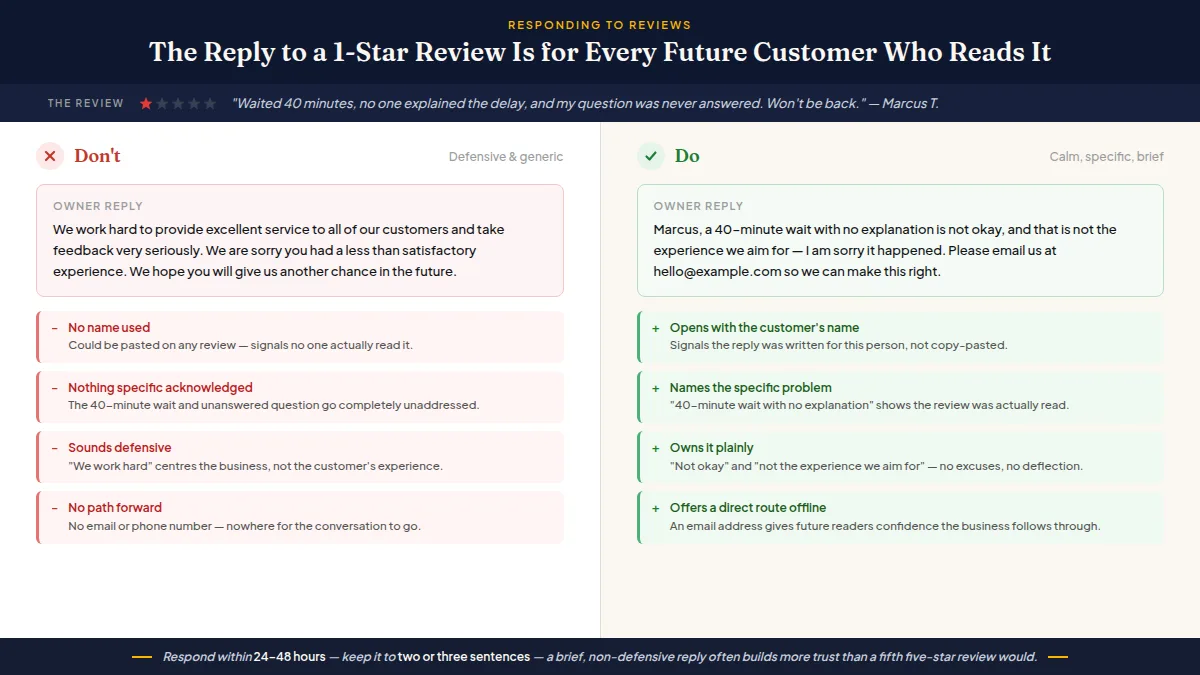
The reply to a one-star review is not for the upset customer — it's for every future customer who reads it.
A structure that works:
- Acknowledge the experience — not "I'm sorry you feel that way," but "That's not the experience we aim for, and I'm sorry it happened."
- Take it offline — give a direct email or phone number so the conversation can continue privately.
- Keep it to two or three sentences — a long defensive reply signals you care more about winning the argument than fixing the problem.
One compliance point worth knowing: Google and Yelp prohibit businesses from soliciting reviews selectively — meaning you cannot run any process designed to funnel happy customers toward a review site while screening out unhappy ones. Ask every customer, and let your responses to the hard reviews demonstrate that you can handle them.
For a broader set of tactics, these proven strategies for generating more online reviews pair well with a solid response practice.
Do this faster
HiFiveStar drafts a reply to any review in seconds — so your profile always looks cared for.
Responding to Google Reviews: The Mechanics and What to Write
Google is where most customers start their search, so it deserves the most attention. Google encourages businesses to respond to reviews, and review engagement is widely considered a local-ranking signal — though no one should promise a specific ranking outcome from replies alone.
To reply, open your Google Business Profile, find the review, and click "Reply." For businesses managing multiple locations, that process gets tedious fast. A tool like HiFiveStar lets you draft and post replies to Google reviews from a single inbox without switching between profiles.
For the reply itself:
- Use the customer's name if they included it.
- Mention your business name and location naturally — this text appears in search results alongside the review.
- Be specific — "glad the lamb chops hit the spot" beats "glad you enjoyed your meal."
- Don't echo the negative detail in a bad-review reply — "I'm sorry your experience with our water damage was poor" just highlights the problem for every searcher who reads it.
For five-star reviews, one or two sentences is plenty. Thank them, name the specific thing they praised, and invite them back. It takes 90 seconds and tells every prospective customer that a real person is running this business.
Review Response Best Practices That Save You Time
Consistency beats perfection. A reply sent within a day beats a carefully crafted response that sits in your drafts for a week. Set aside 10–15 minutes each morning to handle anything that came in the day before. Most days there will be nothing; on the days there is, you will not fall behind.
A few review response best practices that hold up across industries:
- Write different replies — Google can detect copy-pasted responses, and customers can too. Keep a few templates as a starting point, but change at least two or three lines each time.
- Answer the specifics — if the review mentions a staff member by name, include that name in your reply.
- Don't offer a discount or freebie in a public reply to a negative review. It reads as desperate, and Google prohibits incentivizing reviews in any form — including as a make-good intended to prompt a rating revision.
- Reply to the good ones too — responding only to bad reviews sends the message that you are permanently in damage-control mode.
If you are managing several locations, these tips to boost Google reviews cover the volume side of the equation.
How to Turn a Response Habit Into More Stars Over Time
Building the reply habit is the real work. The payoff arrives over six to twelve months, as your average star rating gradually rises — not because responses change existing reviews, but because responding encourages more customers to leave one. When people see that the owner reads and replies, writing a review feels less like shouting into a void.
Track your review count and average rating month by month. Send review requests consistently, reply to everything that comes in, and you will have a clear before-and-after picture inside a quarter. Businesses that sent 20 or more review requests in their first 90 days on HiFiveStar went from an average of 11 new Google reviews to 23. The response habit is what turns that volume into a steadily improving rating rather than a noisy mix of highs and lows.
The practical takeaway: pick a time each day, open your reviews, and reply to everything. No tool required to start. If volume eventually eats your morning, that is a good problem — and software will solve it. Either way, the habit is what compounds.
Frequently Asked Questions
Does responding to reviews actually improve your star rating?
Responding does not change existing ratings, but it encourages more customers to leave reviews, and businesses that engage consistently tend to see their ratings improve over time. Research in the hospitality sector — including a 2022 Harvard Business Review study — found a positive link between responding and both review volume and overall rating. The effect appears to hold broadly, though the size of the impact will vary by industry and starting rating.
How fast should you respond to a Google review?
Responding within 24 hours works well for most businesses. A same-day reply signals attentiveness; waiting longer risks the impression being set before you have said anything.
What should you say when responding to a negative review?
Acknowledge the specific problem, apologize without being defensive, and offer to continue the conversation by email or phone. Keep it to two or three sentences — brevity reads as confidence, not dismissal.
Do you need to respond to every five-star review?
You don't have to, but a short, specific reply to positive reviews shows future customers there's an engaged owner behind the listing — and it takes under a minute per review.
Can you ask a customer to change their review after you respond?
You can resolve the issue and let the customer know you have done so, but you should not ask them directly to revise their rating. Google prohibits any form of review manipulation, including pressuring customers to update a review.
Is it worth responding on sites other than Google?
Yes, particularly on any site where your customers are active. Facebook, Yelp, and industry-specific sites like Houzz or Healthgrades all carry weight for certain business types — and future customers read those replies too.

Ready to Take Control of Your Online Reputation?
Join thousands of local businesses using HiFiveStar to get more reviews and grow faster.