Best Review Management Software for Lawyers
Discover the best review management software for lawyers. Compare top picks to get more client reviews, protect your reputation, and grow your practice.
TL;DR: Lawyers need review management software that gathers client feedback from Google, Avvo, and other directories without crossing ethical lines around solicitation. The best tools let you monitor reviews in one inbox, respond quickly, and send review requests to clients after their matter closes. Look for a platform that flags low ratings privately before they go public, so you can address concerns before they hurt your firm's reputation.
What Lawyers Actually Need From Review Management Software
Most review tools are built for retail or hospitality. Law firms have different needs: a longer sales cycle, clients who are often reluctant to leave reviews at all, strict bar association advertising rules, and a reputation that can make or break a referral pipeline overnight. The best review management software for lawyers handles all of that without adding busywork to an already packed schedule.
Before comparing tools, get clear on what actually matters. You need software that monitors reviews across the platforms clients actually use, makes it easy to ask clients for reviews after their matter closes, and lets you respond quickly from one place. Bonus points if it flags emerging themes in feedback — because the same complaint appearing five times in a month is something you need to catch early.
How Lawyer Google Reviews Actually Affect Your Practice
Google reviews are the single most visible signal for local search. When someone searches "divorce attorney in [city]" or "personal injury lawyer near me," the firms appearing in the local map pack almost always have more reviews and higher ratings than those buried below. Review quantity and recency are widely considered local-ranking signals, and Google explicitly encourages businesses to respond to reviews — so ignoring that inbox has a real cost.
The firms that show up first aren't necessarily the best lawyers in town — they're often just the ones who asked for reviews consistently.
For attorney online reputation management, Google is the priority, but it's not the only platform that matters. Avvo is particularly important in legal — many clients search it specifically before contacting a firm. Yelp and Facebook appear in general searches too. A good tool aggregates the platforms it supports so you're not logging into multiple dashboards every morning. Before committing to any software, verify which specific directories it monitors, since coverage varies significantly between platforms.
Do this faster
HiFiveStar drafts a reply to any review in seconds — so your profile always looks cared for.
What to Look For in Law Firm Review Management Software
The right software for a law firm isn't the same as the right software for a restaurant. Here's what to evaluate:
Review monitoring across the directories your clients use. Check which sites a platform actually supports before you commit — legal-specific directories like Avvo are not universally covered by every tool, and assuming coverage without confirming it is a common mistake.
Review requests that fit how legal matters close. You can't always send a review request the day of a transaction the way a retailer might. Look for tools that let you send requests manually, in batches, or automatically when a matter closes — ideally triggered through whatever billing or case management workflow you already use.
The ability to respond to law firm reviews from one dashboard. Drafting and posting replies one-by-one across platforms eats time. AI-drafted replies can cut that down significantly, as long as you review them before posting — which you should, both for accuracy and bar compliance. No software checks your replies against your state bar's ethics rules, so that review step is on you.
Private feedback routing — done compliantly. Some tools let you show a private feedback form to clients who indicate a low rating before they post publicly. This is only compliant when every client can still leave a public review if they choose — you're giving unhappy clients a faster channel to resolve problems, not filtering who gets to speak publicly. This is a firm requirement under Google and Yelp's guidelines.
Multi-location or multi-attorney support. If your firm has offices in different cities, or if you want to track reviews by individual attorney, check whether the platform handles that structure cleanly.
A Realistic Look at the Main Options
There's no shortage of tools marketed at professional services, but they vary widely in scope, price, and how well they actually fit a legal practice.
Enterprise platforms like Birdeye, Podium, and Reputation.com offer broad feature sets and dedicated account management. They're built for larger organizations and priced accordingly — if you're running a solo practice or a small firm, the cost-to-value ratio often doesn't work out. If budget isn't a constraint, a thorough breakdown is worth reading in this overview of the best reputation management software for businesses.
NiceJob and Grade.us sit in the mid-market. They're more affordable and reasonably capable, though their legal-directory coverage is worth double-checking before you sign up.
HiFiveStar is worth a serious look for small and mid-sized law firms. It covers Google, Yelp, Glassdoor, Indeed, and a handful of other directories in a unified inbox. Every location gets a review link and QR code that can route clients to more than 30 supported review sites. Paid plans add review requests by text, email, and WhatsApp (no cap on volume), AI reply drafts in the client's language, and — on higher plans — automatic triggers via Zapier or Make so requests fire when a matter closes in your billing software. For a solo or small-firm attorney who wants solid functionality without enterprise pricing, it covers the essentials cleanly. There's a free-forever plan, though that tier doesn't include review requests or AI drafts. Note that HiFiveStar's inbox aggregation covers its supported platforms — if monitoring a specific directory like Avvo is a priority for your firm, confirm current platform support directly before purchasing. See what it looks like built for a legal practice at HiFiveStar for law firms.
If your practice is similar in structure to a medical clinic — credentialed professionals, relationship-based trust, longer client lifecycles — the considerations for picking a tool overlap considerably. This piece on review management software for medical clinics covers much of the same ground.
How to Get More Client Reviews as a Lawyer
The single biggest reason law firms have thin review profiles isn't that clients are unhappy — it's that no one ever asked. Most law firms ask almost no one, and it shows.
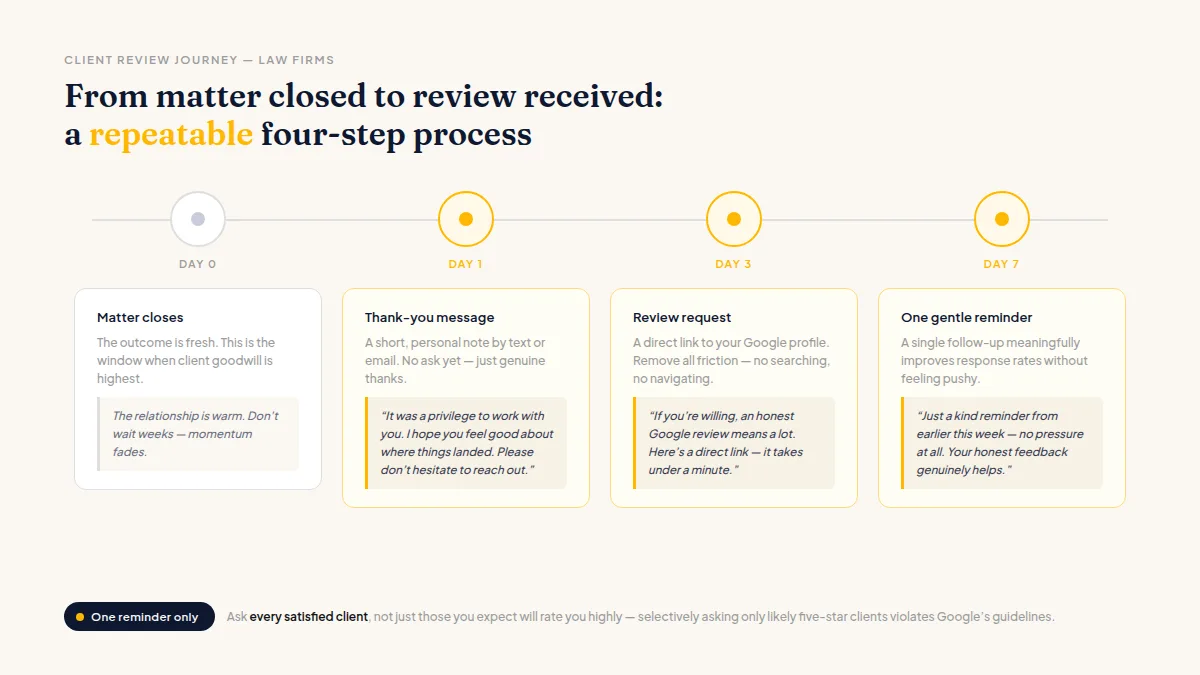
Timing matters. Many attorneys find that asking for a review shortly after a matter closes — while the outcome is fresh — gets better response rates than waiting weeks. A short, personal message by text or email with a direct link to your Google profile removes all friction. Don't make the client search for where to leave the review.
A few practical habits for how to get more client reviews as a lawyer:
- Ask every satisfied client, not just the ones you're certain will leave five stars. Selectively asking only happy clients violates Google's guidelines.
- Use a direct review link, not a homepage link that requires the client to navigate anywhere.
- Send one follow-up reminder — a single reminder meaningfully improves response rates without feeling pushy.
- For clients who mention a minor frustration, a private feedback channel lets them raise it directly with you — but always make clear they can still post publicly if they prefer.
The firms that build a real review base do it with a repeatable process, not a one-time push.
Frequently Asked Questions
Can lawyers ask clients for Google reviews?
Yes — asking clients for honest reviews is fine. What's not allowed is offering any incentive (discounts, gifts, anything of value) in exchange for a review, or selectively soliciting only clients you expect will rate you highly.
Does responding to law firm reviews help with Google rankings?
Google encourages responding to reviews, and review engagement is widely considered a local-ranking signal. More practically, a firm that responds to every review — including critical ones — looks more trustworthy to prospective clients reading those responses.
What review sites matter most for attorneys?
Google is the top priority for local search visibility. Avvo is particularly important in legal because many clients search it specifically. Yelp, Facebook, and directories like Martindale-Hubbell and Lawyers.com matter depending on your practice area and geography.
Is review gating legal for law firms?
No. Routing unhappy clients to a private feedback form is only compliant if every client can still leave a public review if they choose. Using a filter to prevent negative reviews from appearing publicly violates Google and Yelp's guidelines.
Do I need to check AI-drafted review replies for bar compliance?
Yes, every time. No review management software checks your replies against your state bar's advertising or ethics rules — that's your responsibility before anything goes live.
Can review management software post replies to Avvo or legal directories?
It depends on the platform. Most tools, including HiFiveStar, can post replies directly to Google once your location is connected. For directories where direct posting isn't supported, you'll typically copy the drafted reply and post it manually on that platform. Confirm reply-posting capabilities for each specific directory with any vendor you're evaluating.



Ready to Take Control of Your Online Reputation?
Join thousands of local businesses using HiFiveStar to get more reviews and grow faster.