Negative Review Response Templates for Any Business
Use these negative review response templates to reply professionally to unhappy customers across any business type — and protect your online reputation.
TL;DR: Responding to negative reviews promptly and professionally is one of the highest-leverage reputation moves you can make — research from Harvard Business Review found that replying to reviews led to a measurable increase in overall ratings. These templates give you a ready-made starting point for restaurants, salons, clinics, home services, and more. Personalize each one to match your voice, acknowledge the issue specifically, and invite the customer to resolve it offline.
A one-star review sitting on your Google profile is not a crisis — it's a test. Prospective customers read your response just as carefully as they read the complaint, and how you handle it tells them more about your business than the review itself. Most owners either fire back defensively or paste in a hollow corporate apology that makes things worse. What you actually need is a set of ready-to-use negative review response templates you can grab, personalize in sixty seconds, and publish — so you respond fast, stay professional, and move on.
Why Your Response to a Negative Review Matters More Than the Review
Your response is public, permanent, and read by people who haven't bought from you yet. According to Uberall (2023), businesses that reply to at least 32% of their reviews see a measurably higher average rating than those that don't engage at all. A thoughtful response to a complaint signals to every future reader that you take problems seriously.
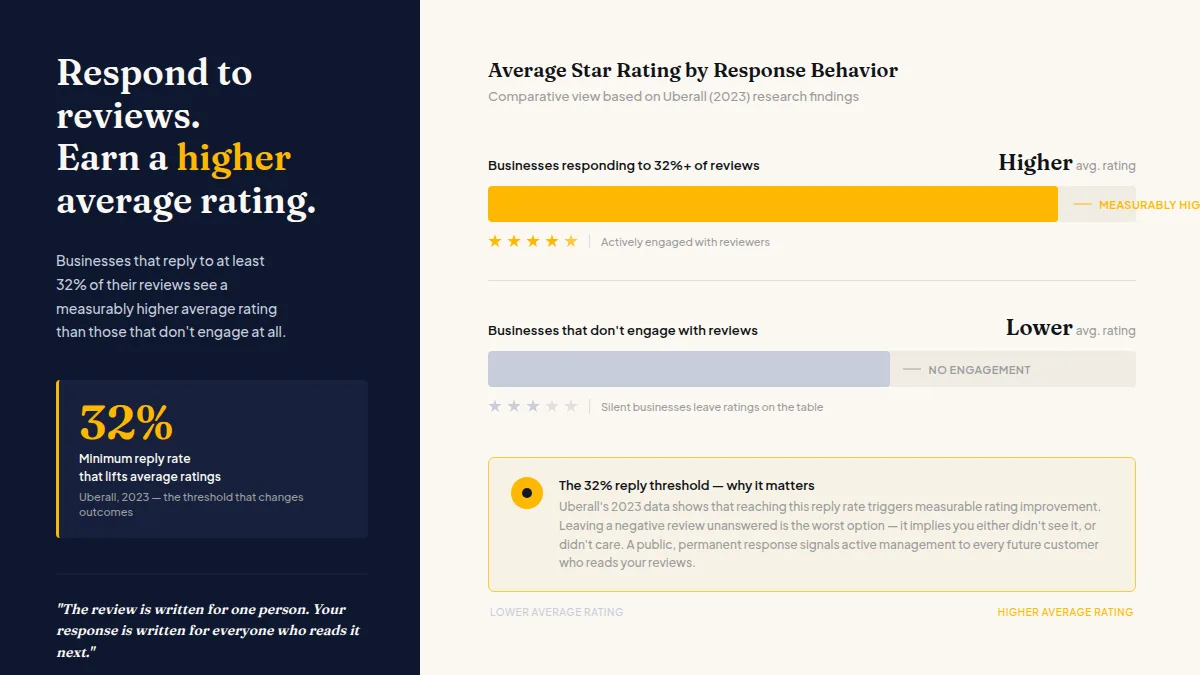
The review is written for one person. Your response is written for everyone who reads it next.
When you respond well, you accomplish three things at once: you give the unhappy reviewer a fair hearing, you demonstrate accountability to future customers, and you create a record that shows your business is actively managed. Leaving a negative review unanswered is the worst option — it implies you either didn't see it or didn't care.
Negative Review Response Templates You Can Use Today
These templates cover the situations local businesses run into most often. Pull one, replace the bracketed parts with real specifics, and keep the tone natural. Never copy-paste without editing — customers can tell immediately when a response is canned.
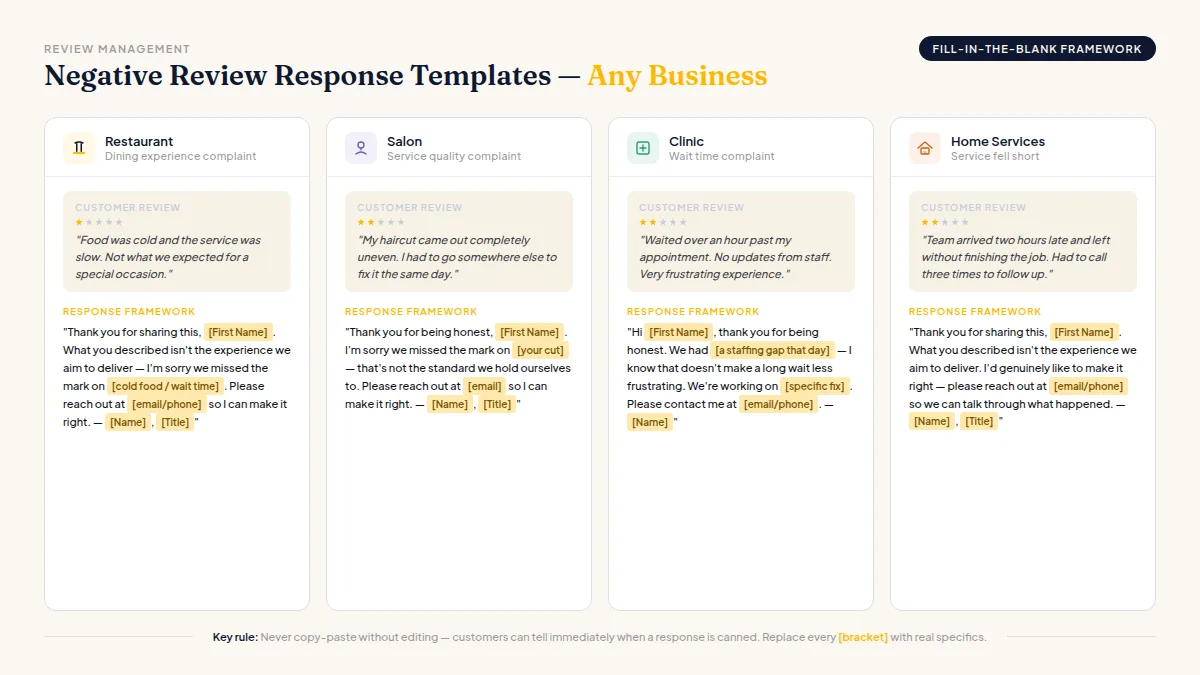
Template 1 — Service fell short (restaurant, salon, clinic, any service business)
"Thank you for taking the time to share this, [First Name]. What you described isn't the experience we aim to deliver, and I'm sorry we missed the mark on [specific issue]. I'd genuinely like to make it right — please reach out to me directly at [email/phone] so we can talk through what happened. — [Your Name], [Title]"
When this works best: Use this as your default for any complaint where you don't yet know the full story. The open-ended invitation to connect privately lets you gather details before committing to a specific remedy.
What it looks like in practice: A salon owner responding to a complaint about an uneven haircut might write: "…I'm sorry we missed the mark on your cut — that's not the standard we hold ourselves to. Please reach out to me at [email] so I can make it right for you." That specificity ("your cut," not "your experience") shows the owner actually read the review.
Template 2 — Wait time or staffing complaint
"Hi [First Name], thank you for being honest with us. We had [a busier-than-usual afternoon / a staffing gap that day], and I know that doesn't make a long wait any less frustrating. We're working on [specific fix, e.g., adjusted scheduling / an online booking system]. If you're willing to give us another chance, I'd love to make sure your next visit goes much better."
What separates a good version from a weak one: Naming the actual fix ("we've added a second technician on Saturday afternoons") performs far better than vague promises to "do better." It tells the next reader that you diagnosed the root cause and acted on it.
Template 3 — Quality complaint (food, product, workmanship)
"I appreciate you telling us, [First Name]. The [dish / product / work] you received should have met a higher standard, and it clearly didn't. Please contact us at [contact info] — we want to understand exactly what went wrong and make it right for you."
Situational note: If the quality issue is something that can vary (a dish that's normally well-reviewed, a product from a single bad batch), say so briefly and without sounding defensive: "This dish consistently earns praise, which makes your experience even more important to understand." That context reassures future readers without dismissing the complaint.
Template 4 — Rude staff complaint
"Thank you for bringing this to my attention directly. I'm sorry your interaction with our team felt [dismissive / unhelpful / unprofessional] — that's not how we want anyone to feel in our [shop / office / restaurant]. I've already spoken with the team about this. Please reach out to me personally at [contact info] if you'd like to discuss further."
Why "I've already spoken with the team" matters: This phrase does real work. It tells future readers that a manager saw the complaint and acted — not just acknowledged it. Businesses that include a concrete corrective action in their response consistently convert skeptical readers better than those that only apologize.
Template 5 — Reviewer seems to have the wrong location or mistaken identity
"Hi [First Name], thank you for the feedback. After looking through our records for [date range], I don't believe we have a visit on file matching your description — it's possible this review may be for a different location. If I'm wrong, please reach out at [contact info] and I'll sort this out immediately."
Important: Keep your tone genuinely open to being wrong. A response that reads as accusatory ("we have no record of you ever visiting") will alienate future readers even if you're correct. The goal is to invite contact, not win an argument.
For a deeper walkthrough of the thinking behind these structures, the guide on how to respond to negative reviews covers the full framework.
Do this on autopilot
HiFiveStar answers every review in your voice — so your profile always looks cared for.
How to Respond to Negative Reviews Without Sounding Defensive
The fastest way to turn a bad review into a bigger problem is to argue facts in public. Even when the reviewer is wrong, winning the argument online costs you more than conceding the point graciously. These rules hold across every business type:
- Acknowledge before you explain. Never open with "Actually…" or "Our policy states…"
- Keep it short. Three to five sentences is enough. Long responses read as defensive.
- Move the conversation offline. Offer a direct contact — email or phone — so resolution happens privately.
- Use the reviewer's first name once if it appears in the review. It signals you actually read it.
- Name something concrete. What changed, what you'll check, what you're offering — vague sympathy does less than a specific next step.
- Never match their tone. If they're angry, you're calm. Every time.
Responding within 24 hours is a reasonable target. Reviews left unanswered for several days feel more permanent to readers browsing your profile — the complaint sits there as the last word. If volume makes it hard to keep up, tools that draft responses in your voice (like HiFiveStar's AI reply drafting) can cut response time significantly without sacrificing authenticity.
Handling Negative Feedback Before It Becomes a Public Review
The most effective reputation strategy isn't just crafting good responses — it's giving dissatisfied customers a fast, private way to raise concerns before they head to Google. A well-designed feedback flow asks every customer how their experience went, then routes anyone who had a problem to a direct resolution channel.
One important compliance note: platforms like Google and Yelp prohibit "review gating" — you cannot filter which customers get asked for a public review based on their satisfaction level. Every customer must have the opportunity to leave a public review if they choose. The compliant approach is to ask all customers for feedback and give unhappy ones an easy way to contact you privately so you can resolve the issue quickly — not to block them from posting publicly.
When you fix a problem fast, many customers update their review or return. Those who don't at least feel heard, and your public response demonstrates that to everyone reading later.
For businesses also focused on building review volume, pairing this with effective review request templates keeps the pipeline of positive feedback healthy alongside your response work.
Frequently Asked Questions
Should I respond to every negative review?
Yes. Every unanswered complaint signals indifference to future customers. Even a brief, professional reply is better than silence.
How long should a negative review response be?
Three to five sentences is the right range — enough to acknowledge the issue, apologize, and offer a next step, but not so long that it reads like a legal defense.
Can I ask Google to remove a fake or mistaken negative review?
You can flag a review that violates Google's policies (spam, conflict of interest, off-topic content) for removal, but Google does not remove reviews simply because you disagree with them. Respond professionally while you pursue the flag.
What's the right tone for a negative review response template?
Direct, calm, and specific. Avoid generic phrases like "we're sorry you feel that way" — they read as dismissive. Reference the actual issue and name a concrete next step.
How quickly should I respond to a negative review?
Within 24-48 hours where possible. Faster responses show attentiveness; delays make the complaint feel more permanent to readers browsing your profile.
Does responding to bad reviews actually help my local ranking?
Google encourages businesses to respond to reviews, and review engagement is widely considered a local-ranking signal. The clearest documented benefit, however, is on conversion: people choose businesses that respond over those that don't.

Ready to Take Control of Your Online Reputation?
Join thousands of local businesses using HiFiveStar to get more reviews and grow faster.