Why Customers Leave Reviews for Competitors (Fix It)
Customers leave reviews for competitors when you never ask. Learn why it happens and how to ask every customer before they review someone else.
TL;DR: Customers default to whoever asks them first — and if you never ask, a competitor who does gets the review instead. The fix is simple: ask every customer right after the visit or job, make it one tap, and repeat it consistently so your happy customers never drift to someone else's Google listing.
Why Customers Review the Business Down the Street Instead of Yours
Your competitor has 340 Google reviews. You have 47. You've been open longer, your work is better, and your customers tell you that to your face — yet their reviews go elsewhere. The reason almost always comes down to friction and timing, not loyalty or preference.
When a customer finishes a meal, a haircut, or a plumbing job, they have roughly a 20-minute window where the experience is fresh enough to motivate action. Your competitor has made it effortless to act inside that window. You haven't. That's fixable.
The Real Reason Why Customers Leave Reviews for Competitors
The answer is almost never that customers like your competitor more. According to a BrightLocal survey (2023), 57% of consumers say they'd leave a review if asked — but only 20% say businesses actually ask them. The gap between those two numbers is where your competitor lives.
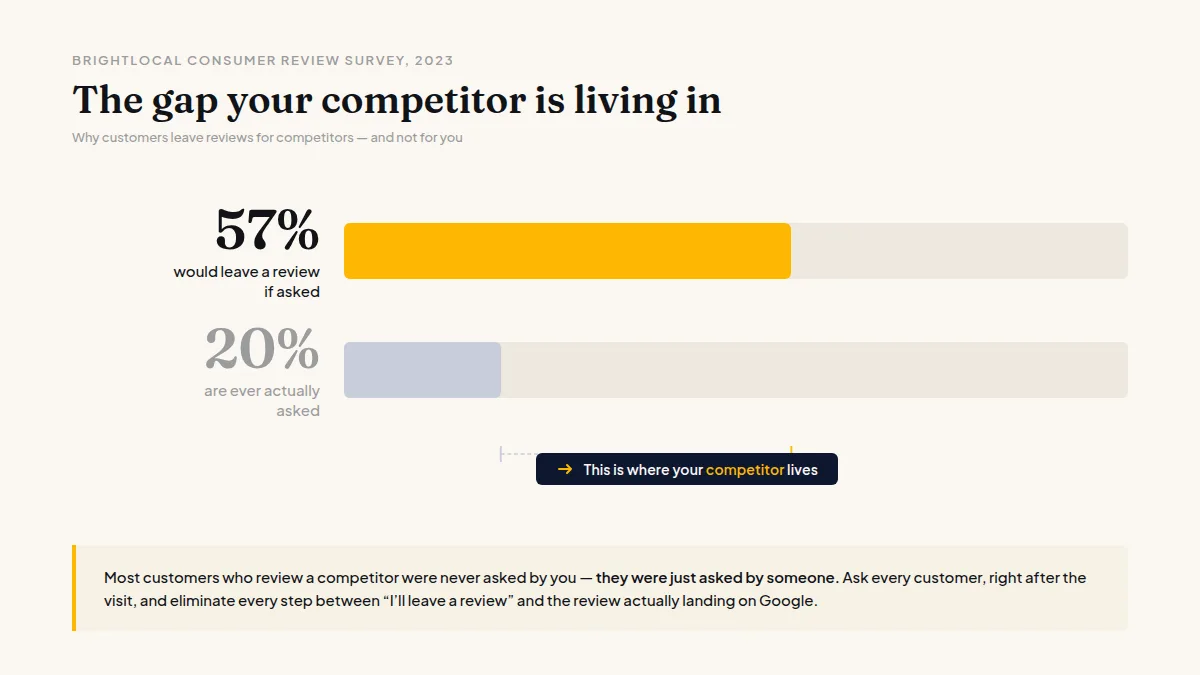
Most customers who review a competitor were never asked by you — they were just asked by someone.
Competitors who rack up reviews faster usually do two things: they ask every single customer, and they eliminate every step between "I'll leave a review" and the review actually landing on Google. A short link or QR code at checkout, on a receipt, or in a follow-up text gets customers directly to the Google review box. Your customers mean to leave a review, lose momentum, and never return to it.
Timing is the other half. Asking right after the visit — while the customer is still at the register, in the chair, or standing in the driveway after a job — consistently outperforms a follow-up two weeks later. The experience is vivid. The motivation is there. Wait, and it fades.
Do this faster
HiFiveStar asks every customer after their visit — so more of the happy ones actually leave a review.
You're Making It Too Hard to Leave a Review
If your review process requires a customer to find you on Google, search your business name, scroll to the reviews section, click "Write a review," sign in to their Google account, and then type something — most won't finish. Not because they don't want to, but because they hit a wall at step three.
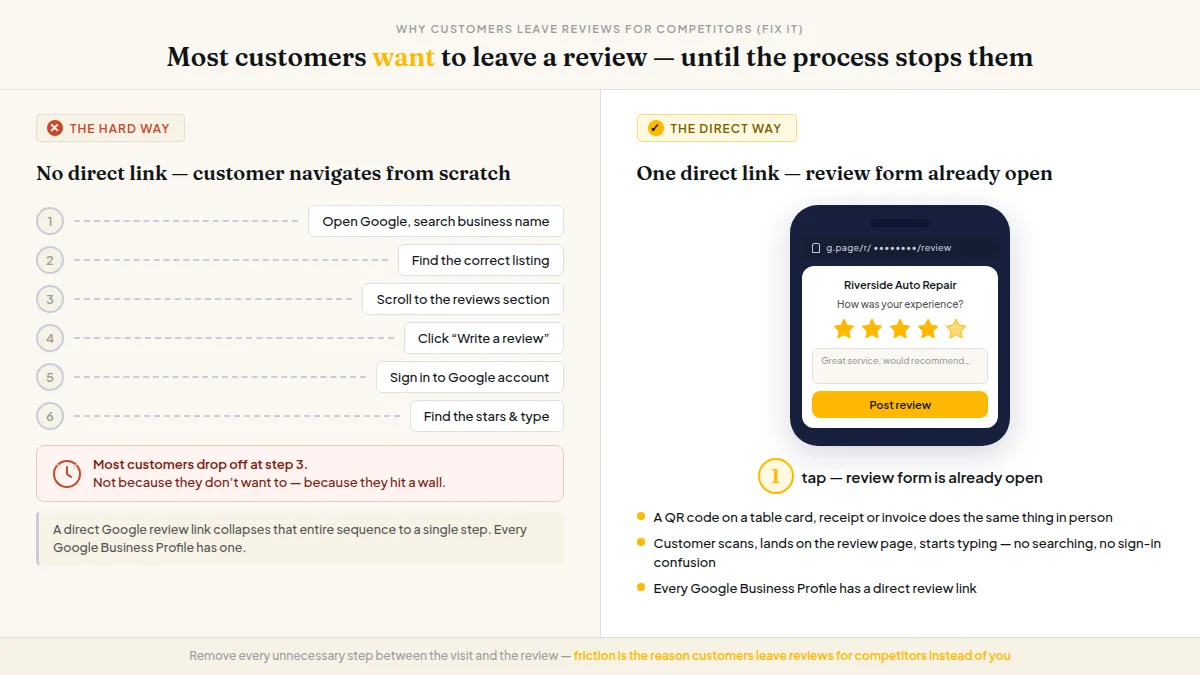
A direct Google review link collapses that entire sequence to a single step. Every Google Business Profile has one. Beyond Google, there's a broader question of where customers actually go to leave reviews — and making sure you're easy to find on the platforms that matter for your industry.
A QR code on a table card, receipt, invoice, or technician's business card achieves the same thing in person. The customer scans, lands on the review page, and starts typing. No searching, no sign-in confusion, no dead ends.
If building and maintaining this feels like a lot, a solid review request strategy for local businesses typically starts with automating the ask and the link delivery — so results don't depend on staff remembering to say the right thing on every shift.
Ask Every Customer — Not Just the Ones You Think Will Say Something Nice
Here's where many businesses quietly undercut themselves: they ask selectively. They ask the customer who complimented the food on the way out, or the client who gave glowing feedback mid-appointment. They skip the ones who seemed neutral.
That selectivity is both strategically wrong and, in some forms, against platform rules. Google does not allow businesses to screen customers before asking or to request only positive reviews. Yelp goes further — their policy asks businesses not to solicit reviews at all, so keep Yelp off your request flow entirely and let those customers find you naturally.
The practical fix is to build asking into every transaction by default. Not "when the vibe is right" — every customer, every time. Automated review requests by text or email after each visit remove the judgment call entirely. Someone pays or checks out; the message goes out. No staff discretion required, no customers accidentally skipped.
What about customers who had a bad experience? Ask them too — and include a private feedback option alongside your review links. Anyone who wants to flag something directly has a path to do it, while every customer still sees the option to leave a public review. Google prohibits any setup designed to route unhappy customers away from public reviews entirely, so the feedback form complements the review links rather than replacing them.
Build a Process That Makes Review Growth Automatic
One-off efforts don't compound. Sending a batch of requests when you remember to — or asking only during a slow month — produces a spike and then silence. Competitors who pull ahead consistently have made the ask part of their daily operation, not a periodic campaign.
A repeatable process looks like this:
- Send a review request by text or email within a few hours of every completed job or visit
- Include one link that opens your Google review page (or a general review landing page if you want to cover multiple platforms)
- Keep the message short — one sentence explaining why reviews help you, then the link
- Follow up once, a few days later, if the first message wasn't opened
- Never offer rewards, discounts, or any incentive for a review — Google and Yelp prohibit it, and customers who notice it lose trust
Businesses that sent 20 or more review requests in their first 90 days using HiFiveStar went from an average of 11 new Google reviews to 23 — not because they did anything unusual, but because they asked consistently and removed friction. That's the entire mechanic.
If you want to see how your review count compares to competitors in local search, tools in this local rank checker roundup can show you where you stand before and after you tighten your process.
Frequently Asked Questions
Why do customers leave reviews for competitors but not for me?
Usually because a competitor asked them first, or made it easier. Most customers who leave a review do so right after the experience, when asked directly — if no one asks, the motivation fades fast.
How do I get more customers to leave Google reviews?
Send a direct Google review link immediately after each visit by text or email, and ask every customer — not just the ones you think are happy. Cutting friction is what moves the number.
Is it okay to ask customers for reviews on every review site?
For Google, yes. For Yelp, no — Yelp's support policy explicitly asks businesses not to solicit reviews, so leave Yelp out of your request flow. You can still display your Yelp page ("Find us on Yelp") without directing people there to review.
Can I offer a discount or gift card to get more reviews?
No. Google and Yelp prohibit any incentive — gifts, discounts, points, prize draws — in exchange for a review. Ask for the review on its own, and thank customers for their time without attaching a reward.
How quickly should I send a review request after a visit?
Asking within a few hours of the visit, while the experience is still fresh, consistently gets the best response. Waiting several days lowers the chance the customer follows through.
Does having more Google reviews help my local ranking?
Review volume and engagement are widely considered signals in Google's local ranking algorithm, though Google hasn't published a definitive breakdown of how much each factor weighs. More reviews, responded to regularly, generally supports visibility — but no tool or tactic guarantees a specific ranking outcome.


Ready to Take Control of Your Online Reputation?
Join thousands of local businesses using HiFiveStar to get more reviews and grow faster.