How to Write a Review Google Actually Rewards
Learn how to write a highly recommended review that Google rewards, with real examples and simple formulas any customer can follow.
TL;DR: Google favors reviews that mention specific details — the service, staff name, location, and outcome — over vague praise like 'great place.' A strong review tells a short story: what the customer needed, what happened, and how it turned out. Share this page or a printed formula with customers so the reviews they leave naturally work harder for your ranking.
What Makes a Review "Highly Recommended" in Google's Eyes
Here's what separates a review that works from one that sits idle: content. According to Whitespark's 2023 Local Search Ranking Factors survey, review signals — quantity, recency, and substance — rank among the top factors for Google Map Pack placement. A one-liner like "Great place, 5 stars" still counts, but a review that names a service, mentions a staff member, describes a situation, and lands on a clear outcome works significantly harder.
Knowing how to write a highly recommended review starts with understanding what Google is actually doing: reading text to decide whether a review is genuine and useful. It can't read minds. It can read "Maria at the front desk stayed fifteen minutes late to help us sort the billing" and extract meaning from it. Vague praise gives it almost nothing to work with.
The reviews Google rewards read like a recommendation from a friend, not a caption on a trophy.
The Four-Part Formula Your Customers Can Actually Use
Most customers default to short reviews because they don't know what to say — they stare at a blank box and give up. Share this framework when you ask. It removes the paralysis.
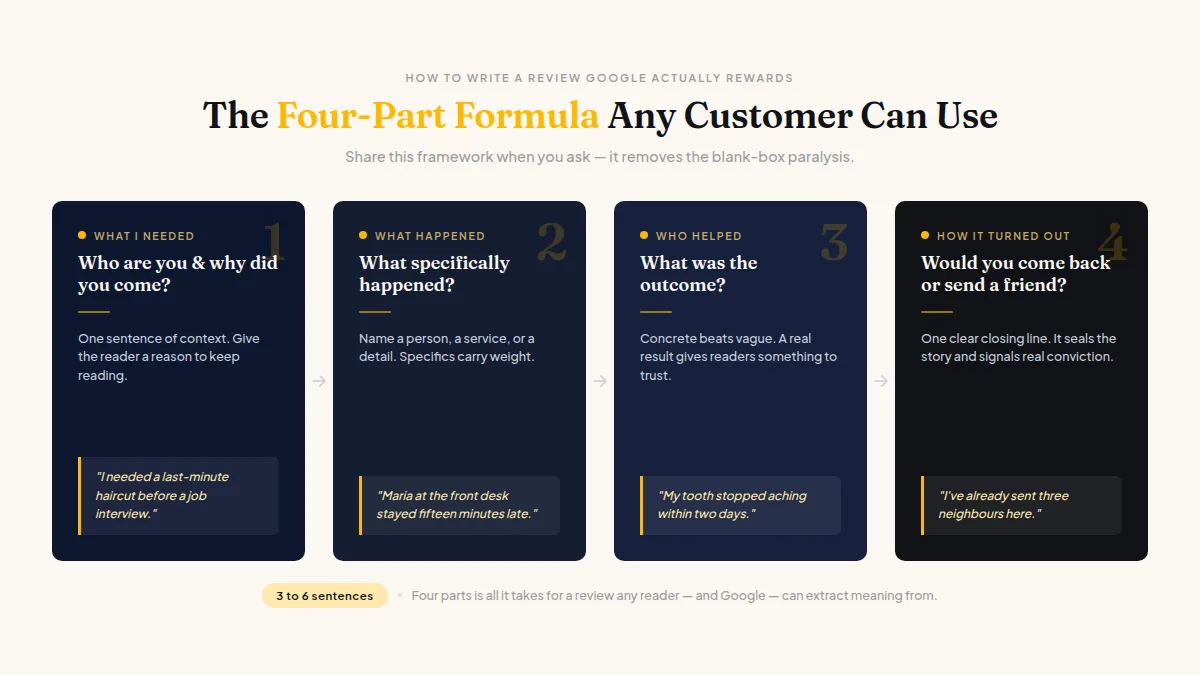
1. Who are you and why did you come? One sentence of context. "I brought my golden retriever in after he ate something he shouldn't have" or "I needed a last-minute haircut before a job interview."
2. What specifically happened? Name a person, a service, or a detail. "Maria at the front desk stayed fifteen minutes late" or "The mechanic explained the brake issue on video before touching anything."
3. What was the outcome? Concrete beats vague. "My tooth stopped aching within two days" beats "It was great."
4. Would you come back or send a friend? One clear closing line. "I've already sent three neighbours here" or "This is the only salon I'll use now."
Four parts, three to six sentences, and the result is a review any reader — and Google — can extract meaning from. For more review examples across different business types, that collection breaks down what works industry by industry.
Do this faster
HiFiveStar asks every customer after their visit — so more of the happy ones actually leave a review.
Real Examples: Before and After
Side-by-side comparison is the fastest way to see what actually makes a review effective.
Restaurant — Before: "Food was delicious and service was fast. Will come back!"
Restaurant — After: "Came in on a Sunday with my parents visiting from out of town. Our server, Jake, walked us through the specials without rushing us. My mum ordered the lamb shoulder and said it was the best she'd had since visiting Greece. Portions are generous and the place was full but quiet enough to actually talk. Already booked a table for next month."
Home services — Before: "Good job. On time. Would recommend."
Home services — After: "Had a blocked drain that two other plumbers couldn't fix. Called these guys on a Thursday morning and Tom was at the house by 2pm. He found the problem in the crawl space, showed me photos on his phone, and had it sorted in about an hour. He also flagged a small issue nearby and didn't push me to fix it on the spot — just said to keep an eye on it. Transparent, fast, no surprise charges on the invoice."
Both second versions name a person, anchor a context, describe a specific detail, and end with a clear outcome. If you're in home services, how other contractors approach the ask shows more compact examples that still hit all four points.
How to Ask for a Detailed Review Without Writing It for Them
This is the step most owners skip, and it's where the most value walks out the door. Customers don't need a request — they need a prompt.
Tell them, right after the visit or job:
- "If you have a minute, mentioning what you came in for and what the result was really helps people who haven't been here before."
- "Even two or three sentences makes a big difference."
- "Mentioning [staff member's name] by name means a lot to the team."
You're not writing the review for them. You're giving them a starting point. Google's policies require that reviews reflect genuine customer experience — customers writing their own words, prompted or not, is exactly that.
One practical note on platform rules: Yelp asks businesses not to solicit reviews at all (Yelp Support, "Don't Ask for Reviews"), so keep your requests pointed at Google and platforms that explicitly welcome them.
Ask every customer — not just the ones you believe had a positive experience. Consistently requesting feedback from all customers is both the compliant approach under Google's review policies and the more sustainable one. Cherry-picking only presumed happy customers violates those policies and skews your review profile in ways that can backfire.
If you want a system for sending requests and tracking responses, review management software handles the follow-up so it stops living on your to-do list.
What to Do Once the Reviews Arrive
Getting better reviews is half the work. How you respond to them is the other half — and most businesses underestimate it.
Respond to every review, positive or negative, within 48 hours. Build it into a daily routine alongside checking messages, or it won't happen consistently. For positive reviews, name something specific the reviewer mentioned: "Glad Tom could sort that drain so quickly" lands better than "Thank you for your kind words." For negative reviews, keep it short, don't argue, and move the conversation offline with a direct contact.
One calm, professional reply to a critical review often does more for a prospective customer's confidence than ten five-star reviews — it shows a real person is running the business.
Review engagement is widely considered a local-ranking signal. A business with 50 replied-to reviews will generally outperform one with 200 ignored ones, all else being equal.
Frequently Asked Questions
How long should a Google review be to be effective?
Three to six sentences is the sweet spot — specific enough to be useful, short enough that most customers will actually write it. A single sentence still helps, but it won't carry as much weight in search summaries or convince an undecided reader the way a detailed account does.
Can I tell customers exactly what to write?
Share a prompt or framework — ask them to mention the service and the outcome — but don't write the review for them or offer to do so. Google requires reviews to reflect the customer's genuine experience in their own words.
Does responding to Google reviews help rankings?
Google encourages responses, and review engagement is widely considered a local-ranking signal. Beyond ranking, a response signals to prospective customers that someone is paying attention — which influences their decision.
Should I ask every customer, or just the ones who seemed happy?
Ask every customer. Google's review policies require that businesses not selectively solicit only positive feedback — doing so violates those guidelines and undermines the integrity of your review profile. Asking consistently after every visit or job is both the compliant and the more sustainable approach.
What details make a review more credible?
Specific names, dates, services, and outcomes. "The hygienist explained each step" is more credible than "great staff." A reviewer who mentions a real detail — a product, a specific problem solved, a person by name — reads as genuine to both Google and to customers scanning before they choose.
How do I get customers to write more without sounding pushy?
Give them a one-line prompt at the moment of asking: "If you mention what you came in for and how it went, it really helps people who haven't been here before." That's not pushy — it's useful. It solves the blank-page problem that stops most people before they start.



Ready to Take Control of Your Online Reputation?
Join thousands of local businesses using HiFiveStar to get more reviews and grow faster.