How to Handle a Fake or Unfair Review on Your Business
Got a fake or unfair review hurting your reputation? Learn how to flag, respond, and protect your business without making things worse.
How to Tell If a Review Is Fake or Just Unfair
A one-star review from someone who was never your customer can tank your rating overnight. Before you do anything else, figure out exactly what you're dealing with — because a fake review and an unfair review require different responses.
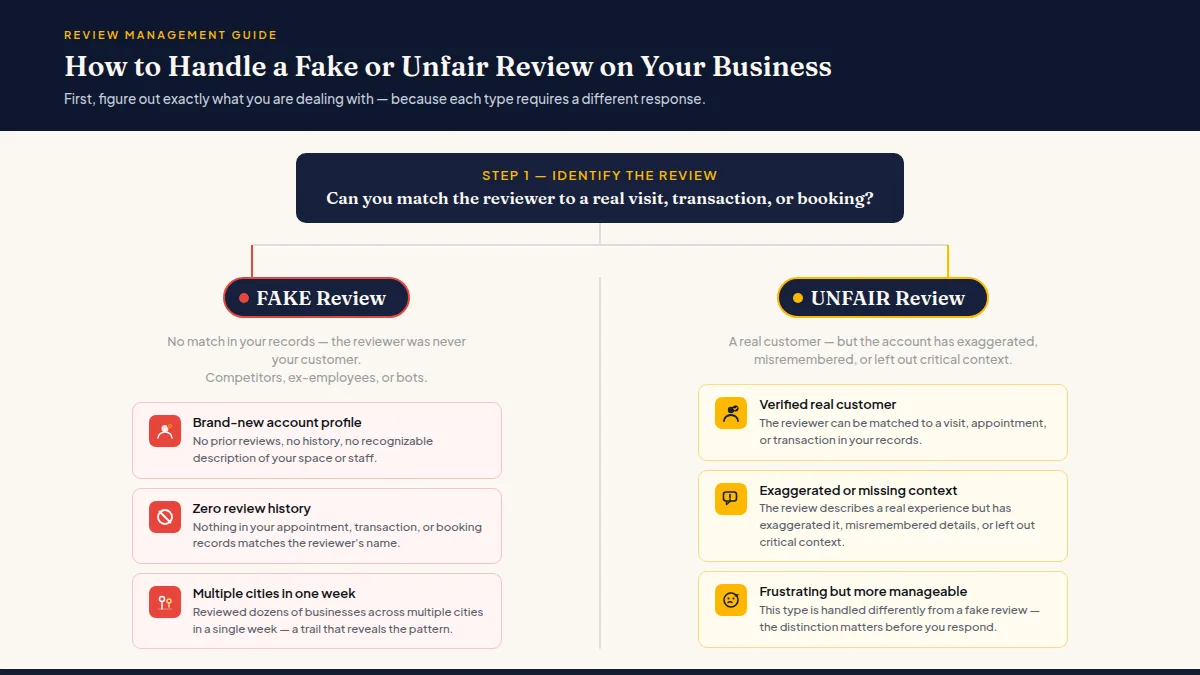
A fake review comes from someone who never set foot in your business: a competitor, a disgruntled ex-employee, or a bot. An unfair review comes from a real customer who experienced something but has exaggerated, misremembered, or left out critical context. The distinction matters.
Check your records first. Can you match the reviewer's name to an appointment, transaction, or booking? If nothing comes up — no visit date, no order, no recognizable description of your space or staff — that's a red flag. Also look at the reviewer's profile: a brand-new account with no other reviews, or one that has reviewed dozens of businesses across multiple cities in a single week, is suspicious. Fake reviewers often leave a trail once you look.
If the review describes a real but exaggerated experience, you're dealing with an unfair review instead — frustrating, but more manageable, and handled differently.
What to Do First When You Spot a Suspicious Review
Before anything else, document everything. Screenshot the review with the date visible. If you flag it and the platform removes it, you'll want that record. If it stays up, you'll need it for any follow-up.
Then resist the urge to fire off an angry reply. A defensive or hostile response makes your business look worse to every future customer who reads it — and they will read it. Potential customers judge your reaction as much as the review itself.
Your response to a bad review is a public message to every future customer, not just the person who wrote it.
For reviews you believe are fabricated, use both tools available to you — flagging and responding. Don't wait to see if one works before trying the other. Run them in parallel.
Do this faster
HiFiveStar drafts a reply to any review in seconds — so your profile always looks cared for.
How to Flag a Review on Google (and Other Platforms)
When you flag a review on Google, you're submitting it for review by Google's team. The process: open Google Maps, find your business profile, locate the review, click the three-dot menu next to it, and select "Report review." Choose the reason that fits — "Conflict of interest" covers competitor attacks and fake reviewers; "Spam" or "Off-topic" may apply in other cases.
A few honest caveats: Google's removal process is slow and the outcome is not guaranteed. Google does not remove a review simply because you asked — it must violate their content policies. You may need to follow up through Google Business Profile support if flagging alone doesn't resolve it. For high-stakes situations — a coordinated attack, multiple fake reviews appearing at once — escalate via Google's support chat or submit a legal removal request if the content is defamatory.
On Yelp, flag the review from your business owner account, but be aware that Yelp's review filter can be erratic. It sometimes removes genuine reviews while leaving suspicious ones standing. Yelp's review practices create real headaches for small businesses in ways worth understanding before you invest significant time in appeals.
Facebook, TripAdvisor, and other platforms all have their own flagging workflows through their business owner dashboards. The core principle is the same everywhere: you're reporting a policy violation, not requesting removal of a review you simply disagree with.
How to Respond to False or Unfair Reviews Professionally
Responding publicly to a false review is not about winning an argument — it's about showing future customers that your business is professional and trustworthy. Here's a framework that works:
- Acknowledge without admitting fault. "We take every review seriously and looked into this carefully."
- State verifiable facts, briefly. "We have no record of a visit matching this description, and we'd welcome the chance to look into it directly."
- Invite offline resolution. Provide a name and direct contact — phone or email — so readers can see you're open to dialogue.
- Keep it short. Three to five sentences maximum. Long defensive replies signal panic.
For unfair reviews — ones from real customers with real grievances, even if wildly out of proportion — lead with genuine empathy before anything else. Acknowledge what they experienced, even if you see it differently, then offer to make it right offline. You're not going to change that reviewer's mind in a public reply, but you can absolutely change the mind of the next hundred people who read the thread.
How you respond to reviews is part of a larger picture of how your business shows up online — one worth managing deliberately.
Build a Review Base That Puts One Bad Review in Context
One fake or unfair review does serious damage when it sits among only a handful of total reviews. The same review is barely a blip when you have 80 genuine ones surrounding it. The single most effective way to protect your reputation when learning how to handle a fake review is to make collecting real reviews a consistent habit — not a panic response after something goes wrong.
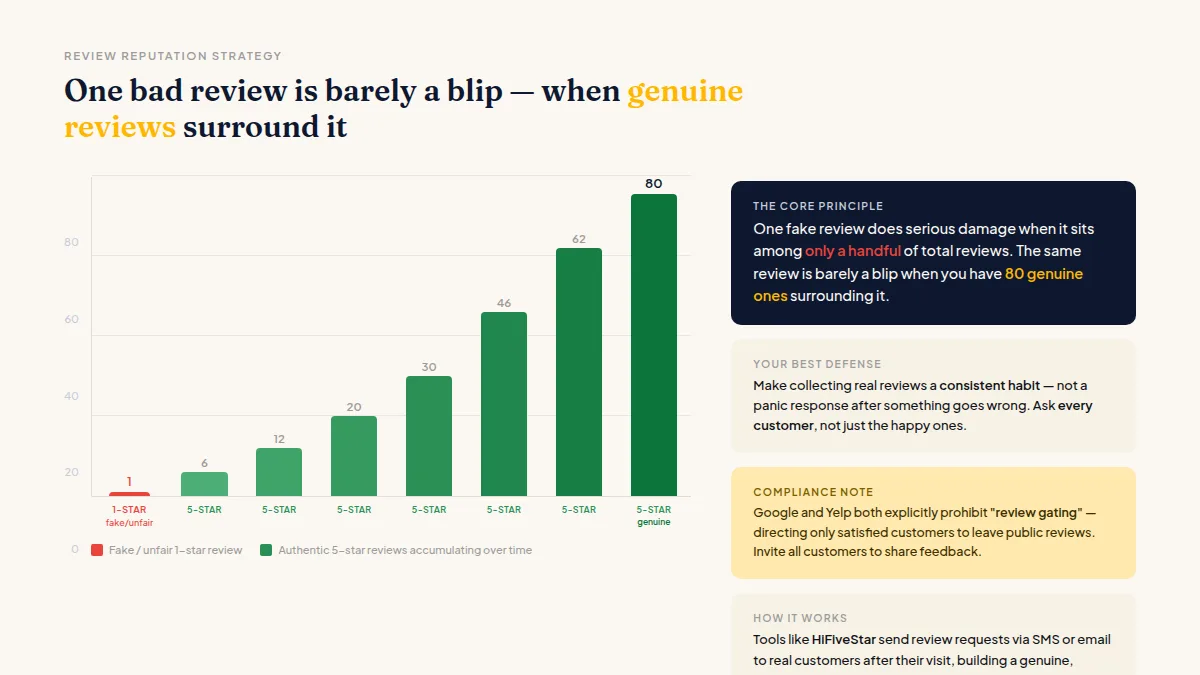
Ask every customer, not just the happy ones. This matters for compliance reasons too: Google and Yelp both explicitly prohibit "review gating" — directing only satisfied customers to leave public reviews while steering unhappy ones elsewhere. The right approach is to invite all customers to share feedback. Put a fast, private way to reach you beside the review link, never in front of it, so someone who had a poor experience can tell you directly — and never block anyone from posting a public review if they choose to.
Tools like HiFiveStar send review requests via SMS or email to real customers after their visit, building a genuine, steady stream of reviews over time. When a fake or unfair review appears, a strong base of authentic feedback is your most durable defense — one no flagging process or public response can fully substitute for.
Frequently Asked Questions
Can Google actually remove a fake review?
Yes, but only if it violates Google's content policies — spam, conflict of interest, and off-topic content are the most commonly enforced categories. Flagging is the first step; follow up via Google Business Profile support for cases that don't resolve quickly.
How long does it take Google to remove a flagged review?
It varies — anywhere from a few days to several weeks — and Google may decide not to remove it at all. Document everything and continue following up through official support channels if the review clearly violates policy.
Should I respond to a review I think is fake?
Yes. A calm, factual response protects your reputation with future readers while the flagging process plays out. Note that you have no record of the experience, invite direct contact, and keep it brief.
What counts as an "unfair" review versus a fake one?
A fake review is from someone who was never your customer. An unfair review comes from a real customer but may be exaggerated, misleading, or missing context. Respond to both — but only flag reviews that appear to violate platform policies, not simply ones you disagree with.
Does responding to reviews help my local search ranking?
Review engagement — including owner responses — is widely considered a positive signal for local search visibility, though Google hasn't confirmed the exact weight it carries. Responding consistently is good practice regardless.
Can I sue someone for leaving a fake review?
In clear cases of defamation — false statements of fact causing measurable harm — legal action is possible, but it's expensive and slow. Most business owners get more practical value from flagging, responding professionally, and building a larger base of genuine reviews than from pursuing legal remedies.
Ready to Take Control of Your Online Reputation?
Join thousands of local businesses using HiFiveStar to get more reviews and grow faster.