Best Review Management Software for Lawyers
Discover the best review management software for lawyers to win more clients, build trust online, and handle Google reviews from one simple inbox.
TL;DR: Lawyers need review management software that collects feedback from Google, Avvo, and other directories, makes it easy to respond professionally, and helps prompt satisfied clients to leave reviews. Look for a tool with a unified reviews inbox, a simple way to request reviews after a matter closes, and AI-assisted reply drafts so responses stay polished without eating into billable time.
What Makes Review Management Different for Law Firms
Most law firms don't have a system for collecting and responding to client reviews — they rely on the occasional happy client who remembers to leave one. That's a problem. A prospective client comparing two family law attorneys in the same city is going to pick the one with more recent, detailed Google reviews. The firm without a consistent process for asking loses that client quietly, every time.
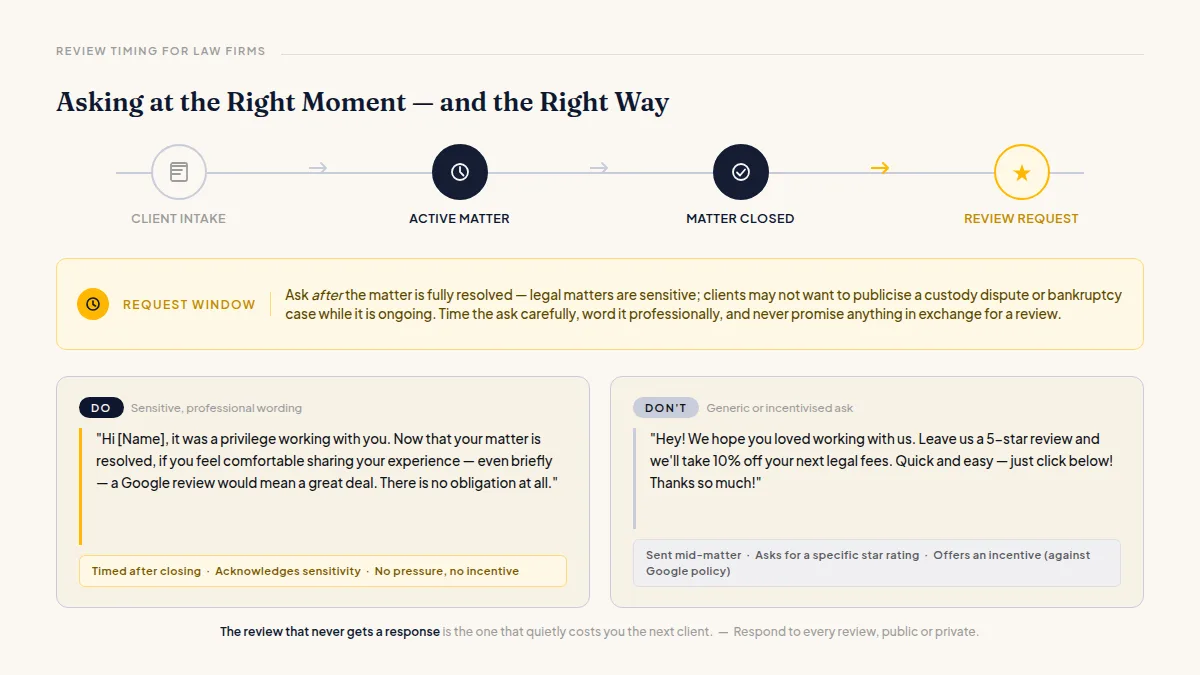
What separates review management for law firms from managing reviews for a restaurant is the client relationship. Legal matters are sensitive. Clients may not want to broadcast that they hired a bankruptcy attorney or went through a custody dispute. Review requests need to be timed carefully, worded professionally, and must never promise anything in exchange for a review. When a negative review lands — fair or not — your response is public, and other prospects are reading it.
The right legal practice reputation software handles all of this without creating extra work for your front desk or paralegals.
What to Actually Look for in Review Management for Law Firms
Look for software that collects reviews from the platforms that matter most to attorneys — primarily Google, but also Yelp and other directories — routes unhappy clients toward a private resolution channel before they default to a one-star post, and lets you respond from one place.
The review that never gets a response is the one that quietly costs you the next client.
Here's what to prioritize when evaluating options:
- Multi-platform monitoring. Google reviews for attorneys carry the most local SEO weight, but clients also check Yelp and other directories. You want every review in one inbox, not six browser tabs.
- Review requests via text, email, or WhatsApp. After a case closes or a consultation wraps, a timely request dramatically outperforms hoping clients remember on their own. Requests sent within a day or two of service completion consistently get higher response rates than those sent a week later.
- A private feedback path — used correctly. You can give unhappy clients a fast, private channel to share concerns before they post publicly. This is compliant when you ask all clients for feedback and never block anyone from leaving a public review — that option must remain open to everyone. The goal is resolution, not suppression.
- AI-assisted reply drafts. Responding to client reviews as a lawyer requires care — you can't confirm someone was your client or disclose anything about their matter. An AI draft gives your team a starting point faster, but a human reviews it before it posts.
- No built-in ethics or compliance checking. No mainstream review management tool verifies that your replies comply with your state bar's advertising rules. That responsibility stays with your firm before any reply goes live.
Do this faster
HiFiveStar drafts a reply to any review in seconds — so your profile always looks cared for.
The Best Review Management Software for Lawyers: Top Options to Consider
The best review management software for lawyers comes down to fit: how many locations you manage, whether you need automation, and how hands-on your team can realistically be. Here's how the main options compare.
HiFiveStar is built for local businesses — including law firms — and covers the full review workflow without enterprise pricing. Every plan pulls reviews from Google, Yelp, Glassdoor, Indeed, and several other supported directories into one inbox. Each location gets a review link and QR code that send clients to Google and 30-plus other review sites. The optional star filter routes low-star feedback to a private form that always includes a path to leave a public review, keeping you on the right side of Google's guidelines. Paid plans add review requests by text, email, and WhatsApp with no volume cap, AI reply drafts in the client's language, and analytics. On higher tiers, automatic review requests can trigger through Stripe, Zapier, or Make when a client pays — useful if your practice management software connects to those tools. Approved replies post directly to Google from the dashboard; for other platforms, you copy and paste the draft. Current pricing is listed on the HiFiveStar pricing page.
Birdeye and Podium are larger platforms with broader feature sets including webchat and payment tools. That scope makes them more expensive and more complex to configure. They suit multi-location firms or larger practices with dedicated operations staff. For a solo attorney or small firm, you'll pay for features you won't use.
Grade.us and ReviewTrackers are built for agencies managing multiple client accounts rather than a single firm running its own reputation. If you're operating the software yourself, the interface adds overhead that doesn't serve you.
For a broader comparison across business types, the roundup of best reputation management software for 2025 covers how these tools stack up in more depth. If your firm handles healthcare-adjacent matters, the breakdown of reputation management software for medical clinics is a useful parallel for seeing how another regulated industry approaches this.
How to Get More Reviews for a Law Firm Without Overcomplicating It
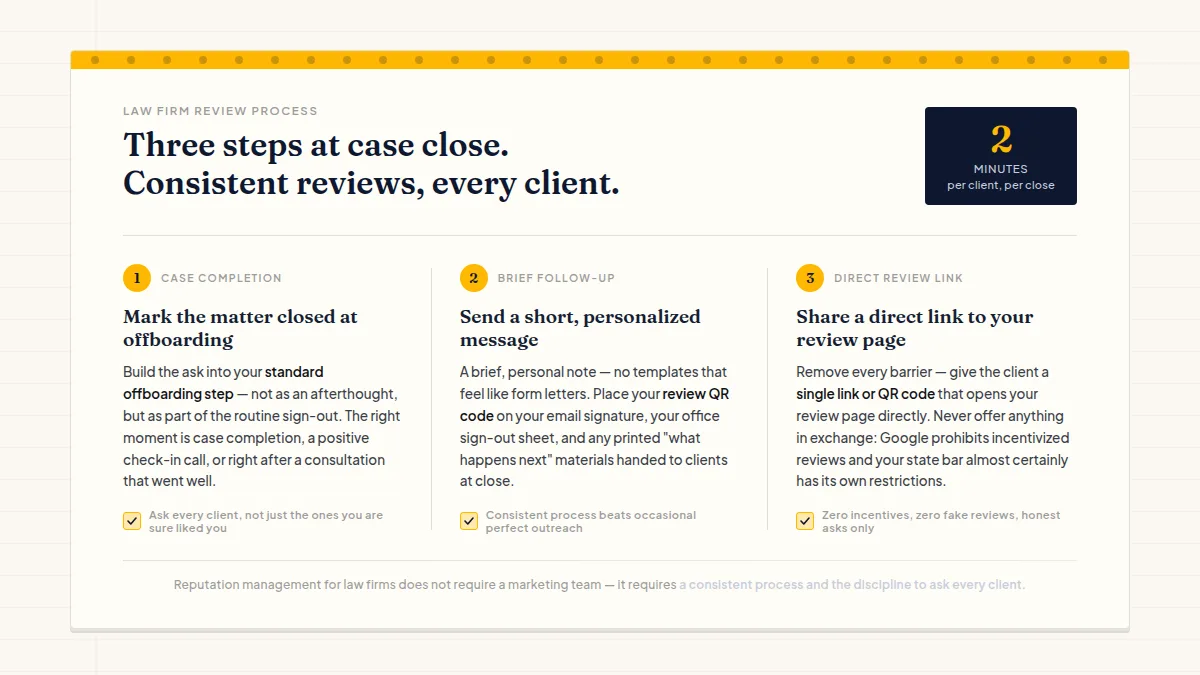
The single most effective thing you can do is ask every client, consistently, at the right moment — case completion, a positive check-in call, or right after a consultation that went well. Firms that build this into a standard offboarding step generate far more reviews than those who wait for clients to volunteer one.
A few practical moves:
- Put your review QR code on your office sign-out sheet, your email signature, and any printed "what happens next" materials you hand clients at close.
- If you use Stripe for payment processing and are on a higher paid plan, you can trigger review requests automatically when a client pays — no manual follow-up needed.
- Never offer anything in exchange for a review. Google prohibits incentivized reviews outright, and your state bar almost certainly has its own restrictions on client solicitations and testimonials.
- When responding to a critical review, acknowledge the concern without admitting fault or confirming representation. Keep it brief and professional — other prospects weigh your reply as much as the original review.
Law firm online reputation management doesn't require a marketing team. It requires a consistent process, a tool that runs quietly in the background, and the discipline to ask every client — not just the ones you're sure liked you.
Frequently Asked Questions
Can a law firm ask clients for Google reviews?
Yes — attorneys can ask clients for honest Google reviews, as long as you don't offer anything in exchange and don't selectively ask only happy clients. Google prohibits incentivized and gated reviews, and your state bar may have additional advertising rules that apply to testimonials.
Is it okay to filter reviews so unhappy clients don't post publicly?
No. Routing all clients to a private feedback option first is compliant; blocking unhappy clients from leaving a public review is not. Every client must still have the option to post publicly. The goal of a private feedback channel is faster resolution, not suppression.
Can a lawyer reply to reviews without violating attorney-client privilege?
Yes, but carefully. Avoid confirming that someone was your client, and never disclose anything about their matter. A short, professional acknowledgment that reveals no case details is the standard safe approach — and always read your reply before it posts.
Which review sites matter most for attorneys?
Google is the highest priority for local search visibility. Yelp is commonly checked for legal services alongside other general directories. A good monitoring tool consolidates the platforms your clients actually use so you're not logging into each one separately.
Does responding to Google reviews help a law firm's local ranking?
Google encourages businesses to respond to reviews, and review engagement is widely considered a local-ranking signal — though Google hasn't published a precise formula. Consistent responses, recent reviews, and review volume all appear to influence how your listing performs in local search.
How often should a law firm ask for reviews?
Ask after every completed matter where the client had a positive experience — not on a calendar schedule, but tied to natural client milestones. Consistent, timely asks outperform occasional bulk requests every time.



Ready to Take Control of Your Online Reputation?
Join thousands of local businesses using HiFiveStar to get more reviews and grow faster.