Build a Daily Review Request Habit for Your Team
Learn how to build a daily review request habit into your team's routine so you collect more real customer reviews consistently and grow your online reputation.
Why Most Teams Never Build a Consistent Review Habit
Most local businesses get a burst of reviews when they first sign up for a review tool, then the numbers slowly flatline. The tool didn't fail — the habit did. Getting more customer reviews consistently isn't about finding a magic script or a better platform. It's about making the ask feel as automatic as handing over a receipt.
The good news: habits are easier to build into a team routine than most owners expect, once you stop treating review requests as a marketing task and start treating them as a customer service step.
How to Build a Review Request Habit That Actually Sticks
The core of how to build a review request habit is simple: attach the ask to something your team already does every single day — and remove every decision point that creates friction. If your staff has to remember to ask, they won't. If the process takes more than ten seconds, it won't survive a busy Friday night.
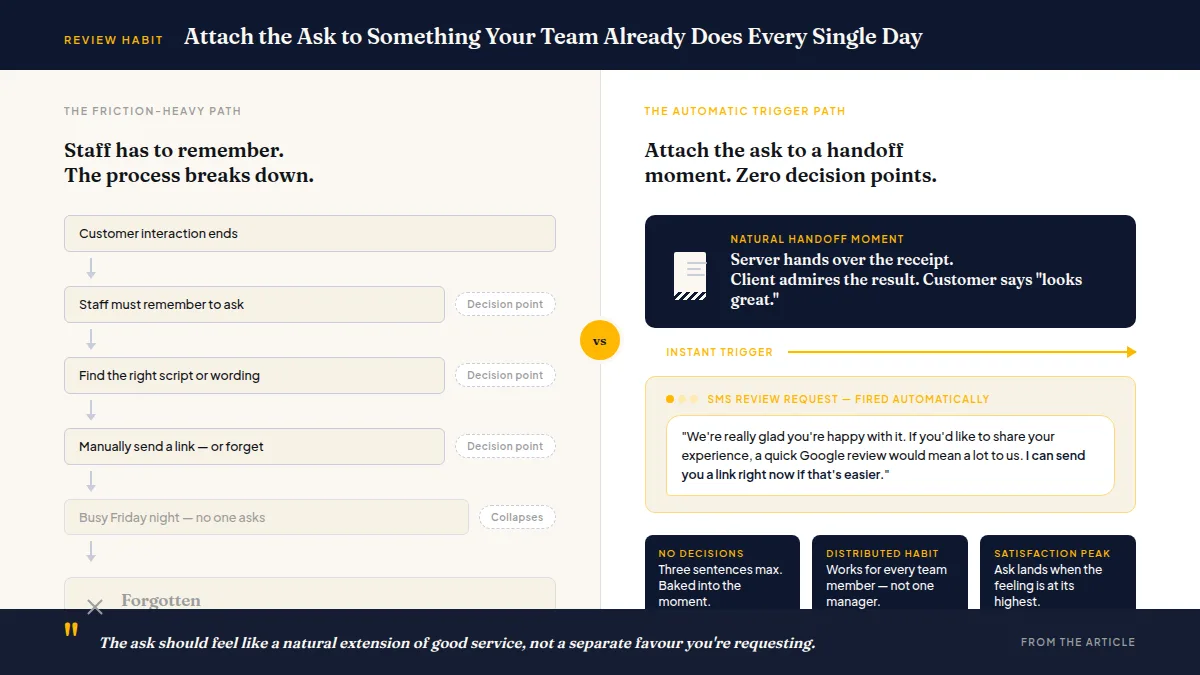
Start by identifying your natural handoff moments — the point every customer reaches when a visit or job ends. For a restaurant, that's when the server brings the check. For a salon, it's when the client is at the front desk paying. For a home-services company, it's the moment the technician finishes the job. These moments happen with every customer, and they pass in seconds.
Once you've identified yours, build a micro-script — three sentences maximum — that every team member uses at that moment. Something like: "Thanks so much for coming in today. If you'd like to share your experience, a quick Google review would mean a lot to us. I can send you a link right now if that's easier." That last line is the key: offer to do the legwork for them.
The ask should feel like a natural extension of good service, not a separate favour you're requesting.
Do this faster
HiFiveStar drafts a reply to any review in seconds — so your profile always looks cared for.
Make It a Team Habit, Not One Person's Job
Review generation routine for local businesses tends to collapse when it falls on one manager or one enthusiastic employee. When that person is off sick, the reviews stop. The fix is to distribute the habit across your whole team and bake it into onboarding from day one.
A few practical ways to do this:
- Add it to your closing checklist. If your team already runs through a checklist at the end of a shift (cleaning tasks, cash-up, etc.), add "review requests sent today: Y/N" as a line item. It takes two seconds to check off and two seconds to notice when it's missing.
- Set a team goal, not an individual one. "We're aiming for 10 new reviews this month" creates shared accountability. Posting the current count somewhere visible — a whiteboard in the break room works fine — keeps it top of mind without pressure.
- Include it in new-hire training. When asking customers for reviews every day is presented as standard practice from someone's first week, it never feels awkward or optional. It's just what the team does.
- Debrief briefly at team meetings. A 90-second weekly check-in ("We got 4 reviews this week — here's what customers said") closes the feedback loop and reminds everyone the habit is worth keeping.
Use Tools to Reduce the Friction to Zero
Even a perfectly trained team will let the habit slip on a chaotic day. The best defence is to make the ask happen automatically, so human memory isn't the last line of defence.
SMS and email review requests — sent shortly after a transaction or appointment — mean the ask goes out even on the days your team is slammed. In practice, many businesses find that a prompt sent within 15-30 minutes of the service, while the experience is still fresh, tends to get the best response. A follow-up 24-48 hours later can catch customers who missed the first message.
Tools like HiFiveStar (on Pro) let you automate these requests so they go out consistently without your staff having to do anything differently in the moment. The team's job becomes simply completing the job well and capturing the customer's contact detail — the system handles the timing and the ask. That's a realistic review generation routine for local businesses that need to keep staff focused on service rather than marketing admin.
One important note: always ask all your customers for feedback, not just the ones you think are happy. Giving every customer a fast private channel to flag an issue, right beside the review link, is good service. But the goal is resolution, not suppression. Every customer must still be free to leave a public review, and platforms like Google and Yelp prohibit selectively routing customers based on expected sentiment. For more on building a reputation that holds up long-term, review management software's role in a positive online reputation is worth understanding before you build your process.
Track the Right Number (and Celebrate Small Wins)
Most teams lose momentum because they never see the connection between asking and results. Tracking one simple metric — new reviews per week — makes that connection visible and keeps the habit alive.
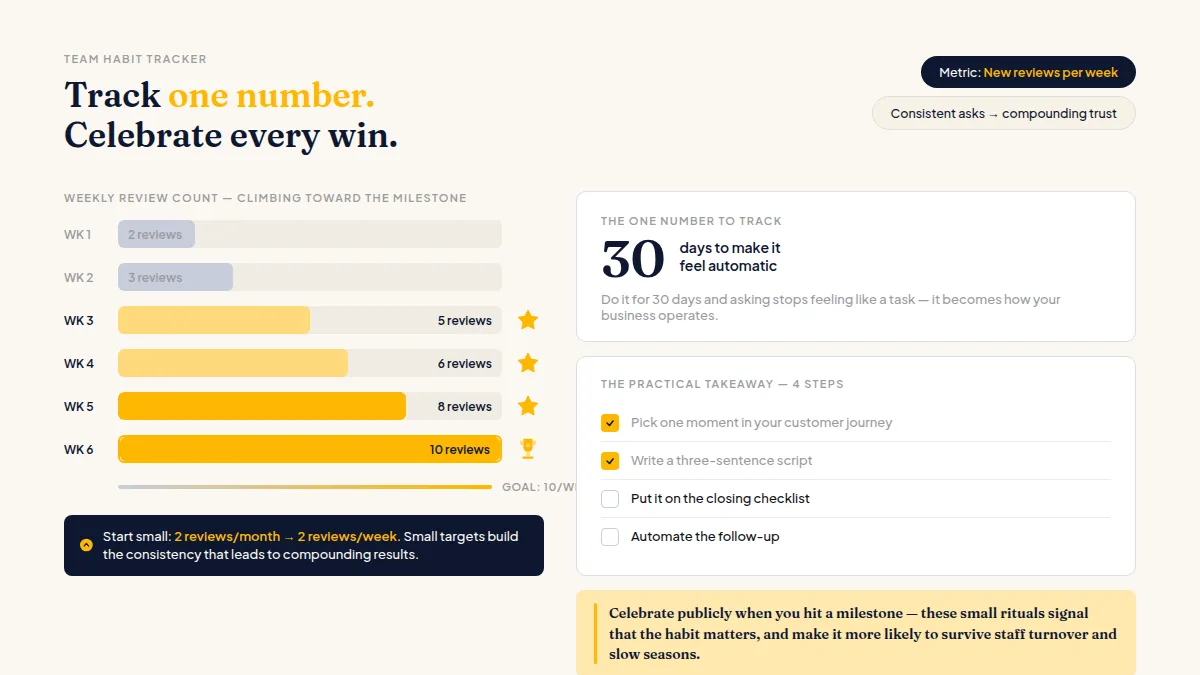
Don't set the bar too high at the start. If you currently get two reviews a month, aim for two a week before you aim for ten. Small, achievable targets build the consistency that leads to compounding results over time. A steady approach to online reputation management pays off not in a single month but across years of accumulated trust.
Celebrate publicly when you hit a milestone. Print out a standout review and stick it in the break room. Mention it in a team meeting. These small rituals signal that the habit matters — and that makes it more likely to survive staff turnover and slow seasons.
The practical takeaway: pick one moment in your customer journey, write a three-sentence script, put it on the closing checklist, and automate the follow-up. Do that for 30 days, and asking customers for reviews every day will stop feeling like a task and start feeling like part of how your business operates.
Frequently Asked Questions
How often should we be asking customers for reviews?
Aim to send a request after every completed transaction or appointment — not just occasionally. Consistency is what builds a steady review volume over time; sporadic asks produce sporadic results.
What's the best time to ask a customer for a review?
In practice, many businesses find the best results come from asking while the experience is still fresh — within a few hours of the service, or at the moment of handoff. A follow-up message 24-48 hours later can catch customers who didn't respond the first time.
Is it against the rules to only ask happy customers for reviews?
Yes. Google, Yelp, and other major platforms prohibit "review gating" — selectively soliciting reviews based on expected sentiment. You should invite all customers to leave feedback and make sure no one is blocked from posting a public review, regardless of their experience.
How do we get staff to actually follow through on asking?
Attach the ask to something they already do (a closing checklist, a handoff moment), keep the script short, and track results as a team. Individual reminders rarely stick; team accountability and visible progress do.
How many reviews does a local business actually need?
There's no single magic number, but a consistent flow of recent reviews matters more than a large total count from years ago. Freshness signals to both customers and search engines that your business is active and well-regarded.
Do automated review request tools really work for small teams?
Yes — and for small teams they often work better than manual asks, because they remove the reliance on staff memory. The team focuses on delivering a great experience; the tool handles the follow-up timing and message.



Ready to Take Control of Your Online Reputation?
Join thousands of local businesses using HiFiveStar to get more reviews and grow faster.