Best Review Management Software for Lawyers
Discover the best review management software for lawyers to collect, monitor, and respond to client reviews across Google, Yelp, and more.
TL;DR: Lawyers need review management software that pulls client feedback from multiple platforms into one place, makes it easy to ask satisfied clients for reviews, and helps craft professional replies — without risking compliance headaches. The right tool automates the busywork so attorneys can focus on cases, not chasing ratings. Look for a platform that covers Google and other key directories, offers private feedback routing, and flags every review the moment it lands.
What Makes Review Management Different for Law Firms
A prospective client searching "divorce attorney in [city]" isn't choosing between lunch spots — they're about to hand someone their most stressful problem. Before they call, they read your reviews. According to the American Bar Association's 2023 Legal Technology Survey Report, 35% of lawyers had a search-optimized website, but far fewer actively managed their online reviews. That gap is where firms lose clients they never knew they had.
The other wrinkle: legal ethics rules vary by state, and some bar associations have specific guidance on soliciting testimonials. Before you build any review-request workflow, check your state bar's advertising rules. No software — including any option below — reviews your replies for compliance. That responsibility stays with you.
What to Look for in the Best Review Management Software for Lawyers
The best review management software for lawyers needs to handle what generic tools often miss: monitoring across Google, Yelp, and niche legal directories; a clean way to request reviews after a matter closes; and the ability to respond without logging into five separate tabs.
The firm that responds to every review — positive or negative — signals professionalism before a prospect has dialed.
Here's what to evaluate before committing to any platform:
- Multi-site monitoring. At minimum, Google. Beyond that, consider Yelp, Glassdoor (for recruiting), and Indeed.
- Text and email requests. A short text sent within 48 hours of a case closing gets read. An email follow-up a few days later catches the rest.
- A single review link. One link routing clients to your Google listing — or 30-plus other sites — removes every friction point.
- Reply drafting. Writing a calm, professional response to a one-star review at 9 p.m. after a day in court is genuinely hard. AI-drafted replies give you a starting point you edit before posting.
- Private feedback handling. A private channel lets dissatisfied clients reach you before they post publicly. Critically: this never blocks a client from leaving a public review. You're giving them a faster path to resolution — nothing more.
- Simplicity. You're running a law practice, not a marketing department. Setup should take 20 minutes, not 20 hours.
Do this faster
HiFiveStar drafts a reply to any review in seconds — so your profile always looks cared for.
Top Options Worth Considering
The market for law firm reputation management software runs from lightweight review tools to full enterprise platforms. Here's how the categories break down:
Dedicated review management tools like HiFiveStar are built for local businesses — including law firms — and focus on the core loop: monitor, request, reply. Every plan (including the free-forever plan) pulls Google, Yelp, Glassdoor, Indeed, and more into one inbox, and gives each location a review link and QR code. Paid plans add review requests by text, email, and WhatsApp, AI reply drafts in the client's language, and — on higher plans — automatic requests triggered when a matter closes through integrations like Stripe or Zapier. One honest note: HiFiveStar does not post replies to Yelp or other non-Google platforms. You draft the reply, copy it, and post it yourself. For a solo practitioner or small firm that wants something working without a dedicated marketing hire, it fits well.
Broad reputation platforms — covered in our best reputation management software roundup — offer competitor monitoring, multi-location dashboards, and deep integrations, but bring pricing and complexity that rarely fits a five-attorney firm.
Legal-specific directories like Avvo and Martindale-Hubbell run their own review systems. Third-party software generally doesn't manage them, but keeping those profiles current matters alongside your Google strategy.
For most small and mid-size firms, the right answer is a focused review management tool and a clean process — not an enterprise platform you'll use 10% of.
How to Get More Reviews for a Law Firm Without Violating Platform Rules
Timing and simplicity drive results. The window right after a matter closes — when the outcome is fresh and the client feels relief — is when they're most likely to act. Waiting weeks, or sending a generic blast, produces far lower response rates than a personal, timely ask.
A workable process:
- Send a request within 48 hours of a matter closing. Text gets opened faster than email for this type of message.
- Keep the ask short. One sentence on why reviews help, one link. Nothing else.
- Follow up once, three to seven days later, if there's no response. Don't chase beyond that.
- Ask every client — not only the ones you expect to be satisfied. Asking selectively is review gating, which Google explicitly prohibits. Ask everyone; let clients decide what to write.
- Respond to every review, including negative ones. A composed, professional reply to a one-star post often does more for your reputation than ten five-star reviews alone — because prospects read both.
For high-volume practices — family law, traffic defense, immigration — automating the request step when a matter closes or an invoice is paid keeps the pipeline consistent without adding to anyone's task list.
Legal Practice Review Monitoring: Staying on Top of What's Being Said
A review posted to Google on Friday afternoon can sit unanswered all weekend and be read by a dozen prospective clients before Monday morning. Effective legal practice review monitoring means having a system that catches it fast and routes it to the right person.
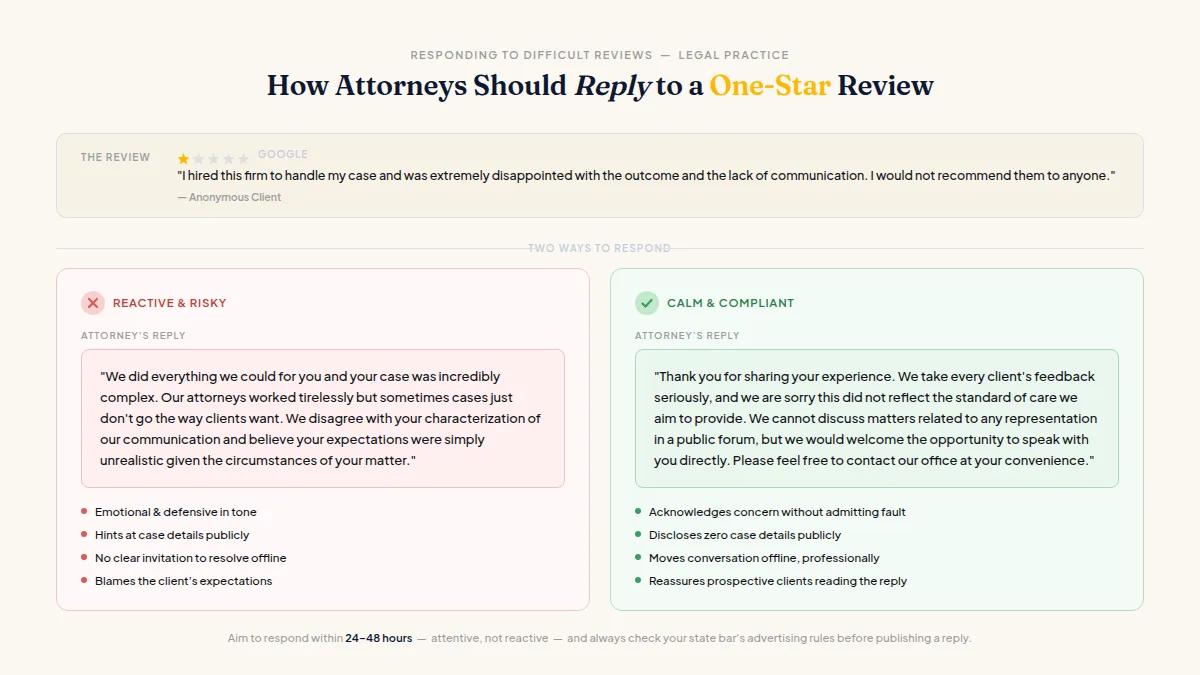
Practical monitoring looks like this:
- A single inbox aggregating Google, Yelp, Glassdoor, Indeed, and any other platform you track — so no one logs into five sites each morning.
- Clear reply ownership. In a multi-attorney firm, it must be explicit who drafts responses and who approves them before they go live.
- A consistent response window. Responding within 24–48 hours shows attentiveness without producing reactive replies to difficult reviews.
If your firm has multiple office locations, check whether the tool surfaces all locations' reviews in one view. HiFiveStar's Reviews screen does this without requiring a separate enterprise tier.
This challenge isn't unique to law — medical clinics face the same monitoring complexity, especially around sensitive feedback and multi-location practices.
Frequently Asked Questions
Can a law firm ask clients to leave Google reviews?
Yes. Asking clients for honest reviews is permitted under Google's policies, provided you ask all clients — not only those likely to be positive — and offer no incentive in exchange. Always check your state bar's advertising rules before building any review-request process.
Does review management software post replies to Google for you?
Some tools can, with conditions. HiFiveStar posts AI-drafted replies directly to Google once your location is connected. For Yelp, Glassdoor, Indeed, and other platforms, you draft the reply in the tool, then copy and post it yourself on that site.
What review sites matter most for law firms?
Google is the most important by a wide margin for local search visibility. Yelp matters in some markets. Glassdoor and Indeed affect recruiting. Avvo and Martindale-Hubbell are legal-specific and managed separately — most third-party review tools don't pull from them.
Is there a free option for law firm review management?
Yes. HiFiveStar's free-forever plan monitors Google, Yelp, Glassdoor, Indeed, and more in one inbox, and provides a review link and QR code for each location. Review requests by text or email and AI reply drafts are available on paid plans.
How many reviews does a law firm actually need?
There's no magic number, but volume and recency both affect how your listing appears in local search. A firm with 12 recent reviews typically looks more active than one with 50 reviews from four years ago. Consistent, ongoing requests matter more than a one-time push.
Can review management software check my replies for legal or ethical compliance?
No software does this reliably. You are responsible for ensuring every client-review reply follows your state bar's rules on confidentiality, advertising, and testimonials. Use AI-drafted replies as a starting point — always review before posting.
The short version: reviews are the first thing a prospective client reads about your firm, and the firms winning new business are the ones asking consistently, responding to everything, and monitoring without letting it consume their week. A focused tool built for local businesses handles that loop without the overhead of an enterprise platform — leaving you to practice law instead of managing dashboards.



Ready to Take Control of Your Online Reputation?
Join thousands of local businesses using HiFiveStar to get more reviews and grow faster.