Best Reputation Management Software for Restaurants
Compare the best reputation management software for restaurants—review requests, AI replies, and feedback gates to protect and grow your online reputation.
What Restaurant Reputation Management Software Actually Does
Most restaurant owners discover they need reputation management software the hard way — a slow Tuesday, a Google search of their own name, and a one-star review from six months ago sitting unanswered at the top of the results. That review is costing you covers right now.
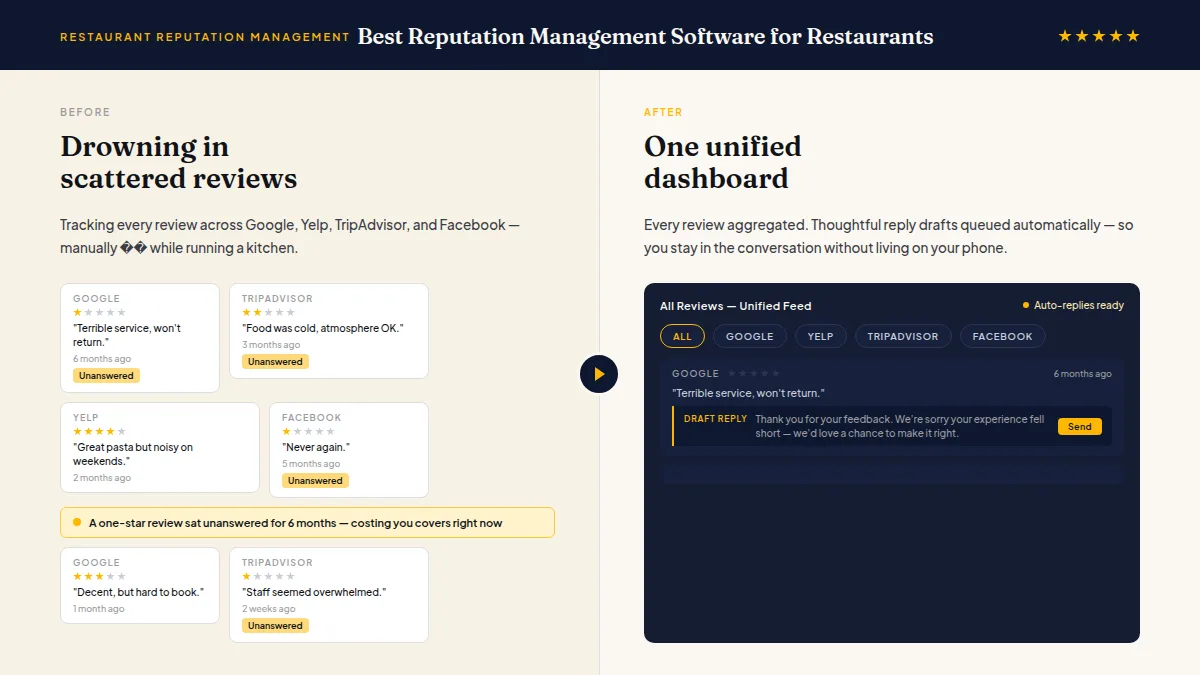
Restaurant review management software solves a specific problem: you have food to cook, staff to manage, and tables to turn. You cannot manually track every review across Google, Yelp, TripAdvisor, and Facebook, draft thoughtful replies, and still run a kitchen. The right tool automates the grunt work so you can stay in the conversation without living on your phone.
This article names the real contenders, what each is genuinely good at, and where each falls short — so you can pick the one that fits how your restaurant actually operates.
The Main Options for Online Reputation Management for Restaurants
These are the platforms restaurant operators actually use and compare. None of them are identical, and the best fit depends on your size, budget, and how much you want to handle yourself.
Birdeye is a full-featured platform built for multi-location businesses. It aggregates reviews from dozens of sources, runs surveys, and includes a webchat widget. If you own a restaurant group with five or more locations and need enterprise-level reporting, Birdeye is worth evaluating. For a single-location owner, the pricing and complexity tend to be overkill.
Podium started in messaging and built reputation features on top of that foundation. Its strength is two-way text conversations — payment via text, appointment reminders, and review requests in one thread. Restaurants that already use text-based customer service find it familiar. The tradeoff: the plan structure is built around that broader messaging suite, so you're often paying for features a restaurant doesn't need.
Grade.us and NiceJob both focus on automated review generation — good at sending follow-up sequences after a visit and nudging customers to post publicly. NiceJob in particular has a clean interface and honest positioning. If your only goal is review volume and you're comfortable handling replies manually, either can work.
Reputation.com targets enterprise and franchise brands. The reporting and competitive benchmarking are sophisticated. For an independent restaurant or small group, the onboarding overhead and contract structure rarely make sense.
Broadly and Swell sit in a similar mid-market space, combining messaging, reviews, and payments. Both work, both are priced for small businesses, and both handle the basics adequately without excelling at any single thing.
The category is crowded, but most tools are either built for enterprise clients or built for one narrow job. Very few are designed specifically around how a restaurant earns and manages trust.
For a wider comparison across business types, the best reputation management software for small businesses in 2025 covers the full field with more detail on pricing tiers.
Do this on autopilot
HiFiveStar answers every review in your voice — so your profile always looks cared for.
What to Actually Look for in a Restaurant Review Response Tool
Google review management for restaurants is non-negotiable: Google is where most diners decide whether to book. According to BrightLocal's 2024 Local Consumer Review Survey, 81% of consumers use Google to evaluate local businesses — more than any other platform. But a restaurant also lives on Yelp, TripAdvisor, and Facebook, so single-platform tools create dangerous blind spots.
Beyond platform coverage, here's what separates useful from annoying in this category:
- Review request timing. Asking for a review three days after a meal is too late. The best tools let you trigger a request via SMS or email within 15–30 minutes of a visit — when the experience is still fresh.
- Reply drafting, not just alerts. A notification about a new review is table stakes. A draft reply — one that sounds like your actual voice, not a corporate template — saves 10 minutes per review and dramatically increases how many you actually respond to.
- A private channel for unhappy guests. A compliant feedback approach asks every customer for feedback, then gives the ones who had a bad experience a fast, private way to reach you directly — before frustration turns into a public post. This is not about suppressing negative reviews. Every customer still has the freedom to post publicly, and that must always be the case. It's about giving unhappy diners a better option than venting on Google.
- Showcase capability. A widget that pulls your best reviews onto your own website converts hesitant visitors. It's a simple feature many platforms charge extra for or omit entirely.
For a feature-by-feature breakdown across the broader market, the best online reputation management software for businesses review goes deeper on how these capabilities compare across platforms.
Why HiFiveStar Fits Restaurants Specifically
HiFiveStar is built around the exact workflow a restaurant needs: ask real customers at the right moment, handle the response, and catch problems before they become public complaints. It monitors Google, Facebook, Yelp, TripAdvisor, and more from one inbox — so you're not toggling between tabs during a lunch rush.
The AI reply drafting is worth calling out specifically. You train it on your voice and your restaurant's personality, and it drafts responses you can post in one click or edit in 30 seconds. That's the practical difference between actually responding to reviews and meaning to respond to reviews.
The feedback gate works the right way: every customer gets asked, and every customer can still leave a public review on any platform they choose. Unhappy guests get a private message option to reach you first — which often turns a complaint into a resolved situation before it goes anywhere public. HiFiveStar's policy is explicit: zero fake reviews, ever. Real customers, real feedback.
There's a free-forever plan that lets you get started without a credit card conversation, and paid plans add higher request volume, more integrations, and advanced features as you grow. For a single-location restaurant deciding whether this category is worth it, starting free is the obvious move.
To see how HiFiveStar is specifically configured for restaurant workflows, the restaurant-focused page walks through the use case in detail.
How to Get More Restaurant Reviews Without Gaming the System
The most reliable way to get more restaurant reviews is to ask — promptly, personally, and every time. According to BrightLocal (2024), 57% of consumers say they would leave a review if asked. Most restaurants ask nobody, or ask inconsistently, which is why their review counts stagnate while a competitor who installed a request tool six months ago now has three times the volume.

A few things that work in practice:
- Tie the request to a specific moment. The best trigger for a restaurant is the point-of-sale interaction or the few minutes after the check is paid. An SMS sent within 15–30 minutes of a visit consistently outperforms one sent the next day.
- Make it one tap. Any friction — logging in, creating an account, hunting for the review page — kills completion. A direct link to your Google or Yelp review page is the only approach that works at scale.
- Respond to the reviews you already have. Replying to existing reviews signals to new customers that the owner is present and cares. It also signals engagement to search algorithms — review engagement is widely considered a local-ranking factor, even if Google hasn't documented the exact mechanics publicly.
Restaurant feedback management is not a one-time project. It's a system you set up once and run in the background — which is precisely what this software category exists to support. The restaurants pulling ahead on Google right now aren't doing anything mysterious: they're asking more customers, responding faster, and handling complaints before they go public.
Frequently Asked Questions
Does reputation management software work for single-location restaurants?
Yes, and it's often more impactful for a single location than for a chain. One location has one reputation to protect, and a handful of unanswered negative reviews can meaningfully hurt your search visibility. Most tools, including HiFiveStar's free plan, are practical for a single location from day one.
Is it against Google's rules to route unhappy customers away from leaving a public review?
Yes. Google explicitly prohibits "review gating" — selectively discouraging or blocking customers from posting public reviews based on whether their experience was positive. The compliant approach is to ask all customers for feedback and give unhappy ones a private channel to resolve the issue, while ensuring every customer can still post a public review freely.
What platforms should a restaurant focus on for review management?
Google is the highest priority for most restaurants because it directly influences local search visibility. Yelp matters heavily in urban markets and for certain cuisine categories. TripAdvisor is important if you get tourist traffic. Facebook still drives referrals in community-based markets. The right tool covers all of them from one place.
How quickly should a restaurant respond to a negative review?
Faster is better. Many owners find that responding within 24 hours is the window where resolution is still possible and the public perception of the reply is most favorable. A calm, specific response that acknowledges the issue and offers to make it right does more for your reputation than a defensive reply sent instantly.
Can I use AI to reply to reviews without sounding like a robot?
Yes, if the tool is trained on your actual voice and you spend 30 seconds editing the draft. The failure mode is using a generic template and posting without review. AI that drafts from your prior responses and your restaurant's personality sounds like you; AI that outputs the same paragraph for every business sounds like every business.
What's the difference between a review request and a survey?
A review request directs a customer to a public platform — Google, Yelp, TripAdvisor — to post a visible review. A survey collects structured feedback internally. Both are useful, but only public reviews affect your search visibility and what a prospective diner sees when they look you up. Effective restaurant feedback management uses both: public requests for visibility, private surveys for operational insight.



Ready to Take Control of Your Online Reputation?
Join thousands of local businesses using HiFiveStar to get more reviews and grow faster.