Best Online Review Management Software for Auto Repair
Discover the best online review management software for auto repair shops to get more Google reviews, reply faster, and protect your shop's reputation.
TL;DR: Auto repair shops live and die by trust, and most customers check reviews before booking a service. The right review management software helps you automatically ask happy customers for reviews, respond to every review without spending hours typing, and catch unhappy feedback before it goes public. Here are the top picks worth considering.
What Makes Review Management Software Worth It for Auto Shops
Most auto repair shops live or die by word of mouth — and today, word of mouth lives on Google. According to BrightLocal's 2023 Local Consumer Review Survey, 98% of consumers read online reviews for local businesses, and auto repair ranks among the most review-researched categories before anyone books an appointment. The problem isn't that shop owners don't care about reviews. It's that chasing reviews manually — texting customers one by one, checking four different platforms, writing individual replies — competes directly with getting cars out the door.
Good online review management software for auto repair handles that pipeline for you: it asks customers for reviews at the right moment, pulls every review into one inbox, and helps you respond fast without sounding like a bot. Here's how to think about what you actually need.
What Auto Repair Shop Reputation Management Software Should Do
The core job is simple: get more reviews from real customers, respond to every review, and catch unhappy customers before frustration turns into a one-star post. Any platform you consider should do all three without requiring a dedicated marketing person to run it.
The must-have features for a shop environment:
- Automated review requests triggered after a repair order closes — via SMS, email, or both
- Multi-platform monitoring covering at minimum Google, Facebook, and Yelp from one dashboard
- AI-assisted reply drafting so a service advisor can approve and send responses in under a minute
- A private feedback channel for customers who had a bad experience (more on compliance below)
- A review widget you can embed on your website to show off what customers actually say
Mobile access matters too. Your service manager isn't sitting at a desktop all day.
The shops that respond to every review — positive and negative — consistently build a stronger reputation than shops that reply only when things go wrong.
Do this faster
HiFiveStar drafts a reply to any review in seconds — so your profile always looks cared for.
How to Get More Reviews for Your Auto Repair Shop (Without Begging)
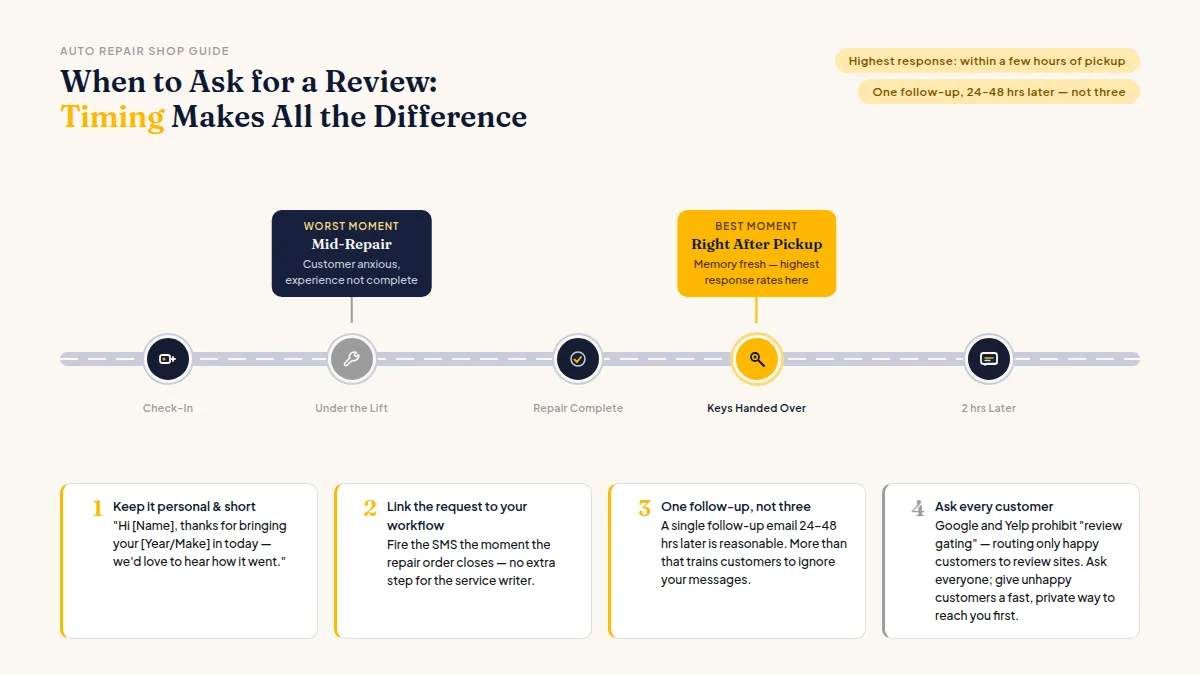
Timing is everything. In practice, the highest response rates come from requests sent within a few hours of vehicle pickup — while the customer is still thinking about the experience. Waiting until end-of-day or, worse, the next morning tends to drop replies significantly because the moment has passed.
A few approaches that work in a shop context:
Link the request to your workflow. If your shop management software closes a repair order when the car is ready, set your review platform to fire the SMS at that exact trigger. No extra step for the service writer.
Keep the message short and personal. "Hi [Name], thanks for bringing your [Year/Make] in today — we'd love to hear how it went: [link]" outperforms anything that reads like a corporate survey invitation.
Follow up once, not three times. A single follow-up email 24-48 hours later is reasonable. Multiple follow-ups train customers to ignore your messages.
Ask every customer, not just the ones you think are happy. This isn't just good ethics — Google and Yelp explicitly prohibit "review gating," the practice of only routing satisfied customers toward public review sites while filtering out unhappy ones. The compliant approach: ask all customers for feedback, and give anyone who had a problem a fast, private way to reach you directly so you can fix it first. That private channel can reduce public one-star posts, but it cannot prevent someone from leaving a public review if they want to. Every customer always retains that right.
For a broader look at platforms built for small service businesses, this comparison of online reputation management software for small businesses covers the landscape well.
Google Reviews for Mechanics: Why Response Rate Is a Competitive Signal
Google reviews for mechanics carry outsized weight compared to most other local categories. Auto repair is high-anxiety — people don't know what they're paying for, they're without their car, and they're trusting a stranger. A shop with 200 reviews averaging 4.7 stars beats a competitor with 40 reviews averaging 4.9 in most customers' minds, because volume signals consistency.
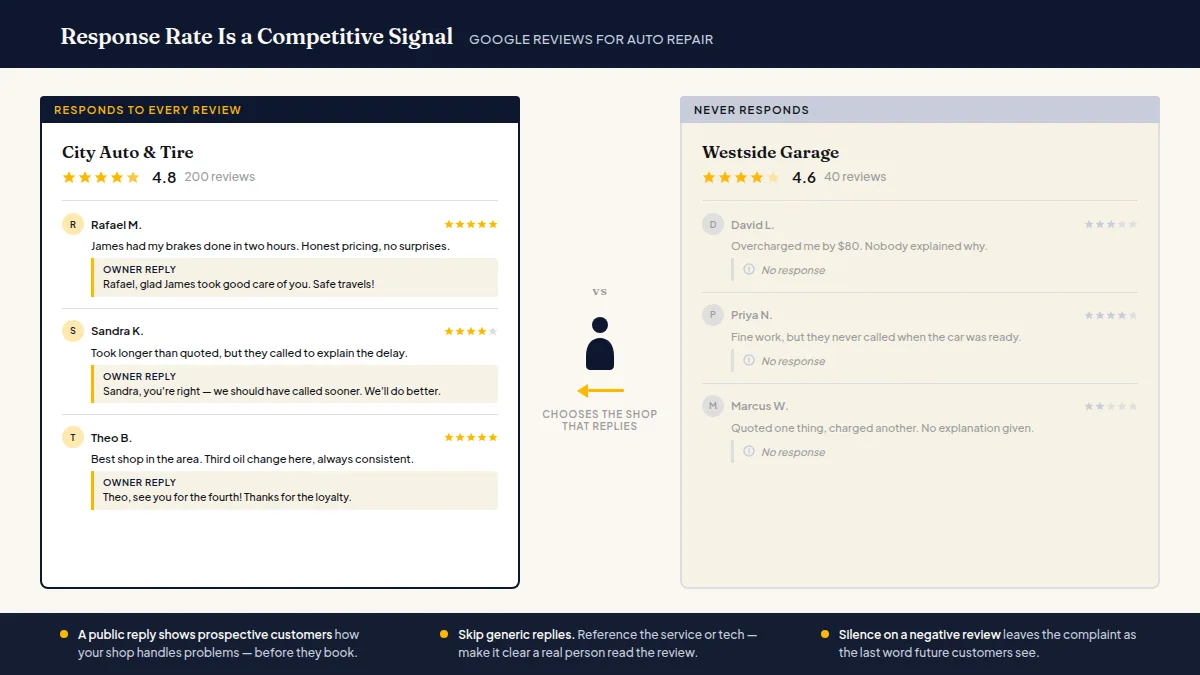
Responding to reviews matters beyond optics. Google encourages businesses to respond to reviews, and review engagement is widely considered a local-ranking signal by SEO practitioners, though Google has not published a definitive breakdown of its local algorithm factors. What is clear: a public response shows future customers how your shop handles problems.
For negative reviews, a simple formula works: acknowledge the frustration, own whatever you can, invite them to call or come back. Don't argue facts in public. For positive reviews, skip the generic "Thanks for the kind words!" and reference something specific — the service they had, the tech who helped, anything that makes it clear a real person read the review.
Review response software for auto shops makes this sustainable. HiFiveStar, for instance, drafts replies on its paid plans, so you're editing and posting rather than writing from scratch — which is the only way a busy shop actually keeps response times under 24 hours. You can see how it's built specifically for this environment at HiFiveStar for auto shops.
What to Look for When Comparing Platforms
The auto repair space has some specific quirks that generic review tools don't always handle well.
Integration with shop management software. Platforms like Mitchell 1, Shop-Ware, and Tekmetric are common in production shops. If your review tool can pull a closed repair order as a trigger, you eliminate manual work entirely. Ask vendors directly what integrations they support before you sign up.
Per-location pricing if you run multiple bays or stores. Some platforms charge per location, which gets expensive fast if you have two or three shops. Understand the pricing structure before the trial ends.
Ease of use for non-marketing staff. Your service writers and managers are the ones who'll actually use this. If the dashboard requires training, it won't get used. Most decent platforms offer a free tier or trial — put your least tech-savvy employee in front of it and see what happens.
Yelp handling. Yelp's own policies restrict automated review solicitation in ways that differ from Google and Facebook. Any platform you use should be clear about what it can and can't do on Yelp so you don't run afoul of their terms.
If you want to compare how auto repair tools stack up against broader small-business reputation platforms, this rundown of top reputation management software for small businesses in 2025 is a useful benchmark.
Frequently Asked Questions
How many reviews does an auto repair shop need to rank well on Google?
There's no published minimum, but in competitive markets many top-ranked shops carry 100+ Google reviews. More important than a raw number is a consistent flow of recent reviews — a steady trickle of new reviews tends to outperform a burst followed by silence.
Can I ask customers for reviews via text message?
Yes, and SMS typically outperforms email for review request response rates in service businesses. Make sure you have explicit opt-in consent before texting customers — most shop management software captures this during the intake process.
Is it against Google's rules to send customers to a feedback form before asking for a review?
Offering a private feedback option is fine. What Google prohibits is selectively blocking unhappy customers from reaching the public review form while only sending happy customers there. You can offer everyone a private channel, but you cannot gate access to the public review link based on sentiment.
What should I do about a fake negative review?
Flag it for removal through Google's review management tools and leave a calm public response in the meantime. If the review is genuinely fraudulent (no record of this customer, competitor activity), document your case before reporting. Removal isn't guaranteed, so the response matters regardless.
Does responding to reviews actually help my search ranking?
Google has not confirmed response rate as a direct ranking factor. What's established is that responding improves engagement signals and demonstrates credibility to prospective customers reading the listing — both of which matter for how your shop competes in local search.
How soon after a repair should I send a review request?
In practice, many shops find the best window is within two to four hours of vehicle pickup. The customer is still thinking about the experience and the request feels timely rather than random. Waiting until the next day tends to reduce response rates noticeably.


Ready to Take Control of Your Online Reputation?
Join thousands of local businesses using HiFiveStar to get more reviews and grow faster.