Review Velocity: What It Is and Why Google Watches It
Learn what review velocity means, why Google monitors it closely, and how a steady stream of real customer reviews can boost your local search rankings.
What Is Review Velocity (and Why Does It Matter)?
Review velocity is the rate at which your business earns new reviews over time — not just how many you have in total, but how consistently and frequently they arrive. A business with 200 reviews collected over five years looks very different to Google than one collecting 10 fresh reviews every month. The pattern matters as much as the count.
Think of it like a heartbeat. A steady, ongoing pulse signals an active, trusted business. A flatline — even one sitting on top of a large review count — suggests something has gone quiet. Google's local search algorithm factors recent review activity into how it assesses business relevance, which means a business that stopped earning reviews six months ago can gradually lose ground to a competitor maintaining a consistent stream.
If you're asking what is review velocity and whether it actually moves the needle for local rankings, the short answer is yes — and the rest of this piece explains exactly how to use that to your advantage.
How Review Velocity Affects Google Ranking
Review velocity works as one of several local SEO signals that tell Google's algorithm your business is current, credible, and actively serving customers right now. It doesn't operate in isolation — proximity, relevance, and profile completeness all contribute — but review frequency is the signal that quietly decays the moment you ignore it.
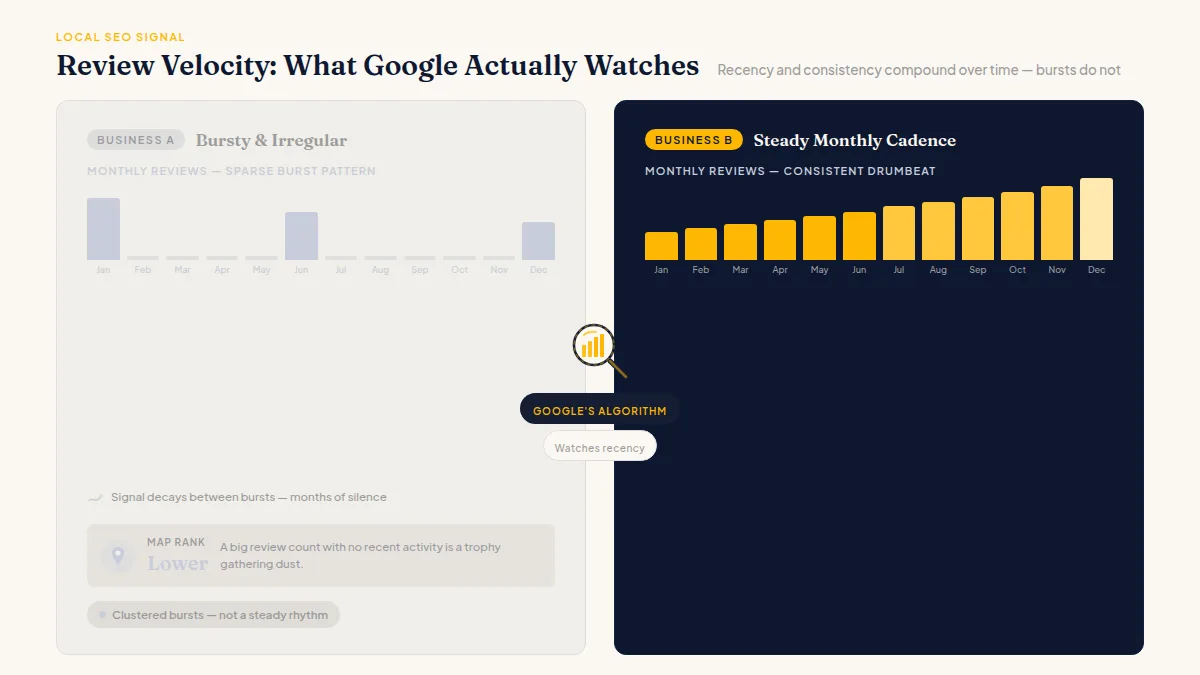
A big review count with no recent activity is a trophy gathering dust — Google cares about what's happening now.
Google has never published a definitive local-ranking checklist, and anyone claiming an exact formula is guessing. What is well-established: Google explicitly encourages businesses to collect reviews, and review engagement — earning them, responding to them — is consistently identified as a meaningful local-ranking signal by SEO researchers and platforms like BrightLocal and Whitespark, which survey local ranking factors every year. Their data points firmly toward recency and consistency as contributors that compound over time.
The practical implication: a competitor earning three reviews a week, week after week, is building a signal that's very difficult to outrun with a single one-time push.
Do this faster
HiFiveStar asks every customer after their visit — so more of the happy ones actually leave a review.
How Often Should You Get New Reviews?
There's no magic number, but the goal is a steady rhythm that both Google and potential customers can see — not clustered bursts. The right cadence depends on your customer volume, your industry, and how competitive your local market is.
A high-traffic restaurant might reasonably target 10–20 reviews a month. A specialist dental clinic seeing 80 patients a week might aim for 5–10. A home-services contractor completing 15 jobs a month might shoot for 3–5. The point isn't an arbitrary ceiling — it's to get more Google reviews consistently rather than in irregular waves.
Sporadic campaigns create spiky patterns: 40 reviews in January, silence until June. That kind of spike can trigger Google's spam filters, which flag unnatural activity. Steady growth tied to your real customer flow is both safer and more durable.
One of the lowest-friction ways to prompt customers at the right moment is placing a QR code on your counter or checkout area — no app required, no awkward verbal ask.
Building a Consistent Review-Collection Habit
Consistency comes from process, not motivation. A one-time blast to past customers is a reasonable starting point, but it won't sustain velocity. What sustains it is embedding the ask into how you already operate: end of appointment, post-service follow-up, receipt email, or a well-timed SMS a few hours after the job is done.
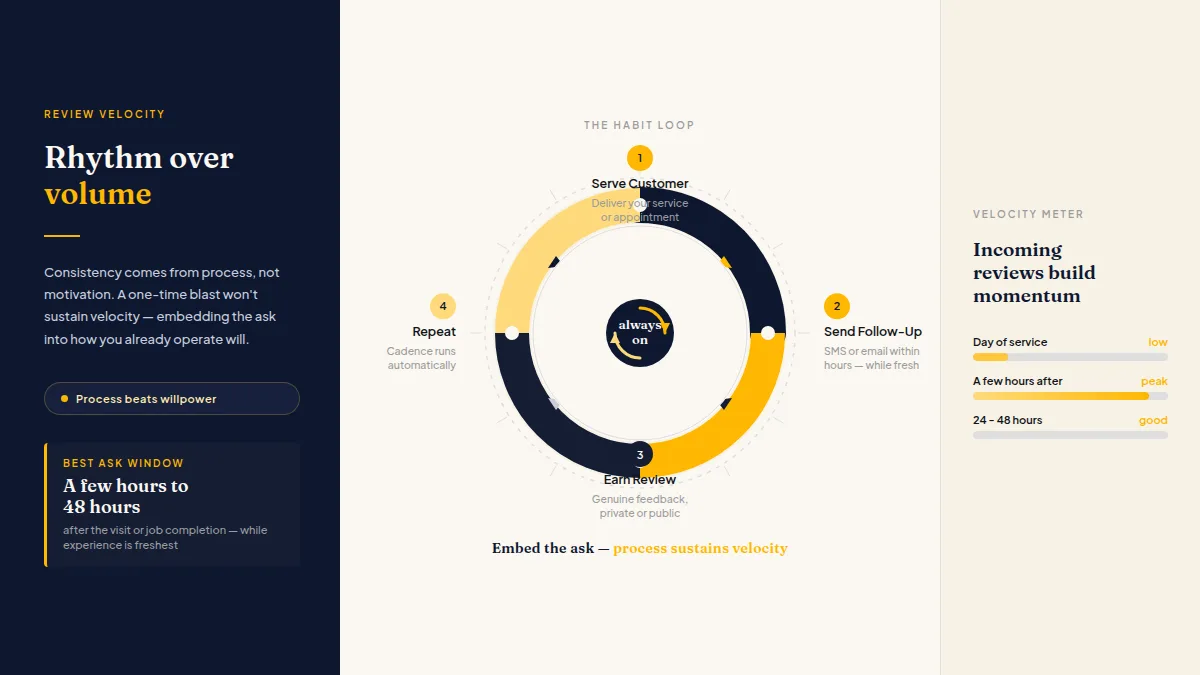
Timing the ask when the customer's experience is freshest produces the best response rates. For most service businesses, that window is somewhere between a few hours and 48 hours after the visit or job completion. Wait a week and the memory has faded — daily life has crowded it out.
On Pro, a tool like HiFiveStar handles this automatically, sending SMS or email review requests tied to your real customer interactions so the cadence runs without you chasing it manually. Its review page opens on your review sites, with an optional Private Feedback button after them: every customer can leave a public review, and the private channel is simply a faster route to resolution for anyone unhappy.
Responding to every review — positive and negative — also signals engagement and is one of the easiest, no-cost actions you can take to show Google and future customers that you're paying attention.
Protecting Your Velocity Without Gaming the System
Healthy review velocity comes from real customers, not shortcuts. Incentivized reviews, purchased reviews, and review-swapping arrangements all violate Google's policies and risk getting your listing penalized or suspended — outcomes far more damaging than a slow review rate ever would be.
The approach that actually works is straightforward: ask every customer, make it easy, and do it consistently. Don't cherry-pick only satisfied customers to ask — that's review gating and it violates platform policies. Ask everyone, give unhappy customers a quick private path to resolution, and let the reviews reflect your real customer experience.
For customers who prefer to act in the moment rather than respond to a follow-up message later, QR code cards or posters in your physical space give them an immediate option.
Frequently Asked Questions
What is review velocity in local SEO?
Review velocity is the rate at which a business receives new reviews over time. It measures consistency and recency, not just total count — and it's a recognized factor in how Google evaluates local business relevance.
How does review velocity affect my Google ranking?
A steady stream of new reviews signals to Google that your business is active and that customers are engaging with it right now. Businesses that stop earning reviews can lose ground in local search to competitors who maintain a consistent pace, even if they hold a larger total review count.
How often should I get new reviews to stay competitive?
It depends on your customer volume and market, but most service businesses find that a few genuine reviews per month — spread evenly rather than arriving in a single burst — is enough to maintain a healthy signal. Consistency matters more than hitting a specific number.
Is it against Google's rules to ask customers for reviews?
No — Google explicitly encourages businesses to ask customers for reviews. What's against the rules is selectively asking only happy customers (review gating), incentivizing reviews, or fabricating them. Ask all customers and let them respond honestly.
Can too many reviews in a short time hurt my listing?
A sudden, unnatural spike — especially from accounts with no prior Google activity — can trigger spam detection and result in reviews being filtered or, in serious cases, listing action. Organic, spread-out growth tied to real customer flow is always the safer path.
Does responding to reviews help with velocity or ranking?
Responding to reviews doesn't generate new ones, but Google encourages it and review engagement is consistently identified as a positive local-ranking signal. It also shows prospective customers that you're active and attentive — which often encourages more people to leave reviews in the first place.



Ready to Take Control of Your Online Reputation?
Join thousands of local businesses using HiFiveStar to get more reviews and grow faster.