Positive Review Examples for Restaurants (Copy & Paste)
Ready-to-use positive review examples for restaurants your customers can copy and paste. Help diners leave great Google reviews in seconds.
TL;DR: Great restaurant reviews mention specific dishes, the atmosphere, staff friendliness, and how the meal made the diner feel. Giving customers a few ready-made examples to copy and tweak removes the blank-page problem and dramatically increases how many actually follow through. The examples below cover casual dining, fine dining, and quick-service spots.
What Makes a Restaurant Review Actually Useful (and Why It Matters)
A five-star rating with no text barely moves the needle. A review that names the pasta carbonara, mentions the corner booth, and calls out the server Marco? That converts. According to BrightLocal (2023), 49% of consumers trust online reviews as much as personal recommendations from friends and family — which means one well-written review from a real customer does word-of-mouth work at scale.
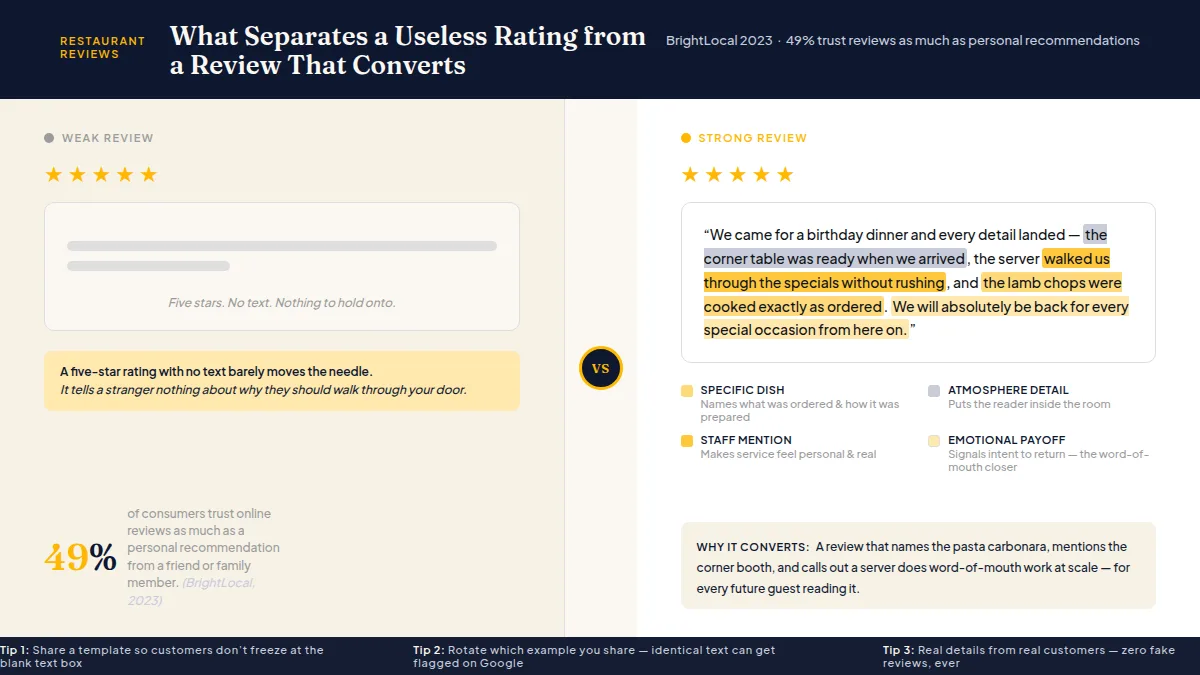
This post gives you ready-made positive review examples for restaurants copy and paste directly into your own requests or coaching materials, so customers know what "a helpful review" looks like before they sit down to write one.
Positive Review Examples for Restaurants (Copy & Paste Ready)
These templates sound like real customers because they're written the way real customers talk. Share them in a follow-up text or email so people who want to leave a review — but freeze at the blank text box — have a starting point. Rotate which ones you share: multiple reviewers posting identical text looks coordinated and can get flagged on Google.
Short and punchy (well-suited for Google):
"Best wood-fired pizza in the neighborhood. The dough is made fresh daily, service was fast even on a Friday night, and the staff remembered we'd been before. We'll be back next week."
Mid-length with detail:
"We came for a birthday dinner and every detail landed — the corner table was ready when we arrived, the server walked us through the specials without rushing, and the lamb chops were cooked exactly as ordered. Dessert arrived with a candle without us asking. Hard to find a restaurant this consistent."
Family or group dining:
"Took a group of eight for a work lunch and it went off without a hitch. Everyone from the vegetarians to the steak eaters found something they loved. The kitchen handled a nut allergy without drama. Fast service, fair prices, loud in the best way."
Quick weekday visit:
"Stopped in for a solo lunch. The soup of the day was the best minestrone I've had in years. In and out in 40 minutes. Worth making a regular stop."
Repeat customer angle:
"We've been coming here for three years and the consistency is what keeps us coming back — same quality every visit. New menu items rotate in but the classics never change. Staff turnover seems low, which says something. Highly recommend."
A note on platform differences: Google reviews reward specificity and recency, so detailed reviews with dish names and dates tend to perform best there. Yelp's algorithm weighs reviewer history heavily — a customer with an active Yelp account will get more traction than a first-time poster. TripAdvisor matters most for restaurants drawing tourist traffic. When you share these templates, nudging customers toward Google first usually delivers the strongest local search return.
These work as good restaurant review templates to share with customers or post as prompts on a table card near the QR code.
Do this faster
HiFiveStar asks happy customers at exactly the right moment — so more of them actually leave a review.
What to Tell Customers to Write in a Restaurant Review
Customers want to help — they just don't know what to say. A short nudge from you, in a text or on a receipt card, is the difference between "great food!" and a review that actually pulls in new diners.
The three things that make a restaurant review useful: what they ordered, how the service felt, and whether they'd come back.
Ask them to mention:
- A specific dish — not "the food was good" but "the smash burger with the house sauce"
- The occasion or context — date night, family lunch, quick solo meal
- One thing that stood out — speed, the server's name, the atmosphere, a chef's recommendation
- Whether they'd return — this phrase carries disproportionate weight with readers scanning reviews quickly
You don't need to write a full script. Sending customers this short list in a follow-up message produces noticeably more detailed reviews than a bare "please leave us a review" link. For a broader set of restaurant review examples for customers across different dining scenarios, this collection of 5-star review examples covers more ground.
How to Ask Customers to Leave a Review Without Being Pushy
Ask every customer — not just the ones you're confident are happy. Google and Yelp both prohibit review gating: selectively sending requests only to satisfied customers, or steering unhappy ones away from public platforms. Ask everyone; just make it easy for guests with a complaint to tell you directly first, so you can address it before they leave.
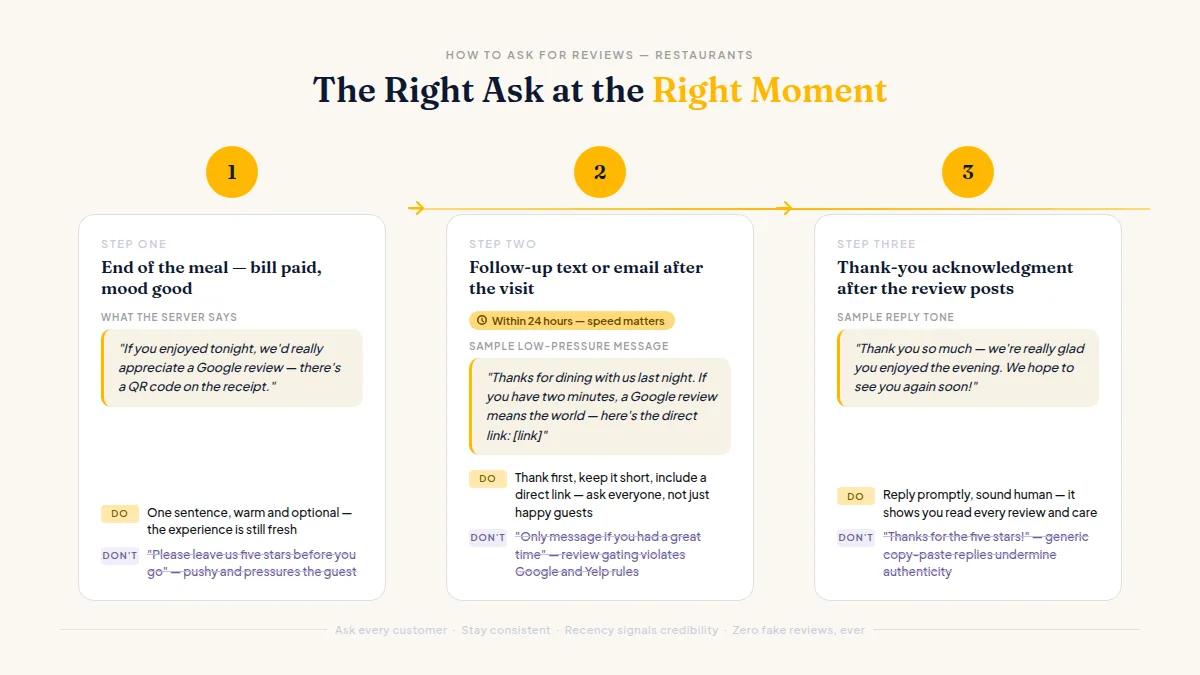
Timing matters more than the words you use. In a restaurant, the best moment is right after the bill is paid — the experience is fresh and the customer is still in a good mood. One sentence from the server works: "If you enjoyed tonight, we'd really appreciate a Google review — there's a QR code on the receipt." That's it.
For digital follow-up, a text sent within a couple of hours of the visit outperforms one sent the next day. Keep it short: thank them, note it takes two minutes, and include the direct link to your Google review page. Response rates drop sharply after 24 hours, so speed matters.
Tools built for restaurant reputation management can automate this cadence — review requests go out by text or email after each visit, every customer gets asked, and you stay consistent even on a packed Saturday night.
How to Get More Google Reviews for a Restaurant (Consistently)
One strong month of reviews followed by three quiet ones looks worse than a steady trickle year-round. Recency matters to Google's local ranking algorithm and to the diners reading your listing — a restaurant with 200 reviews and none in six months raises questions.
A few things that work in practice:
Put the QR code everywhere — table tents, the back of the menu, the receipt, a small sign near the exit. Customers who want to leave a review but forget should be able to do it in 20 seconds.
Train staff to ask verbally — one sentence from a server outperforms any printed prompt. People respond to a real person more than a table card.
Follow up digitally within hours — if you collect a phone number or email at reservation or order, a short text while the meal is still fresh converts far better than a next-day email.
Respond to every review — public responses signal to Google that the listing is actively managed, and they show prospective diners that feedback gets read. Google explicitly encourages owner responses, and consistent engagement is one of the clearest habits shared by well-ranked local listings.
Frequently Asked Questions
Can I copy and paste review templates for customers to use?
Yes — sharing examples or templates with customers is fine. The review they post should reflect their real experience; templates are a starting point, not a verbatim script.
Is it against Google's rules to ask all my customers for reviews?
No. Google encourages businesses to request honest reviews. What's prohibited is review gating — only asking customers you believe are satisfied, or discouraging unhappy ones from posting publicly. Ask everyone.
What's the best time to ask a restaurant customer for a review?
Right after the experience, while it's still fresh. In person, that's after the bill is paid. By text or email, within a couple of hours of the visit. Waiting until the next day produces meaningfully lower response rates.
How many Google reviews does a restaurant need to rank well locally?
Google hasn't published a threshold. In practice, a higher volume of recent, detailed reviews — combined with consistent owner responses — correlates with stronger local visibility. Recency and consistency matter as much as total count.
What should I do if a customer leaves a negative review?
Respond publicly, stay specific, and address the issue raised. Invite the customer to contact you directly to make it right. A measured response to a critical review often impresses prospective diners more than a wall of uncontested five-stars.
Can I offer a discount to customers who leave a review?
No. Google explicitly prohibits incentivizing reviews — offering anything of value in exchange for a review violates their guidelines and can result in removal of those reviews or action against your listing. Ask for honest feedback, no strings attached.


Ready to Take Control of Your Online Reputation?
Join thousands of local businesses using HiFiveStar to get more reviews and grow faster.