Negative Review Response Templates for Any Business
Ready-to-use negative review response templates for any business type, plus tips to protect your reputation and turn critics into loyal customers.
TL;DR: Responding to negative reviews promptly and professionally can actually win back unhappy customers and impress prospects reading your replies. A good response acknowledges the issue, apologizes sincerely, and offers a clear next step — without getting defensive. These templates give you a solid starting point for any industry, from restaurants to dental offices to home services.
Why Negative Reviews Sting — and Why Your Reply Matters More Than the Review
A one-star review lands in your inbox and your first instinct is to defend yourself, ignore it, or fire back. All three are mistakes. The reply you write in the next 24 hours is read by far more potential customers than the original complaint ever will be — because people searching your business look at how you handle problems, not just whether you have them.
According to a 2022 survey by ReviewTrackers, 53% of customers expect a response to a negative review within seven days, and many expect one faster. Your response is public proof that a real human runs this business and takes customers seriously. A well-crafted reply to a bad review can build more trust than a wall of five-star ratings with no owner engagement.
This post gives you copy-paste-ready negative review response templates organized by situation, plus the reasoning behind each one so you can adapt them to your own voice.
The Structure Every Negative Review Response Needs
Every solid reply follows the same four-part structure: acknowledge the specific complaint, apologize without over-admitting liability, offer a resolution, and move the conversation offline. Miss any one of these and the reply falls flat.
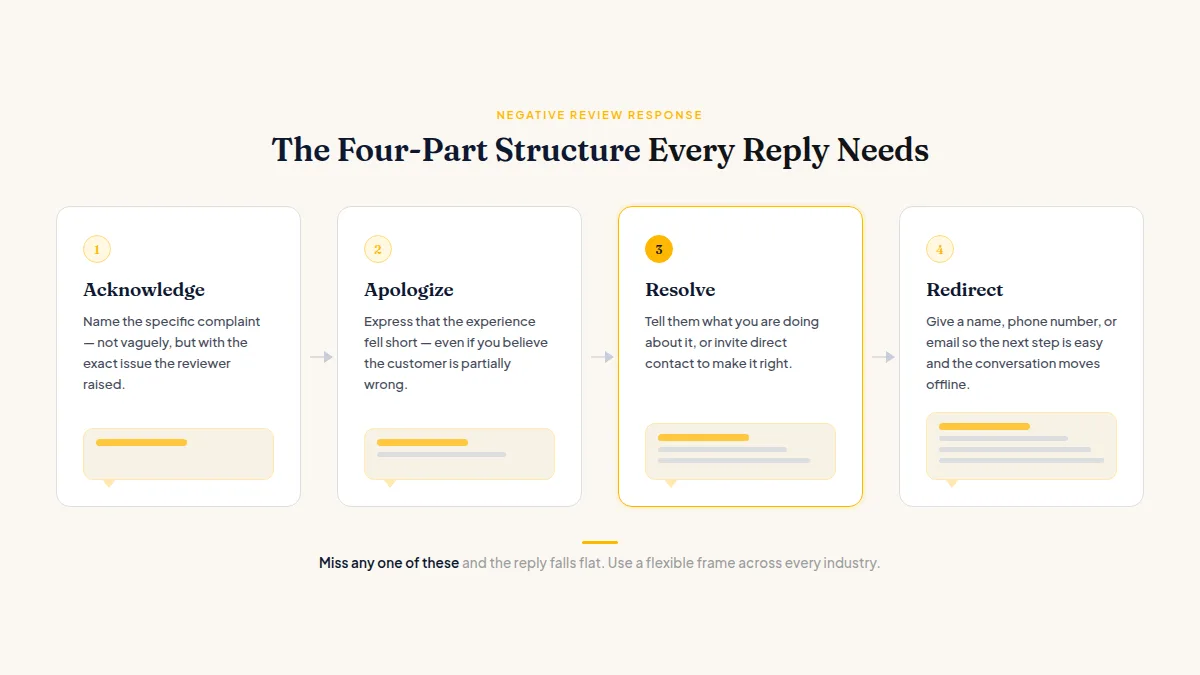
Acknowledge the issue by name — not vaguely, but specifically. Apologize that the experience fell short, even if you believe the customer is partially wrong. Resolve by telling them what you're doing about it or inviting direct contact. Redirect by giving a name, phone number, or email so the next step is easy.
A reply that ends with "we'd love to make this right — please call us at [number]" does more practical work than three paragraphs of explanation.
You don't need a new template for every industry. You need a flexible frame. The examples below cover the scenarios that come up most often across restaurants, salons, home services, medical clinics, and retail shops.
Do this on autopilot
HiFiveStar asks happy customers at exactly the right moment — so more of them actually leave a review.
Negative Review Response Templates for the Most Common Situations
These are real, usable drafts. Swap in your business name, the reviewer's first name if visible, and any specific detail they mentioned. That personalization is what separates a genuine reply from a copy-paste non-answer.
Template 1 — Service fell short of expectations
"Hi [Name], thank you for taking the time to share this. We're genuinely sorry your experience with [specific service] didn't meet the standard we hold ourselves to — that's not the visit we want anyone to have. Please reach out to us directly at [phone/email]. We'd like to understand what happened and make it right."
Template 2 — Long wait times
"Hi [Name], we appreciate your feedback and we're sorry for the wait you experienced on [day/service]. We know your time matters. We're actively working on [specific fix — e.g., scheduling changes, staffing adjustments]. We'd welcome the chance to have you back and show you a better experience."
Template 3 — Staff or attitude complaint
"Thank you for letting us know, [Name]. We take feedback about our team seriously, and this is not the experience we want for any customer. Please contact [owner name] directly at [contact info] so we can look into this properly and follow up with you."
Template 4 — Quality or product issue
"Hi [Name], we're sorry the [product/service] didn't hit the mark. Quality is something we genuinely care about, and we want to understand exactly what went wrong. Please get in touch at [email/phone] and we'll make sure we fix this for you."
Template 5 — Customer may be mistaken or confused
"Thank you for your review, [Name]. We want to make sure we understand your experience correctly — it sounds like there may have been a miscommunication around [issue]. We'd appreciate the chance to talk through this directly. Please reach out to [contact info] at your convenience."
On that last template: keep your tone curious, not defensive. If you're confident the customer has the facts wrong, you can gently clarify — but only after you've shown empathy first. Always keep the door open for a public review regardless; you're offering a private resolution channel, not discouraging honest feedback.
For a deeper look at the principles behind these replies, how to respond to negative reviews covers the strategic side in detail.
Tailoring Your Tone Without Losing Authenticity
Every bad review reply that actually works shares one quality: it sounds like a person wrote it. Templated language is a starting point, not a final draft. Before you hit send, read your reply out loud. If it sounds like a press release, rewrite it.
A few adjustments that make any template feel more human: drop corporate hedges like "we apologize for any inconvenience" and say you're sorry for the specific thing instead. Reference a detail from their review so they know you read it. Match their register — if they wrote casually, a stiff formal reply creates distance.
If you're managing reviews across Google, Facebook, and Yelp from one place, tools like HiFiveStar can draft a reply in your voice using AI, which you review before it goes out. That's useful when you have 15 reviews waiting and a full afternoon of appointments. For more on that workflow, AI review response generators explains how to use them without sounding robotic.
Building a System So Negative Reviews Don't Pile Up
Responding well is essential, but a smarter long-term move is improving the ratio of negative reviews to positive ones. The way to do that isn't to hide bad feedback — it's to ask every customer for feedback promptly, give unhappy ones a fast private path to resolution, and make it easy for satisfied customers to share their experience publicly.
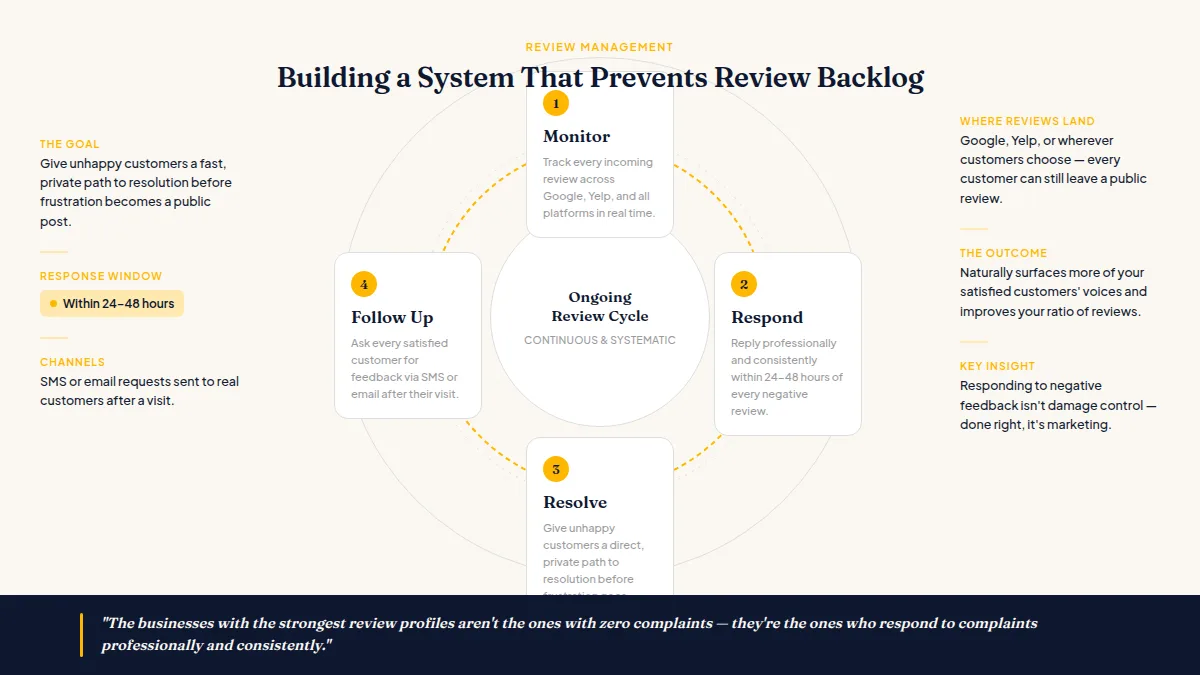
That's what a review request system does when it's working correctly. Platforms like HiFiveStar send SMS or email requests to real customers after a visit, which naturally surfaces more of your satisfied customers' voices. Every customer can still leave a public review on Google, Yelp, or wherever they choose — the goal is simply giving anyone with a complaint a direct line to you before frustration becomes a public post.
For practical send strategies, effective review request templates is a good next read.
The businesses with the strongest review profiles aren't the ones with zero complaints — they're the ones who respond to complaints professionally and consistently.
Responding to negative customer feedback isn't damage control. Done right, it's marketing. A thoughtful reply to a one-star review tells every future customer exactly what kind of business they're dealing with — and that signal often matters more than the complaint itself.
Frequently Asked Questions
How quickly should I respond to a negative review?
Within 24–48 hours is a reasonable target. Many customers watch to see whether a business responds at all — a prompt, professional reply shows the complaint was taken seriously.
Should I apologize even if the customer is wrong?
You can express empathy for their experience without admitting fault. Saying "I'm sorry this fell short of what you expected" is honest and non-defensive, and it reads far better than arguing publicly.
Can I ask a customer to remove or change a negative review after I've resolved the issue?
You can invite them to update their review if the issue was resolved to their satisfaction — but you can't demand removal or make it a condition of your resolution. That violates platform policy on Google and Yelp. Resolve the issue first, with no strings attached.
What's the difference between review gating and a private feedback channel?
Review gating — which Google and Yelp explicitly prohibit — means only asking satisfied customers for public reviews and blocking unhappy ones from posting publicly. A compliant private feedback channel asks all customers for feedback and gives unhappy ones a fast way to reach you directly, while still allowing anyone to post a public review.
Do review responses help with local search rankings?
Review engagement — including owner responses — is widely considered a positive signal for local search visibility, though Google hasn't published a definitive breakdown. Responding consistently is good practice regardless.
How long should a negative review response be?
Three to five sentences is usually enough. Short replies that address the specific issue and offer a clear next step consistently outperform long explanations, which can read as defensive.

Ready to Take Control of Your Online Reputation?
Join thousands of local businesses using HiFiveStar to get more reviews and grow faster.