Hotel Negative Review Responses That Win Back Guests
Real hotel negative review response samples that turn unhappy guests into returning ones. Copy these templates and protect your star rating.
TL;DR: A hotel negative review response should acknowledge the guest's experience, apologize without excuses, name one concrete fix, and invite them back. Done well, it shows future guests you take problems seriously — and often brings the unhappy one back. The templates below cover the most common complaints so you can reply fast and move on.
What a Hotel Negative Review Response Actually Does
A hotel negative review response isn't damage control — it's a public sales pitch to every future guest reading that page. The guest who complained may never return, but the thousand people reading your reply next month are deciding right now whether to book. Write for them.
That said, write for the original guest too. A reply that dismisses or turns defensive confirms every suspicion a prospective guest already had.
The Structure Every Hotel Negative Review Response Needs
The best hotel review reply samples share the same skeleton, and it works because it mirrors how a good front-desk manager handles a complaint in person. Get this order right and the rest follows naturally.
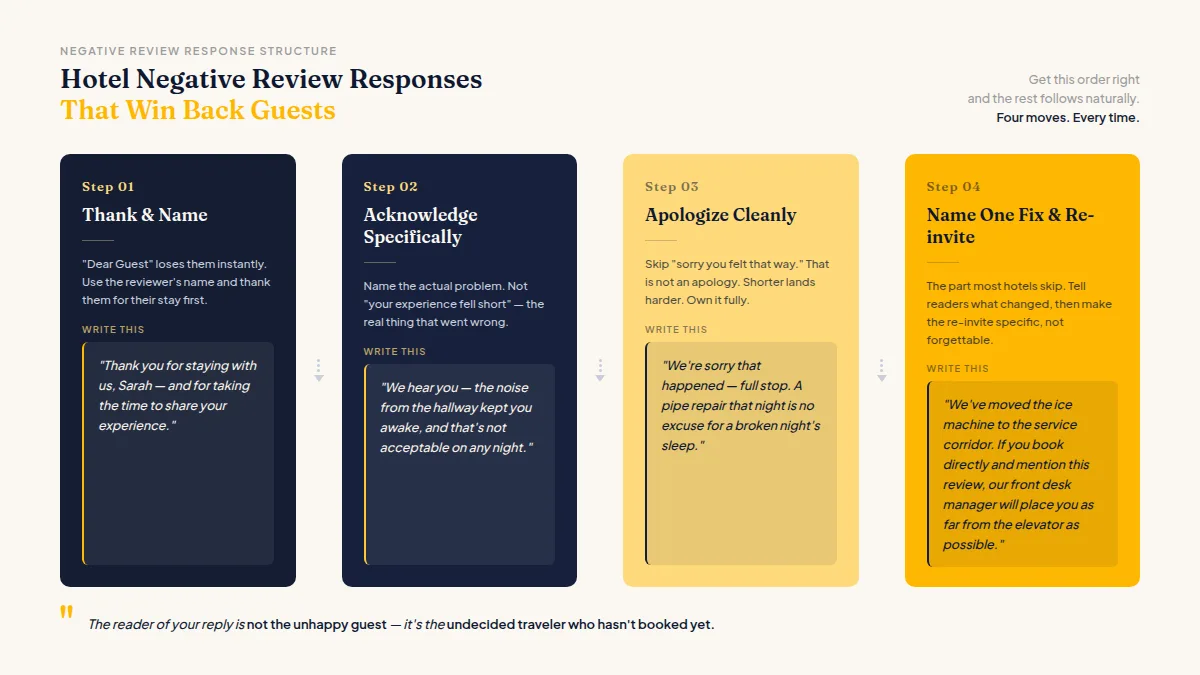
1. Thank by name, then acknowledge specifically. "Thank you for staying with us, Sarah" beats "Dear Guest" every time. Then name the actual problem — not "your experience fell short of our standards" but "the noise from the hallway kept you awake."
2. Apologize without lawyering. Skip "we're sorry you felt that way." That's not an apology, and guests know it. "We're sorry that happened — full stop" is shorter and lands harder.
3. Explain briefly, or just own it. If there's a genuine reason — a pipe repair, a staffing gap during a local event — one sentence of context is fair. If there isn't, don't invent one.
4. Say what changed. This is the part most hotels skip, and it's the part prospective guests remember. "We've moved the ice machine to the service corridor" or "Our housekeeping lead now does a same-day follow-up check on all maintenance requests" tells readers you're a team that fixes things.
5. Invite them back, specifically. "We hope you'll give us another chance" is forgettable. "If you book directly and mention this review, our front desk manager will make sure your room is as far from the elevator as possible" is something a guest might actually act on.
The reader of your reply is not the unhappy guest — it's the undecided traveler who hasn't booked yet.
Do this faster
HiFiveStar asks every customer after their visit — so more of the happy ones actually leave a review.
Bad Hotel Review Reply Examples vs. Replies That Actually Work
Reading these side by side shows the gap more clearly than any checklist.
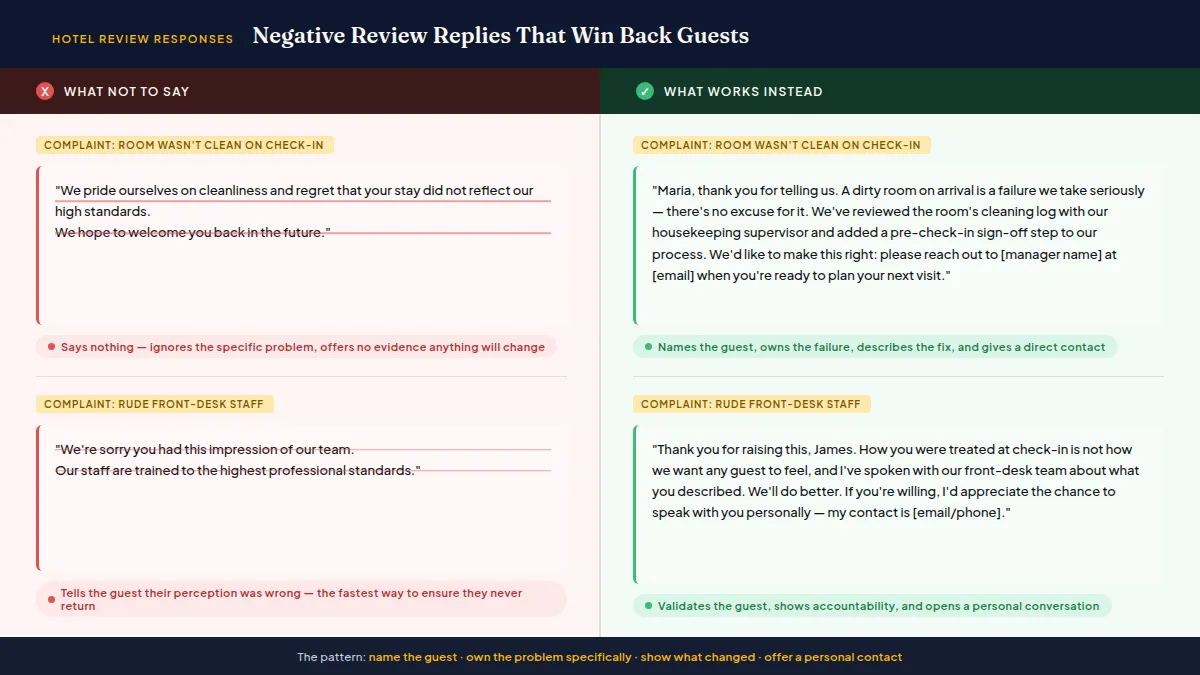
Complaint: Room wasn't clean on check-in
What not to write: "We pride ourselves on cleanliness and regret that your stay did not reflect our high standards. We hope to welcome you back in the future."
That reply says nothing. It ignores the specific problem and offers no evidence anything will change.
What to write instead: "Maria, thank you for telling us. A dirty room on arrival is a failure we take seriously — there's no excuse for it. We've reviewed the room's cleaning log with our housekeeping supervisor and added a pre-check-in sign-off step to our process. We'd like to make this right: please reach out to [manager name] at [email] when you're ready to plan your next visit."
Complaint: Rude front-desk staff
What not to write: "We're sorry you had this impression of our team. Our staff are trained to the highest professional standards."
Telling a guest their perception was wrong is the fastest way to ensure they never return.
What to write instead: "Thank you for raising this, James. How you were treated at check-in is not how we want any guest to feel, and I've spoken with our front-desk team about what you described. We'll do better. If you're willing, I'd appreciate the chance to speak with you personally — my contact is [email/phone]."
For a wider set of frameworks you can adapt across industries, the bad review response examples for local businesses guide covers the underlying principles that hold across property types.
How to Respond to Negative Hotel Reviews Without Making Things Worse
A few hard rules — most hotel managers learn them the expensive way.
Don't respond angry. Write your first draft, then wait an hour before posting. The replies that go viral for the wrong reasons — owners calling guests liars, staff clapping back — almost always get posted in the first ten minutes.
Don't copy-paste the same reply. Guests and prospective bookers both notice boilerplate. If your Google and Tripadvisor pages show the same paragraph on every one-star review, it signals that nobody actually read the complaints.
Don't overpromise. "We've completely renovated our HVAC system" when you've only ordered a quote is a lie waiting to haunt you. Stick to what you've actually done.
Keep it short. A 400-word defensive essay is worse than a 60-word genuine apology. Most strong hotel negative review responses run 80-150 words. Anything longer usually means the manager is writing for themselves, not the reader.
Reply within 48 hours. Most guests who escalate to a public review do so within a day or two of checkout, so the conversation is still fresh. Waiting a week sends its own message. Google encourages responding to reviews, and review engagement is widely considered a local-ranking signal — one more reason to stay current.
If you're managing multiple properties or tracking reviews across Tripadvisor, Google, and other platforms, hotel reputation management tools — including HiFiveStar — are designed to centralize that workflow. Check each platform's current feature set, since capabilities vary and change over time.
When the Negative Hotel Review Is Partly the Guest's Fault
This happens. The guest booked a standard room and expected a suite. They arrived three hours before check-in and were upset their room wasn't ready. They ignored the no-pets policy.
The answer is still not to say that in your public reply.
You can be factual without being combative: "Our check-in time is 3 PM, and we're sorry we couldn't accommodate an early arrival that day — during high-occupancy weeks our housekeeping team is working right up until the room is ready. We offer luggage storage and lounge access for early arrivals, and I wish we had communicated that more clearly at the time."
That reply tells future guests something useful (check-in is 3 PM, luggage storage is available), defends the hotel without attacking the reviewer, and still sounds human.
One important note: Google and Yelp don't allow businesses to solicit reviews only from happy customers or to discourage negative ones. The goal with every guest — before any review is posted — is to give them a genuine, easy way to leave feedback, not to screen who gets asked.
For ready-to-adapt frameworks across complaint types, the negative review response templates collection is a practical starting point.
Frequently Asked Questions
How long should a hotel negative review response be?
Aim for 80-150 words. Enough to acknowledge the specific problem, apologize, mention what changed, and invite the guest back — but not so long that it reads like a legal brief.
Should I respond to every negative hotel review?
Yes. Unanswered bad reviews signal to future guests that nobody is minding the property. Even a two-sentence reply shows that a real person read the complaint.
How quickly should a hotel reply to a bad review?
Within 24-48 hours is the practical target. The conversation is still active, the guest may still reconsider their impression, and prospective bookers who find the review fresh will also find your response.
Can I ask a guest to remove or change their review after resolving their complaint?
You can let them know you'd appreciate an update if your resolution changed their experience, but you can't pressure them or offer incentives — Google and Yelp both prohibit that.
What if the review contains false information?
Address the factual error calmly in one sentence, without accusations. You can also flag the review to the platform if it violates their content policies, but don't count on removal.
Does responding to negative reviews help a hotel's Google ranking?
Google encourages businesses to respond to reviews, and review engagement is widely considered a signal in local search. No one can promise a specific ranking outcome, but staying active with responses is consistently regarded as good practice.



Ready to Take Control of Your Online Reputation?
Join thousands of local businesses using HiFiveStar to get more reviews and grow faster.