How to Respond to Negative Customer Feedback Privately
Learn how to respond to negative customer feedback: acknowledge the issue, offer a practical fix, and follow up without pressuring customers.
TL;DR: Reply to private feedback promptly, acknowledge what went wrong, and apologize for the customer's experience without getting defensive. Ask for any details you need, offer a specific next step, and follow up to check whether the problem was resolved. Never make help conditional on the customer staying silent or changing a public review.
How to respond to negative customer feedback: start with the next step
When a customer sends negative feedback privately, acknowledge the specific problem, check whether anything needs urgent attention, and tell them what you will do next. You do not need a complete investigation before replying. You do need a named person taking responsibility, a realistic deadline, and enough detail to show that someone has read the complaint.
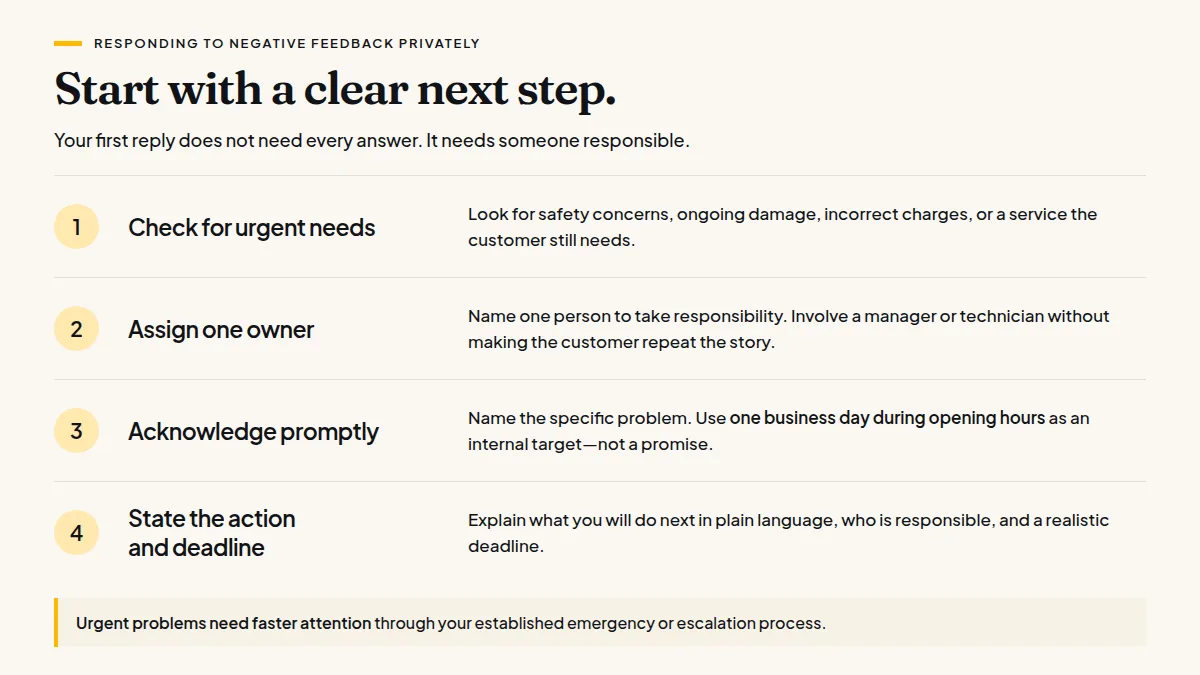
A message saying “Your technician left without fixing the leak” needs a different response from “Your waiting area was cold.” Before writing back, check for immediate safety concerns, ongoing damage, an incorrect charge, or a service the customer still needs.
Set an internal target for an initial reply—for example, within one business day during opening hours. Treat that as an operating standard, not a promise you cannot keep. Urgent problems need faster attention through your established emergency or escalation process.
Assign one person to own the complaint. That person can involve a manager or technician without making the customer repeat the story to three employees.
The starting point for learning how to respond to negative customer feedback is simple: reduce the customer’s uncertainty before trying to defend the business.
Your first reply does not need every answer; it needs a clear next step and someone responsible for delivering it.
Write a reply that acknowledges the problem and sets expectations
A useful private reply names what went wrong, recognizes its impact, and explains the next action in plain language. Apologize for the experience without guessing at facts you have not checked. Ask only for information you genuinely need, and give a specific time for your next update—even if the investigation may take longer.
Responding to private customer feedback works best when you build the message around four elements:
- The problem: “You booked a 10 a.m. appointment and waited 45 minutes.”
- The impact: “That disrupted your workday.”
- The action: “I’m checking the booking record with our front-desk manager.”
- The deadline: “I’ll email you by 3 p.m. tomorrow with an update.”
“I’m sorry you feel that way” shifts attention away from the problem. “I’m sorry you waited without an update” addresses the experience directly.
Before you reply to an unhappy customer, check what they have already supplied. If their message includes the appointment date and invoice number, do not ask for them again. Never request passwords, full payment-card details, or unnecessary medical information by ordinary email.
Keep explanations short. A staffing shortage might explain a delay, but it does not erase the inconvenience. Lead with the customer’s experience, then explain only what helps them understand the resolution.
For more wording options, adapt these response templates for common complaints to the facts rather than copying a generic apology.
Do this faster
Turn customer visits into review requests that actually get answered — automatically on Pro.
Customer complaint response examples you can adapt
The strongest customer complaint response examples connect an apology to a concrete action the business can deliver. Use the messages below as starting points, not promises: replace the details, confirm your authority to offer the remedy, and remove anything you have not verified. Keep the conversation focused on resolving the original problem.
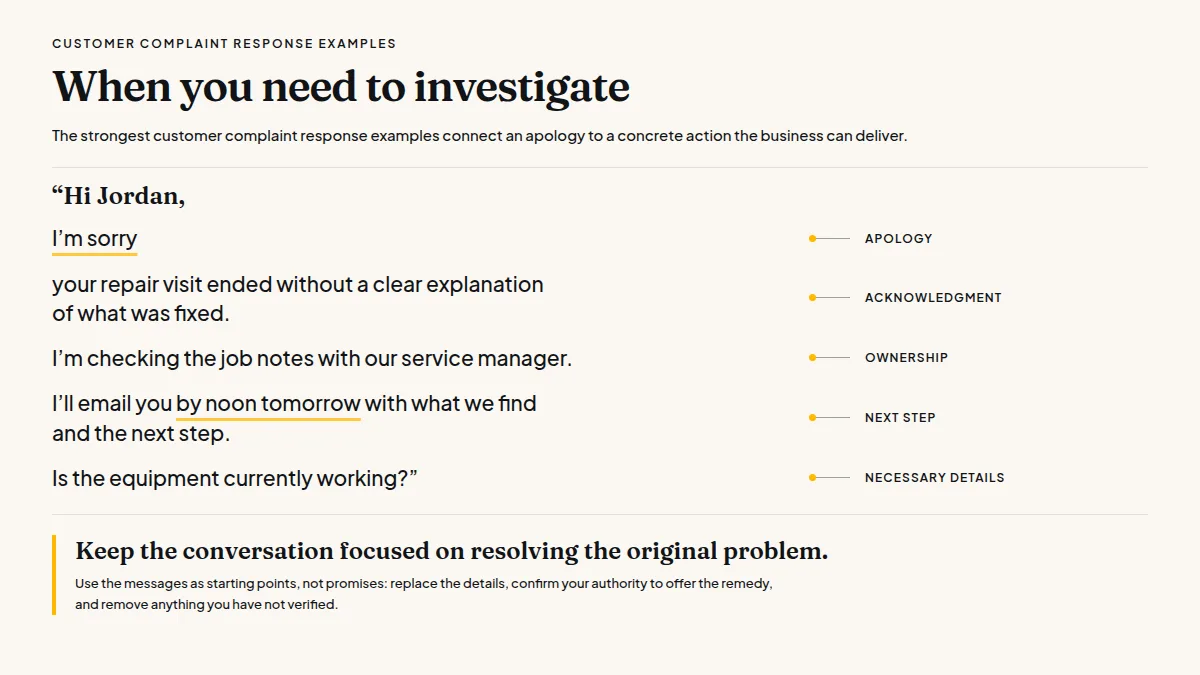
When you need to investigate
“Hi Jordan, I’m sorry your repair visit ended without a clear explanation of what was fixed. I’m checking the job notes with our service manager. I’ll email you by noon tomorrow with what we find and the next step. Is the equipment currently working?”
This acknowledges the communication failure without assuming the repair itself failed.
When you have confirmed a billing error
“Hi Priya, I checked your receipt and confirmed that we charged you twice for the same item. I’m sorry for the mistake. I’ve submitted a refund for the duplicate charge and attached the confirmation. The payment processor’s estimated posting time is shown there.”
Only say a refund is submitted after you have submitted it. Distinguish your action from the bank’s processing time.
When the requested outcome is unavailable
“Hi Alex, I understand you wanted the appointment with the original technician. They are unavailable this week. I can offer Tuesday morning with another qualified technician or the next available appointment with your original technician on Monday. Which would work better?”
Avoid presenting an exception you cannot sustain. If neither option works, ask what practical outcome the customer needs before offering something else.
A refund, repair, or repeat visit should address the underlying service problem—not depend on whether the customer posts, changes, or removes a review.
Follow up until the customer knows what happened
Following up after a customer complaint means delivering the promised update, checking whether the remedy worked, and recording any change your team needs to make. If you miss a deadline, contact the customer before it passes. A short progress update is better than silence, especially when you are waiting on another person or supplier.
Use a simple complaint log: date received, issue, owner, promised update, action taken, and status. A small shop can start with a shared spreadsheet. Record facts, not labels such as “difficult customer.”
After completing the remedy, ask a specific question: “Did the replacement arrive undamaged?” is easier to answer than “Are you satisfied now?”
If there is no reply, send one reasonable follow-up, then document the outcome as unconfirmed rather than assuming the problem is solved. Reviewing recurring issues with customer feedback tools can help you distinguish an isolated mistake from a process that needs changing.
A complaint is not finished when you send an apology; it is finished when you deliver the promised action and explain the outcome.
If you use HiFiveStar, private feedback is emailed as it arrives when notifications are enabled for that location, and you can answer by email when the customer provided an address.
Keep complaint resolution separate from review requests. Do not selectively ask only happy customers or discourage negative reviews: Google prohibits that practice, and Yelp asks businesses not to request reviews at all. Where requests are permitted, ask every customer after the visit or job, with private feedback offered alongside—not before—the review link.
Frequently Asked Questions
Private complaints usually raise the same practical questions: how quickly to answer, what to apologize for, and when to stop the conversation. Use these answers as working rules for your team. Adjust escalation and response times to the seriousness of the issue, and avoid promising an outcome before someone has checked the facts.
How quickly should I respond to private customer feedback?
Aim to acknowledge it within one business day during opening hours. Escalate safety concerns, ongoing damage, and other urgent issues immediately through the appropriate process.
Should I apologize before knowing who was at fault?
You can acknowledge the experience without assigning fault: “I’m sorry you left without a clear answer.” Explain what you are checking rather than admitting to an unverified mistake.
How do I handle customer complaints when the customer is wrong?
Explain the verified facts calmly and offer any reasonable next step. Avoid arguing over motives or trying to win the exchange.
What if the customer becomes abusive?
Set a clear boundary and offer an appropriate channel for continuing the complaint. Follow your safety procedures for threats rather than asking staff to tolerate them.
What should I record after resolving a complaint?
Record the issue, action taken, customer response, and any process change. Before closing it, check that every promised action has an owner and is complete.



Ready to Take Control of Your Online Reputation?
Join thousands of local businesses using HiFiveStar to get more reviews and grow faster.