Digital Marketing Agency Services: Add Review Management
Add review management to your digital marketing agency services and give clients a revenue stream they can see every day.
TL;DR: Review management is one of the easiest services to add to a digital marketing agency because every local business client already cares about their star rating. You set up the tool, connect their profiles, and clients watch new reviews and reply drafts land in one inbox. It's a recurring service with visible, daily proof of value.
Why Review Management Belongs in Your Agency's Service Stack
Most digital marketing agency services focus on traffic — SEO, paid ads, social media. But traffic sent to a business with a 3.8-star rating and 12 reviews loses to the competitor down the street sitting at 4.7 stars with 200 reviews. Review management plugs that leak. If you're running campaigns for local businesses and not managing their reviews, you're leaving results — and recurring revenue — on the table.
According to BrightLocal's Local Consumer Review Survey (2024), 87% of consumers read online reviews for local businesses, and 48% wouldn't consider a business with fewer than 4 stars. Your clients' customers are reading reviews before they click any ad you wrote. That makes review management a direct multiplier on the marketing work you're already doing.
What a Local Business Review Management Service Actually Covers
A solid local business review management service does three things: it brings all reviews into one place, it helps the business get more of them, and it makes responding fast enough that replies actually happen.
For a local business owner, the problem isn't that they don't care about reviews — it's that checking nine different sites every morning doesn't happen when they're also opening the shop. A good tool pulls reviews from all of them into one inbox so nothing gets missed. HiFiveStar, for example, reads reviews from nine sites — Google, Facebook, Tripadvisor, Yelp, Indeed, Glassdoor, Zillow, HomeAdvisor, and Thumbtack — each on its own schedule, into one Reviews inbox.
Then there's volume. A business that asks every customer for a review after each visit or completed job gets more reviews than one that waits and hopes. Paid plans can send review requests by text, email, and WhatsApp, and automate the ask after a Stripe payment or Shopify order on higher tiers. That consistency compounds: businesses that sent 20 or more review requests in their first 90 days on HiFiveStar went from 11 new Google reviews to 23, on average.
Responding is the third piece. Google encourages businesses to respond to reviews, and review engagement is widely considered a local-ranking signal. AI reply drafts make it realistic — an owner or agency staff member can review a draft, adjust it, and post in a fraction of the time it takes to write from scratch.
Do this faster
More 5-star reviews, higher local ranking, more customers. HiFiveStar helps you run that loop.
How to Add Review Management to Your Agency Without Rebuilding Your Stack
You don't need to build anything. White label review software lets you resell an existing platform under your agency's brand, so clients log in at a URL with your name in it and see your logo. That means zero development time and a service that looks like yours.
The fastest way to add a recurring-revenue line is to resell a platform your clients can't easily outgrow or cancel.
Here's how the rollout typically works:
- Pick the right tool. You want one inbox for all major review sites, automated review requests, AI reply drafts, and an analytics view you can screenshot for client reports. White label is a must if you want clients to see your brand, not the software's.
- Set up each client as a separate location or account. This keeps review data clean and billing separate.
- Build a standard onboarding checklist. Connect the client's Facebook Page, generate their review link and QR code, set up request templates, and configure notification preferences. Done once per client.
- Package it as a managed service. Most agencies charge a monthly management fee on top of the software cost. You handle onboarding, monitor the inbox, draft replies for client approval, and send a monthly summary. The client gets outcomes; you get a predictable retainer.
If you're already running SEO or paid ads for restaurants, home services businesses, or salons, adding review management takes about an hour per client per month once onboarding is complete. That's high-margin recurring revenue for digital agencies.
Managing Client Reviews: What the Day-to-Day Looks Like
The operational side of how to manage client reviews is simpler than most agencies expect. The main tasks are monitoring, responding, and reporting.
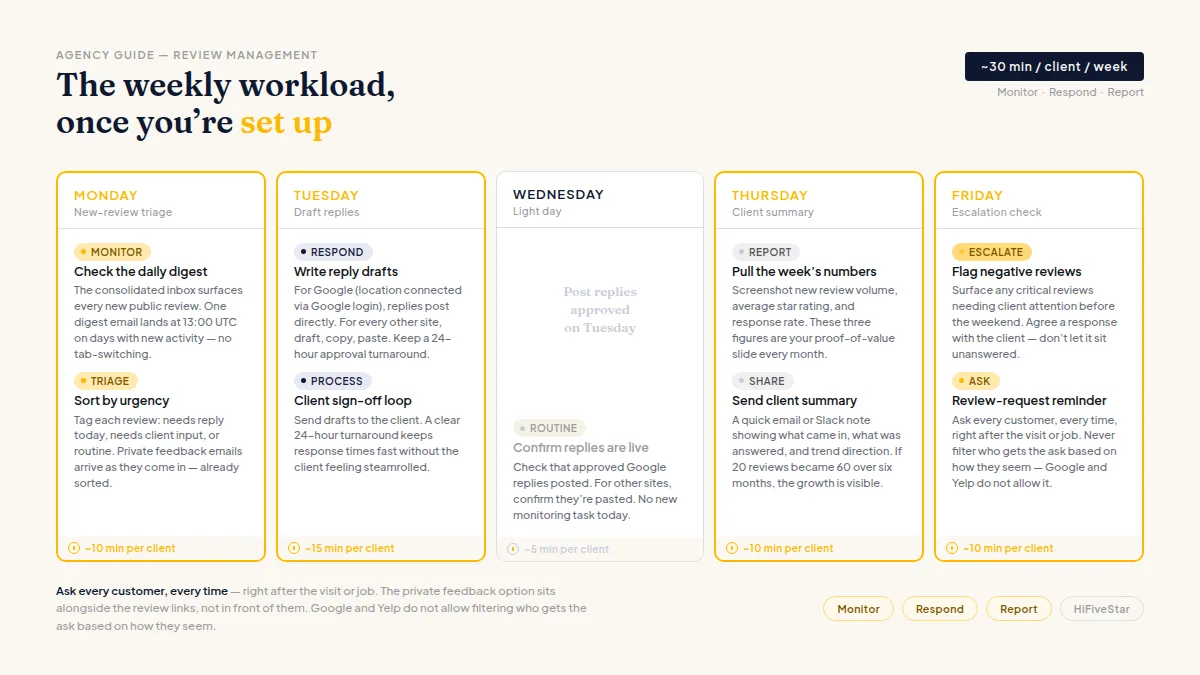
Monitoring: a consolidated inbox shows every new review across all connected sites. New public reviews come in a daily digest email (HiFiveStar sends one at 13:00 UTC on days with new activity), and new private feedback emails arrive as they come in. You're not refreshing eight tabs.
Responding: for Google, if the client's location is connected with their Google login, a reply can post directly from the platform. For every other site, you draft the reply, copy it, and paste it on that platform — straightforward, but it means you need a process for getting client sign-off quickly. Many agencies draft replies for client approval on a 24-hour turnaround, which keeps response times fast without the client feeling steamrolled.
Reporting: pull a monthly screenshot of new review volume, average star rating, and response rate. That's your proof of value slide. If a client is growing from 20 reviews to 60 reviews over six months, the work is visible.
One thing worth calling out: Google and Yelp do not allow asking only happy customers for reviews or steering unhappy customers away from public review sites. Ask every customer, every time, right after the visit or job. The private feedback option sits alongside the review links — not in front of them — so anyone who wants to leave a public review can. Never filter who gets the ask based on how they seem. Understanding why some agencies still get this wrong is worth five minutes before you pitch a client.
Pricing and Positioning Review Management for Agencies
Recurring revenue for digital agencies comes from services clients can't easily measure — but can't afford to drop. Review management fits that description perfectly, because the results show up in star ratings and new review counts that are publicly visible.
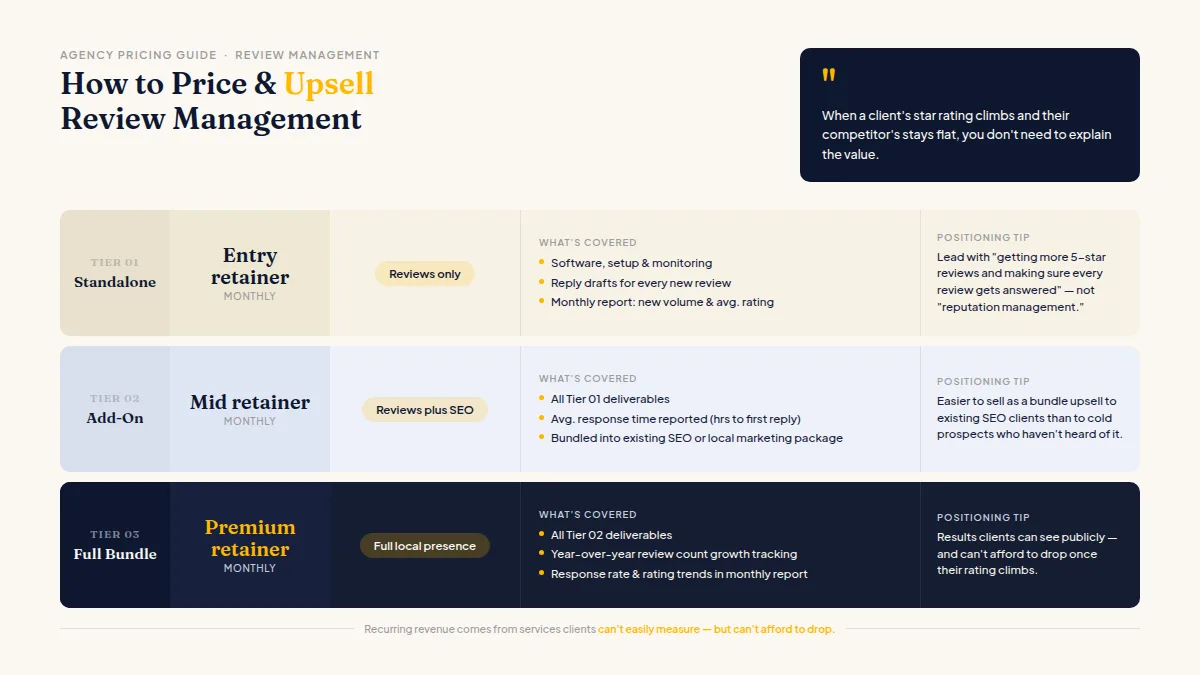
When a client's star rating climbs and their competitor's stays flat, you don't need to explain the value.
Structuring the offer: most agencies price review management as a monthly retainer covering software, setup, monitoring, and a set number of reply drafts. Some bundle it into existing SEO or local marketing packages as an upsell — which is often easier than selling it standalone to a prospect who hasn't heard of it.
What supports a higher price point:
- Monthly reporting that shows new review volume, average rating, and response rate
- Demonstrated response time (average hours to first reply)
- Year-over-year review count growth, which compounds visibly
Avoid positioning it purely as "reputation management" — that phrase reads as crisis management to many small business owners. Lead instead with "getting more 5-star reviews and making sure every review gets answered." That's the outcome they want. If a prospect is comparing you to other agency services, this overview of local reputation management options for small businesses gives useful context on what clients have typically seen before they talk to you.
For agencies that handle medical or healthcare clients — dental offices, clinics — the operational rules are stricter. Automated review requests from practice management software aren't available; requests go out by hand or CSV upload. Medical review management services have specific constraints worth knowing before you scope those engagements.
Frequently Asked Questions
How do I add review management to my agency's services?
Pick a platform that offers white label review software, set up each client as a separate account, and package your time as a monthly managed service. Onboarding takes roughly an hour per client, and ongoing work is light once templates and notifications are configured.
What is agency white label review software?
It's review management software that lets you resell it under your own brand. Clients log in at a URL and see your agency's logo and name, not the underlying software provider's. HiFiveStar offers white label on paid plans.
How many review sites can I monitor for clients?
That depends on the platform. HiFiveStar reads reviews from nine sites — Google, Facebook, Tripadvisor, Yelp, Indeed, Glassdoor, Zillow, HomeAdvisor, and Thumbtack — in one inbox, each on its own update schedule.
Can I automate review requests for all client industries?
For most local businesses, yes — paid plans can trigger automatic review requests after a Stripe payment or Shopify order, among others. Dental and medical practices are an exception: patient details aren't routed through those services, so requests go out manually or by CSV.
Is it allowed to ask only happy customers for a review?
No. Google and Yelp prohibit selectively asking only satisfied customers or discouraging unhappy ones from leaving public reviews. Ask every customer, right after the visit or completed job.
What should a monthly review management report include?
At minimum: total new reviews in the period, average star rating (current vs. prior period), review response rate, and a count of review requests sent. That gives clients a clear picture of momentum and shows the direct impact of your work.
Keep reading
Ready to Take Control of Your Online Reputation?
Join thousands of local businesses using HiFiveStar to get more reviews and grow faster.