Best Auto Repair Review Management Software
Compare the best auto repair review management software to get more Google reviews, reply faster, and protect your shop's online reputation.
TL;DR: The best auto repair review management software helps shops automatically ask happy customers for reviews, respond to feedback from one inbox, and catch complaints before they go public. Look for tools that connect Google, Facebook, and Yelp and include a feedback gate so unhappy customers reach you privately. HiFiveStar's free-forever plan brings your Google and Yelp reviews into one inbox and can send unhappy customers to a private feedback form; paid plans add review requests and AI reply drafts.
What Auto Repair Review Management Software Actually Does
Most auto shops live or die by word of mouth — and today, word of mouth happens on Google. Auto repair review management software automates the work of asking customers for reviews, helps you reply without spending 20 minutes staring at a screen, and pulls every review from every platform into one place. If you're still copying Google review links into texts by hand or letting reviews pile up unanswered, a dedicated tool pays for itself fast.
The core problem isn't that customers won't leave reviews. It's timing and friction. According to BrightLocal's Local Consumer Review Survey (2024), 50% of consumers say they'd leave a review if asked — most just never get the ask at the right moment. For a shop, that moment is 15-30 minutes after pickup, when the customer is driving away satisfied and the experience is fresh.
How to Get More Reviews for My Auto Repair Shop: The Mechanics of a Good Request
The single highest-leverage thing you can do is automate the ask at the moment your tech closes a repair order. A text message sent within an hour of pickup — short, personal, no wall of legal text — consistently outperforms a generic email blast sent days later. Many shops find SMS gets responses at a far higher rate than email alone, so lead with text and use email as a follow-up.
The shops that win on Google aren't the ones with the best reviews — they're the ones who ask for them consistently.
A few things that actually move the needle:
- Personalize the message. Use the customer's first name and mention the vehicle or service ("Thanks for bringing in your Accord today, Sarah"). Generic requests feel like spam.
- Keep the link frictionless. One tap to the review platform, no account login required on your end. Every extra step kills conversions.
- Don't batch-blast old customers. Start with fresh ROs from this week. Recency matters — both for response rate and for how authentic the reviews read.
- Follow up once, not three times. A single reminder 48-72 hours later is fine. More than that damages the customer relationship.
For shops that process high repair-order volume, tools like HiFiveStar's auto shop reputation software can send the request for you: on higher paid plans it goes out automatically when a customer pays through Stripe, or through Zapier or Make if your shop software connects to them.
Do this faster
HiFiveStar drafts a reply to any review in seconds — so your profile always looks cared for.
Respond to Customer Reviews for Auto Repair Without Burning an Hour a Day
Responding to Google reviews for auto repair shops is one of the most underused competitive advantages in the industry. Most of your competitors aren't doing it. Google encourages responding to reviews, and review engagement is widely considered a local-ranking signal — not responding is leaving a visible gap in your reputation.
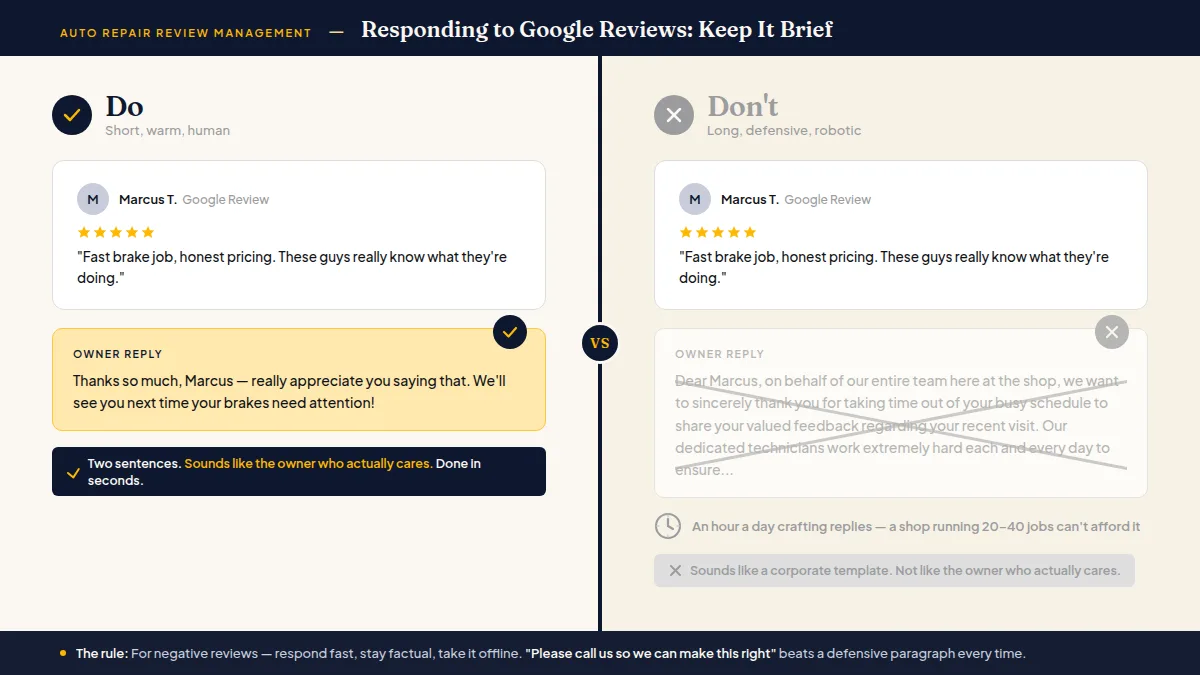
The challenge is that a shop running 20-40 ROs a day can't have a service writer crafting individual replies. That's where AI-drafted responses earn their place. Good review software will draft a reply in your shop's voice — not a corporate template — that you can approve or tweak in seconds. The goal isn't to sound like a robot thanking someone for their "valued patronage." It's to sound like the owner who actually cares.
For negative reviews specifically: respond fast (many owners aim for same-day), stay factual, take the conversation offline. "Please call us at [number] so we can make this right" beats a defensive paragraph every time. One clean, professional response to a 1-star review tells future customers more about your shop than ten 5-star reviews.
Auto Shop Online Reputation Management: What to Look for in Software
The market for online reputation management software for small businesses is wide, but auto shops have specific needs that generic tools often miss — particularly around high-volume RO workflows and multi-platform review coverage.
Key things to evaluate before committing to any platform:
Platform coverage. Google is non-negotiable. But shops also get reviews on Facebook, Yelp, and sometimes CarGurus or RepairPal. Make sure the tool pulls them all into one inbox rather than forcing you to tab between platforms.
Request channel. SMS and email both. SMS alone misses older customers who prefer email; email alone leaves response rates on the table.
Feedback routing (done right). Some tools offer a feedback gate — all customers get asked for feedback, and anyone who flags an issue gets a private channel to reach you before they post publicly. This is a legitimate way to resolve problems fast. What you cannot do is block or filter which customers get the option to post a public review. Every customer must still have a clear path to leave a public review on any platform they choose — platforms like Google and Yelp explicitly prohibit selectively soliciting only happy customers for public reviews.
AI reply drafting. Not just templates — actual drafts that sound like a person. Review the output carefully before you commit to a tool; some AI replies are generic enough to make your shop sound like every other shop.
Ease of RO integration. The best tools trigger requests automatically when a job closes. If setup requires IT involvement, that's a red flag for a small shop.
If you want to compare the broader field before narrowing to auto-specific tools, the comparison of online reputation management platforms covers the major players across industries.
Review Software for Mechanics: Making the Case to Your Team
The biggest implementation failure isn't the software — it's the shop floor. If your techs or service writers don't understand why the tool matters, the automation never triggers correctly and your request volume drops to zero.
Make the case simply: more Google reviews means more cars in the bays. Show your team your current Google review count versus a competitor a few miles away. The gap is almost always striking. Then connect the dots — reviews drive map pack rankings, map pack rankings drive phone calls, phone calls become ROs.
Assign one person to own the review inbox. Not a committee — one person who checks replies daily, flags anything that needs owner attention, and keeps the response rate close to 100%. That accountability is what separates shops with strong reputations from shops that have good intentions but no follow-through.
HiFiveStar's free-forever plan is an easy place to start if you're starting from scratch: no commitment, your reviews in one inbox, and a review link and QR code to share. A paid plan adds review requests when you're ready to ask every customer.
Frequently Asked Questions
Does review management software really help auto repair shops rank higher on Google?
Review quantity, recency, and engagement are all widely considered local search ranking factors, though Google doesn't publish a precise formula. Shops that consistently collect fresh reviews and respond to them tend to rank better in local map results than comparable shops that don't.
Is it against Google's rules to only send review requests to happy customers?
Yes. Google's policies prohibit review gating — meaning you can't selectively ask only satisfied customers for public reviews while steering unhappy customers away. The compliant approach is to ask all customers for feedback and give dissatisfied ones a private channel to resolve issues, while still allowing every customer to post a public review if they choose.
How quickly should I respond to a negative Google review?
Same-day is the target most experienced shop owners work toward. A fast, calm, professional response signals to potential customers that you take service seriously — and it often defuses the situation before it spreads.
What's the best time to send a review request after a repair?
In practice, requests sent within 1-2 hours of vehicle pickup tend to get the best response. The experience is still fresh and the customer hasn't mentally moved on. Waiting a day or more typically drops response rates noticeably.
Can I manage reviews from Google, Yelp, and Facebook in one place?
Yes, that's the core function of auto repair review management software. A good platform aggregates reviews from all connected platforms into a single inbox so you're not logging into three separate accounts to monitor and respond.
Do I need to respond to positive reviews, or just negative ones?
Both. Responding to positive reviews reinforces the relationship with that customer and signals to everyone reading that you're an engaged, attentive business. It doesn't have to be long — two genuine sentences beats a wall of boilerplate text.



Ready to Take Control of Your Online Reputation?
Join thousands of local businesses using HiFiveStar to get more reviews and grow faster.