Turn Google Reviews Into Case Studies That Close More Deals
Learn how to turn Google reviews into compelling case studies that build trust and close more deals for your local business — step by step.
TL;DR: Your best Google reviews already contain the raw material for persuasive case studies — a real customer, a real problem, and a real outcome. Pull out the specific detail, add a little context, and you have social proof that moves hesitant prospects from 'maybe' to 'yes'. Pair that with a review-showcase widget on your site and the proof works around the clock.
What Google Reviews Actually Contain (That Most Businesses Ignore)
A five-star Google review is a customer telling you, in their own words, exactly what problem you solved and why it mattered. That's the raw material of a case study. Most local businesses leave it sitting on a reviews page where it reaches people who are already considering them. Turn it into a case study and it reaches people who haven't heard of you yet — right at the moment they're deciding whether to hire someone.
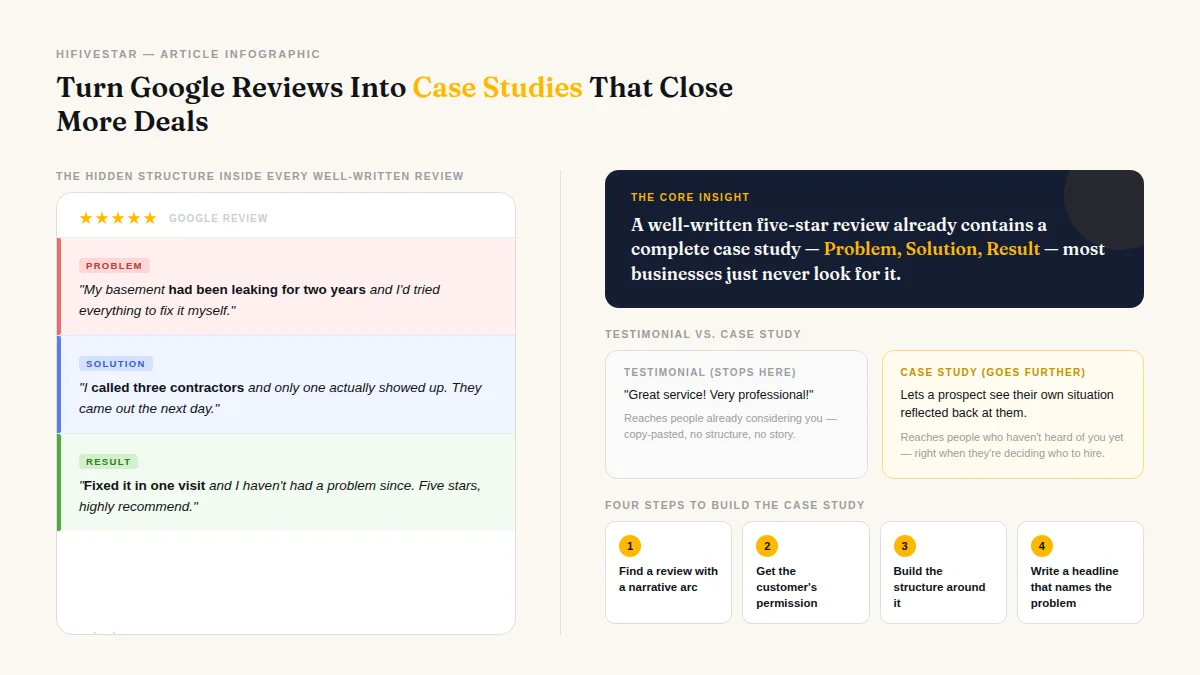
Learning how to turn Google reviews into case studies is less about writing skill and more about recognizing the structure that's already there. A real case study has three parts — problem, solution, result — and that arc is almost always hiding inside a well-written review. Most businesses stop at copy-pasting a quote onto their website. That's not a case study. It's a testimonial. The difference matters because a case study does something a testimonial can't: it lets a prospect see their own situation reflected back at them.
How to Turn Google Reviews Into Case Studies
The process works in four steps: find a review with a story, get the customer's permission, build the structure around it, and write a headline that names the problem.
Step 1: Find reviews with a narrative arc. You're looking for reviews that mention a problem ("my basement had been leaking for two years"), a decision ("I called three contractors and only one showed up"), and an outcome ("they fixed it in one visit and I haven't had a problem since"). Vague five-star reviews — "Great service! Very professional!" — don't give you much to work with. Reviews that tell a story do.
Step 2: Contact the customer. Before you publish anything with their name or details, ask permission. A quick text or email is enough: "You left us a great review a few months ago — would you mind if we expanded it into a short story on our website?" Most customers who took the time to write a detailed review are happy to say yes. Some will offer to add more detail.
The customers who write detailed reviews are already trying to help you — give them a format where that help goes further.
Step 3: Fill in the structure. Take the review as the core and build three paragraphs around it. First paragraph: who the customer is and what situation they were in (without sharing anything they haven't made public). Second paragraph: what you actually did — the specific service, the timeline, any obstacles you worked through. Third paragraph: the result, ideally in the customer's own words from the review. Keep the whole thing under 400 words. Brevity makes it readable and shareable.
Step 4: Name the problem in the headline. "Case Study: Leaking Basement Fixed in One Visit" outperforms "Happy Customer Story" every time. Prospective customers search for their specific problem, not your business name. A headline that matches their situation is what pulls them in.
Do this faster
More 5-star reviews, higher local ranking, more customers. HiFiveStar helps you run that loop.
Where to Publish Review-Based Case Studies
One publication isn't enough. The same content works across multiple channels, each reaching a prospect at a different stage of the buying decision.
- A dedicated page on your website. Group case studies by service type so a prospect searching for "roof replacement" finds stories about roof replacements, not HVAC work. This also improves your chances of ranking for problem-specific queries.
- Follow-up emails. When someone requests a quote, send one relevant case study — the one that matches their stated problem. The timing is ideal: they're evaluating options and you've just shown them a customer who was in the same position.
- Social media. Surface the single most striking detail from the case study and link to the full version. You're not summarizing — you're giving someone a reason to click.
- In-person sales conversations. Print two or three case studies and bring them to in-home estimates. Handing a prospect something physical they can read while you're measuring changes the dynamic. It shifts you from vendor to proven problem-solver before you've said a word about price.
Each case study you publish compounds. Every new review is another potential story, and each story builds a library that works for you around the clock.
Building a System So You Never Run Out of Material
The bottleneck for most businesses isn't writing ability — it's reviews. If you're only getting a handful per year, you don't have much raw material. The fix is asking every customer, not just the ones you think are thrilled, and asking at the right moment.

Timing matters more than most businesses realize. Asking within 15–30 minutes of completing a service produces significantly stronger response rates than following up days later. According to BrightLocal's 2024 Local Consumer Review Survey, 50% of consumers say they'd be likely to leave a review if asked. The ask itself is the gap most businesses never close.
Tools like HiFiveStar can automate SMS and email review requests on Pro, so the prompt goes out at the right time without requiring you to remember. You can read more about building that pipeline in this guide on how to get more Google reviews.
More reviews means more stories. More stories means more case studies. That's the compounding effect of treating Google reviews as content assets rather than passive reputation signals.
For case studies specifically, rich reviews are what you need — the ones where a customer describes their situation, not just their satisfaction. Specific prompts produce specific reviews. Instead of "Please leave us a review," try: "If you have a minute, tell people what your situation was before you called us and how it turned out." That single change in phrasing shifts the kind of review you receive.
Once you have a steady flow of detailed reviews, ranking higher on Google becomes a natural downstream benefit — review content and engagement are widely recognized as local-ranking signals.
Frequently Asked Questions
Can I use a Google review in a case study without asking permission?
Always ask first. Even though public reviews are publicly visible, using a customer's name and story in marketing materials is best done with their explicit consent. Most customers who wrote a detailed review are glad to help further.
How long should a review-based case study be?
Three short paragraphs, roughly 200–400 words. Enough to cover the problem, what you did, and the result. The quote from the original review should anchor the middle or end. Longer than that and most prospects won't finish it.
What if my reviews are mostly short and vague?
That's a signal to change how you ask. Specific prompts produce specific reviews. "Tell people what your situation was before you called us and how it turned out" gives customers a structure to follow that generates the narrative detail you need.
Do case studies based on reviews help with SEO?
They can. Pages targeting specific problem-based queries — "water heater replacement [city]" — and containing real customer language tend to match how people actually search. Review text often includes the exact phrases your prospects type into Google.
How do I write a case study if the reviewer is anonymous?
Use the situation rather than the person. "A homeowner in [neighborhood] with a 20-year-old electrical panel came to us after two other contractors declined the job" is a workable opening without a name. The problem-solution-result arc carries the story regardless.
How many case studies do I actually need?
Start with one per core service. A plumber might need five: water heater replacement, drain clearing, pipe repair, leak detection, bathroom remodel. A dentist might need four: prevention, cosmetic work, emergency care, implants. Cover your main services first, then add as new reviews arrive.


Ready to Take Control of Your Online Reputation?
Join thousands of local businesses using HiFiveStar to get more reviews and grow faster.